Showing posts with label Bloodroot. Show all posts

Saturday, June 25, 2022

Flowers & Flies


This area just south of the shade garden has experienced its initial weeding where we are trying to change wild ground into garden.  The Sweet William's stunning flowers are surrounded by uninvited plants.  Some of those are Jewel Weed which we believe the deer find unappealing.  After the flowers are past we really should remove the uninvited allowing the Sweet William an opportunity to spread.  We may remove all of the seed pods except those from the brightly tricolored plant.


Becky has always had an eye that sees nearly everything.  It is highly likely that I would have walked right by here seeing nothing special.  Another part of the impressive is that when she returned to the house, she consulted her National Audubon Society book and rather quickly found their photo with the name of this unusual insect.  Scorpion Fly has an unusual appendage dangling from the front of its head.  Just what it eats and how it catches dinner remains unknown to us.


This vicious looking Early Tachinid fly has been noticed before.  It just looks capable of delivering a painful bite.  Once again the Audubon book provided us with a proper name.  That text describes this bug as easily spooked so we know not how Becky got this photo.


We view this jumble of self planted growth as truly special.  One of several such Cardinal Flower plants grow here.  The tall plant holding the lower left corner of the photo is Cardinal Flower.  To its immediate right is an odd looking leaf composed of two connected oval sections joined to an unusually shaped third part.  This is the highly elusive Bloodroot.  We are trying, with little success, to grow this native treasure while this one appears strong in the midst of many other plants.  Careful inspection revealed that both of these plants are growing from the same thimble full of soil.  Intervention is totally unwise so we will wait and watch to see what their future holds.  Given Cardinal Flower's growth habit of replacing one plant with up to six new plants next Spring each with a huge root mass, the Bloodroot may get crowded out but no way to clear ground for the Bloodroot could be found. 


Here is the likely source of the errant Cardinal Flower seed.  The hooded gardener did plant these several years ago in his quest to find a location where this native treasure would survive with only a small amount of help.  Following snow melt, spent Chrysanthemum stems were spread across these evergreen plants.  Several harsh frosts blackened these leaves but they did put out new growth.  Plants from seeds are rarely seen here because their emergence usually happens in June.  Tiny new growth is seen as weeds and removed.  The seeds that blew to the other side of the path grew under the protective cover of other plants and did flower last year.

That clean line of separation between these precious plants and old pasture growth is the result of a visit from the seated weeder.  Blue Eyed Grass can be seen between his knee and the Cardinal Flower.  Becky rescued a single plant from the lawn in Unadilla and has been trying to grow it ever since.  Given its structural similarity to the much hated Quack Grass, its future here has been dim.  This year several were rescued and placed in this well cared for area.  Our timing was perfect and necessary water carried and  provided.  The transplants took a solid hold, flowered and are now growing full seed balls.  With no other grass like plants in the area, these may well hold a bright future. 
 

Sunday, June 12, 2022

Help From Friends


Native plants are afforded some measure of protection by laws that prohibit their harvest from State Land.  With the permission of a property owner, they can be harvested.  We had the good fortune to be granted access to a tremendous wealth of several varieties of native plants.  The light bright green leaves pictured above are new growth on a transplanted Wintergreen plant.  If new growth is visible, then where is the old growth?  The dark green leaves at the left edge of the photo may well be Wintergreen.  Never before have we seen anything like these new leaves on Wintergreen.

One of the problems has been just how this plant grows.  Long stems at or just below the surface connect with roots that may be some distance away.  One author described a method to transplant in view of this unusual placement of critical plant parts.  He suggested finding the stem on either side of the leaves and cutting it while leaving the plant where it was.  Returning one year later to a carefully marked plant will reveal if the severed plant responded with new root growth.  If the plant was still alive, it might then be successfully moved.  That seemed like way too much trouble.  On one rare occasion, a small scrap of a plant was successfully moved.  It showed signs of life for three years, then disappeared completely.  A protective wire cage was not supplied.


These plants were hastily dug on the day before Steve and Elaine moved away.  Wintergreen is visible at the top edge of the picture but the new growth appears to come from dark striped leaves that are somewhat different from those in the first photo.  The small leaves with a center white stripe belong to Partridge Berry.  There are several pink buds visible that illustrate a unique feature of this plant.  The base of the buds almost come together connecting with what will be a berry with two belly buttons.  Apparently Wintergreen and Partridge Berry are frequently seen growing together.  We are more than a little pleased having been permitted to dig these plants.  They do seem happy here.


This is another view of the plant shown in the first picture.  The plant in the lower right corner is a weed and will be removed.  Moving toward the center, dark green leaves are seen and may be the origin of the new growth.  Our resident authority thinks that the leaves in the upper left corner are violets.  There are hundreds of varieties of violets so we are hopeful that these will prove special.


This is the up to the moment condition of our Bloodroot patch. Supervised weeding protected as many as eight young plants.  We did briefly see flowers on tiny plants earlier but no seed pods were evident.  We have kept a careful watch on the woods across the valley but no seeds were seen there either.  The red flowers are on Columbine.  They are allowed to stay and spread since they were a favored plant of John Burroughs and none of these plants naturally grow without neighbors.

Friday, May 27, 2022

Initial Disappointment


We have slowly come to realize that many native perennial plants need time to adjust to a new home.  In the recent past new Giant white trilliums have been unreliable to accepting their new home.  Some show no above ground growth in their first year with us.  Small flowerless plants sometimes appear in their second year.  Our harsh early spring weather really hammered many of our plants.  Yesterday we were cleaning up some weeds and finally took a close look at our collection.  Huge plants are absent but there are new plants growing close by older plants.  It is not hard to see the possibility of an impressive group of pure white blossoms on display here next year.


Cardinal flower apparently has always been mostly absent in this part of NYS.  More that one century ago, Roxbury native John Burroughs described his difficulty in finding at least a single flowering plant.  Our weather is the problem.  These plants overwintered as new growth.  Their emergence from the snow cover saw beautiful light green tender rosettes.  Given time to adjust to typical early spring cold snaps, these plants would survive.  Here we get winds from the south raising temperatures into the 60's followed by hard frost.  Our habit is to cover these plants with Chrysanthemum stems following snow melt.  Still the bitter cold blackened these leaves.  We were certain that these plants were dead.  Clearly they are alive and we will soon see their brilliant red flowers.  A nearby group did not experience that success.  More than half of them are now gone but seed is on the ground.  Plants from seed will not flower this year.


Bloodroot has been smacking us around for years.  The cage protected area where transplants have been placed for several springs did not produce a mature plant.  Extremely small leaves did appear this year but hard frost ended them.  These pictured plants first appeared here last year.  They are self seeded  and were tiny.  Perhaps four plants are growing here and we very carefully remove weeds.  At our age we are no longer buying plants.  What grows here is largely on their own.


 Fragrant ladies tresses
grew here for several years.  It is a southern plant and we felt lucky each year that it produced flowers.  It did send up several shoots this year but a severe frost ended them.  We will leave this ground alone after we remove the garlic mustard because it might be possible for us to see desired growth next year. 

Friday, May 6, 2022

Finally Warmer Weather


Our recent weather featured three consecutive days of overnight frost.  Some plants were damaged while others look just fine.  These two Goldenseal plants were transplanted about four years ago.  Native plants sometimes do not take that well but these are now sending up new plants.  We may have the option of relocating the young ones.


Trilliums are a plant remembered from my childhood.  Our woods featured a large dense group of these plants.  Many authors describe a seven year wait for plants going from seed to maturity.  Each year we transplant more but few survive.  These are doing fine with first flowers open.  The white flowers in the background are Wood anemones and they have increased in numbers creating a more natural looking carpet.  We hope to live long enough to see the Trilliums more densely packed.  The newly applied leaf mulch was run through the mower last Fall.  Somehow it lacks a natural appearance now but will build a rich black natural looking soil.


The cage protecting these two Twinleaf plants is necessary as our resident deer have destroyed them in the past.  Each plant produced two flower buds but one was broken in the wind.  The flowers lasted less than two full days.  We  will be watching for seeds but the frosts may have ended that.  At least the plants look good.


Trout lilies present a genuine puzzle.  The last glacier left behind soil filled with many stones.  We find a large number of plants with only a single leaf since their struggle to move their corm deeper and flower is blocked by stones.  This garden placement featured soil that was sifted and is stone free to a depth of eight inches.  Here these plants moved from our woods grow like weeds.  We have never seen a dense mass of flowers like this in a natural setting.

Later that day a deer was seen feeding here.  Inspection revealed that these blossoms are tasty since all are now gone and they were bitten off.  No seeds will form this year but more plants are clearly not needed in this location.


Our Bloodroot continue to struggle.  Three plants from seed are trying to grow here.  The oldest plant next to the dead stick flowered first but never opened its leaf.  It appears to be dead.  Close by to its left is another plant trying to spread its leaf and open its flower.  In the center of the picture is a plant in flower but no leaf can be seen.  We have been trying to establish a natural looking group for many years.  Clearly something is missing here.

 
Nearby a more successful introduction of a native plant appears to be off to a great start.  Our transplanted Yellow Ladies-slipper initially had only two or three  stems.  We knew of a wild plant that was growing right next to a rotting tree stump.  We planted a dead stump here and it continues to break down.  Perhaps the stump contributes something to the soil that this plant needs.  This new growth promises an impressive mature flowering plant this year.
 

Sunday, April 24, 2022

Open Bloodroot Flowers


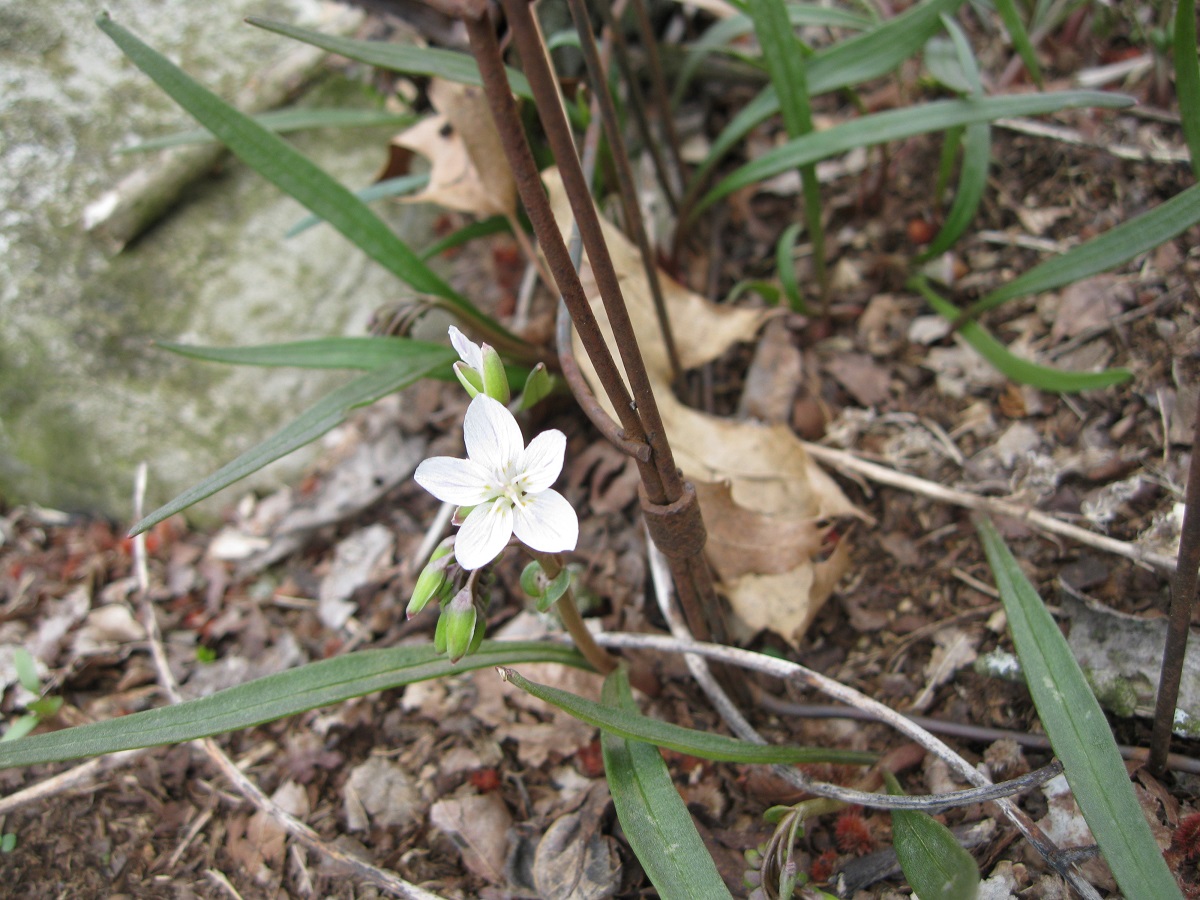
Finally we can finally see open Bloodroot flowers.  This plant is in our shade garden and we were working there this morning when this flower opened.  If that happened in a moment we missed it.  A pollinating flying insect was seen close by before the petals spread but we have no idea just how long it took for this flower to open.  Its pollen load is massive but it will be short lived.  This may be a young plant growing here from seed since none of the larger older plants have put in an appearance this year.  Our deer herd spend a great deal of time on this ground last year.  A wire cage is now in place but the damage has already been done.


This Spring beauty also opened its first flower here today.  It shares a protective wire cage with the Bloodroot.  That protection may well be responsible for the increase in size of this plant compared with the tiny plant seen here last year.  The corner of the cage can be seen with the plant growing both on he inside and the outside.  Removing the cage now will damage the plant so these plants will remain untended until their growing period comes to an end.  Weeds will undoubtedly be growing here by then.


Three years ago we planted three Sharp lobed hepatica plants in this area of our shade garden.  They are just now making their appearance here.  Many times it takes several years for the transplants of a native plant to settle in.  We were pleased to find all three plants.  Some frost heave had taken place.  We chose to bring in new soil rather than resetting the plants.  This seemed less invasive than essentially digging them up and replanting them.  The fallen tree leaf mulch was reground last Fall.  Is it possible for a plant to look happy?


The remainder of today's pictures were taken today at Irma's woods.  We have been making daily trips here except for being trapped at home by the recent storm.  These plants displayed buds before the storm but some were open yesterday.  That these flowers are short lived can be seen by the condition of the flower in the upper right corner of the photo.  Despite being in only its second day open, both the pollen and some of the petals are gone.  It does not take much of a wind to dislodge these flower parts.  Neither ours at home or these plants show any sign of the unfurled leaf that will be soon be seen under the open flower.


These five plants are freshly opened today.  That can be said with certainty because  we found this quintet days ago and have been making daily visits here.  The color of these flowers is pure despite their rather small appearance this year.  Last year was hard on these plants and that may be the cause of the smaller than normal amount of visible plant.  Larger and taller is how they are usually seen.


These Sharp lobed hepatica plants have been growing here undisturbed for many years.  This is without question an impressive display.


Here are today's two stars side by side.
 

Thursday, April 21, 2022

After The Storm


We were well informed that a massive storm was heading our way but we did not call for an early  propane delivery.  Our power was out for twenty-four hours and the generator did its job leaving us with some propane.  The power just went out again.  NYSEG plans to have the power back on by eleven PM Friday.  Today is Wednesday.  This could be close.

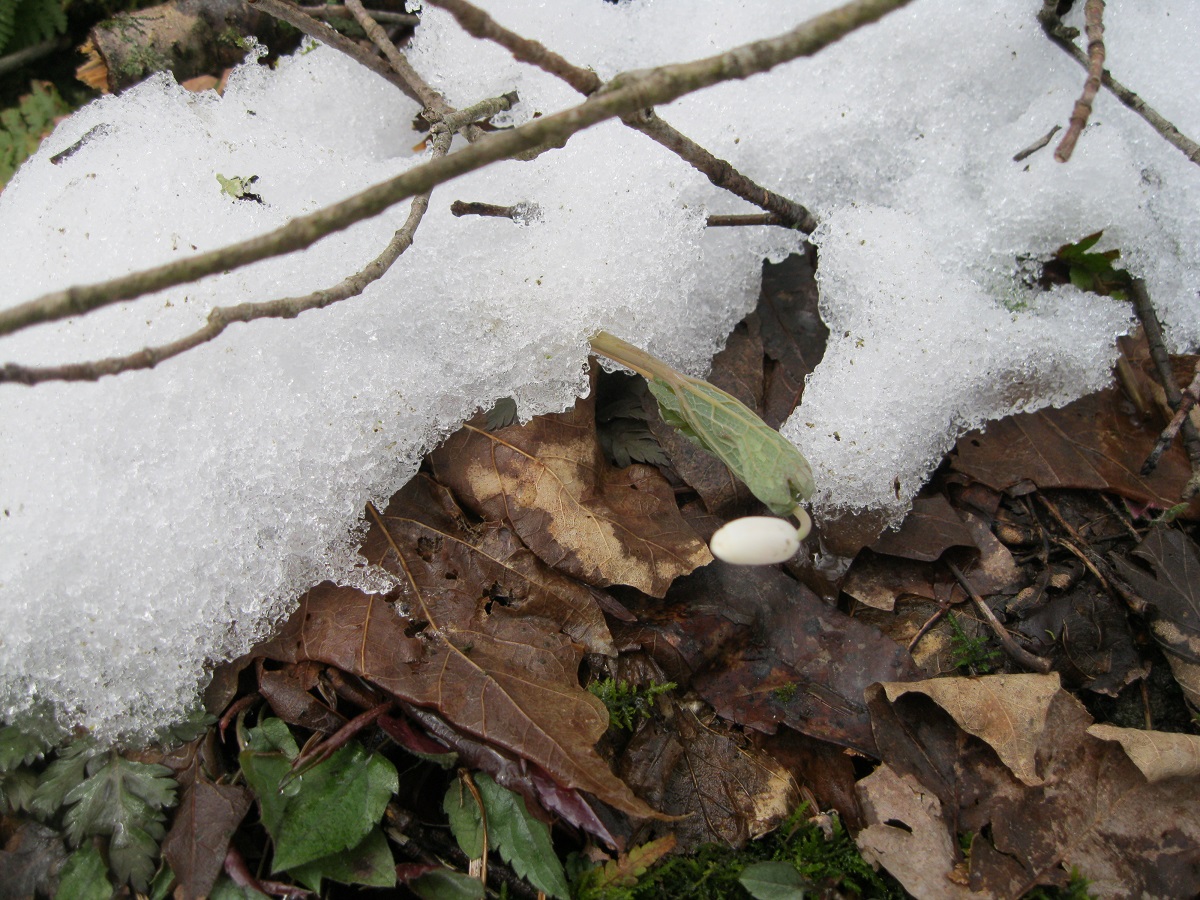
Another trip to Irma's woods was made.  Snow was still covering the ground but flowers were found.  This bloodroot still tightly wrapped by its protective leaf is visible because of the adjacent vertical stone.  It looks like it will survive the storm in fine shape.


This bloodroot has partially exposed its flower bud past the protective leaf but the snow has bent it.  We will wait to see if it is simply bent or actually broken.


The moss covering the stone provides an attractive background for the three lobed liver colored  hepatica leaf.  The white wood chip between the closed flower and the leaf is likely from one of the storm broken tree branches.  Many of the breaks occurred high up in the trees leaving long white scars on the remaining branches.


A Sharp-lobed Hepatica flower stem and the partially hidden leaf in the lower right hand corner of the picture are familiar.  However, it seems that we frequently encounter plant parts whose identity is not known to us.  The bright green leaves in the center of the photo is today's puzzle. 


Once again a moss covered stone edge reveals a sheltered plant.  Foam flower is frequently seen in our woods.  Long lasting leaves provide this glimpse of beauty for most of the summer.


Back in our shade garden, the Black cohosh the was a gift from Jane has made an appearance.  No storm damage is visible at this time.  Many more shoots will soon be seen guaranteeing its survival.


This Lungwort is not native but was given to us by a Unadilla neighbor.  Its two color flowers and speckled leaves create an early visual treat.  The plant is somewhat invasive but is easily kept in bounds.


This is a long looked for treat.  Last year this ground next to our Bloodroot planting produced new plants from seed.  The parent plants had a difficult summer and have yet to make much of an appearance while these three emerging plants look ready to go.


This Summer sweet bush was flattened to the ground by the heavy wet snow as is evident by the bare ground.  I passed close by this plant several times as I made my way to the propane tank to see how its supply was holding up.  Shaking the snow from the bent branches might have helped but it also could have broken branches.  Sometimes doing nothing is a wise course to follow. 
 

Monday, April 18, 2022

Ahead Of The Storm


Typical April days have presented our plants with a wide variety of conditions.  Several warm sunny days were followed by ground whitening frost on two consecutive nights.  Today is presently warm but a wet heavy snowfall is set to begin at any moment.  Predictions vary from 3" to 11" and we are ready to be snowed in for possibly several days.  Pictures taken both before the storm and after will allow us to see just how these native plants handle April in NY.  Three Bloodroot plants show different degrees of releasing their flowers.  Starting with the partially open bud in the upper left, the protective curled leaf has been left behind with the petals starting to open.  The flower in the center is a bit further along with its pollen load visible.  In the lower right a bud still in close contact with its leaf is still holding its tightly curled petals.  We will return after the storm releases us from its grip to see the condition of these plants.


This flower has nearly extended its eight petals into a flat circle.  The small green leaves beneath the flower are likely a wild Geranium.  The larger leaves to the right remain unknown to us.  One of these days we will try to identify the fallen tree leaves since these trees are nothing like the Red maples and Oaks that grow on our land.  These rotting leaves may have produced soil that meets the needs of the Bloodroot plants.  There has to be a reason why their growth here is limited to one small piece of ground.


These two separate plants are possibly displaying good judgement by holding their buds close with the approaching storm.


Subdued light resulting from the storm cloud cover allowed us to finally take a picture of Spring beauty flowers that show their actual colors.  This plant grows from a pea like structure that is located far from the above ground growth.  Without this pea no growth will follow transplantation attempts.  One cannot go for the pea until the plant begins to die back  Taken too soon it will simply die.  Trying to find it later will likely prove unsuccessful.  So we drive across the valley to see this beautiful plant in flower.


These next pictures were taken in our woodland garden.  Our Dutchman's breeches have been protected under a wire cage preventing the deer from simply trampling them into a state of nonexistence.  Even the cage presents a hazard when its removal fails to see a dead blossom breaking stalk trapped in the wire.  These plants will soon disappear from sight when their short growing season comes to an end.  We will endeavor to place name bearing stones at the known edge of these plants.


We have been checking here daily for the first signs of life from our Wild ginger.  Its habit of protecting the top surface of the leaves by holding them inside of a tight package with only the unseen underside of the leaves pushing up through woodland soil.  When the canopy of wide intact open leaves covers the soil, the flowers will open in actual contact with the ground.  These flowers are easily missed as they will be hidden from view.  Roots seen creeping just above the ground are normal for this plant.  We have learned to simply leave this plant to fend for itself.  How much new ground will be claimed this year remains to be seen.  We anxiously await for it to spillover the path defining stones as that will make the open flowers easier to see.


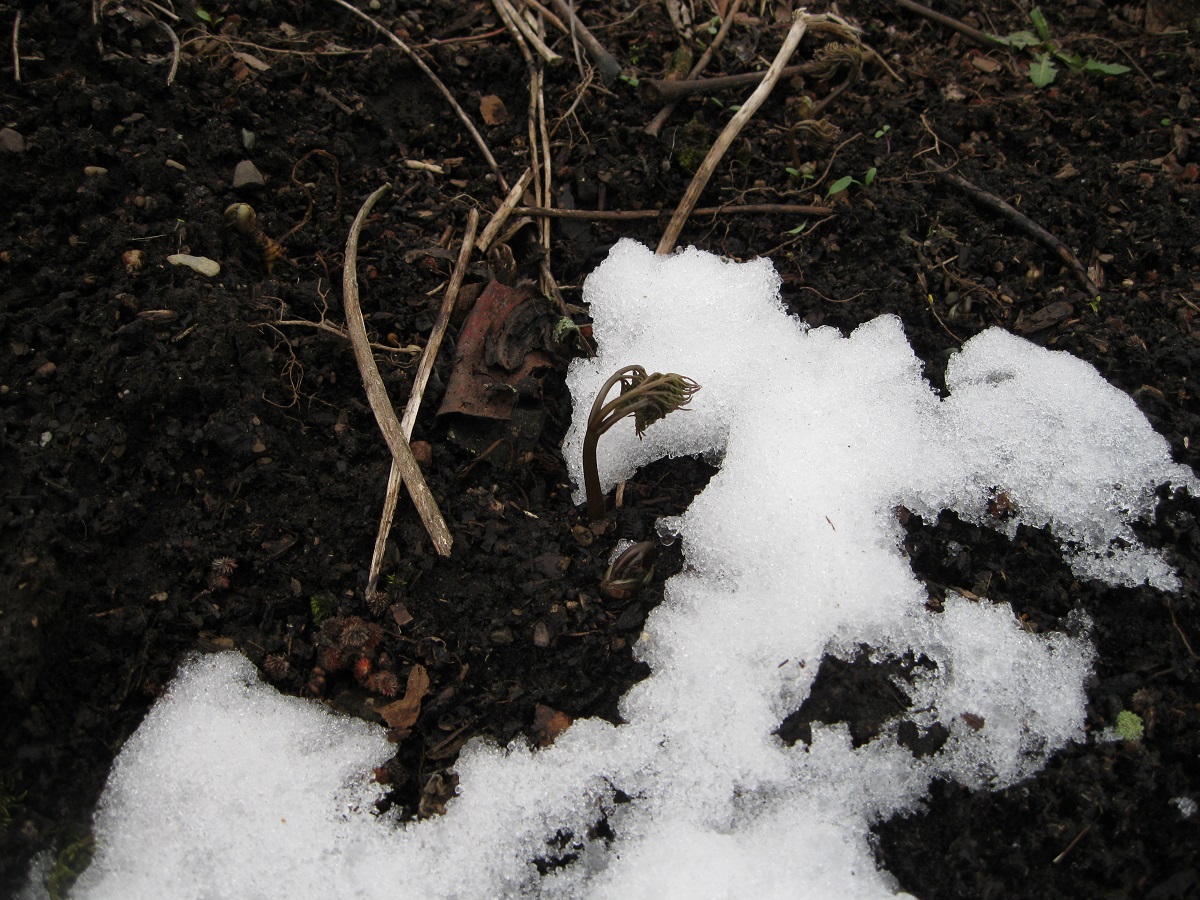
In the center of this carefully cropped picture are the only two Bloodroot plants to have made an appearance in our shade garden this year.  A spherical light brown ball can be seen atop a reddish colored stem with the leaf wrapper close to the ground.  Each day we search for more but so far have found nothing.  I failed to describe the location of the second plant.  Its still tightly wrapped flower is still held close to the ground to the left of its big brother.  So we wait.
 

Friday, April 15, 2022

Another Visit To Irma's Woods


Last night was clear and cold.  The gravitational pull of the full moon was a factor in the frost that formed.  Today is also clear and cold so a trip to Irma's Woods seemed like a productive way to spend the morning.  A normal person would likely see the ground covered with fallen tree leaves in this photo.  A close look may reveal two deep purple plant stems and possibly flower buds.  Our resident expert strongly believes that she has found Blue Cohosh plants pushing their way above the ground.


This is today's unknown plant.  We will see how much time and additional growth will be necessary for our resident expert to identify this one.


Why is there another photo of Sharp-lobed hepatica here?  This plants sports blossoms with twelve petals but frequently fewer petals are seen.  Just to the left of the center flower, a leaf grown last year rises above the forest floor.  Having seen the first one it is likely that several more will be found.  The moss covered stone adds interest to this scene.


The first common Trillium to appear here sports a red flower and goes by the local name Stinking Benjamin.  Trillium erectum is its proper name but its use for this plant remains a mystery.  This plant is located at some distance from the road but we used zoom not trespass to take this picture.


Memory has it that at one point in his career, John Burrroughs built a shed atop a larger and more level bedrock stone in his woods.  There it served as his writing studio.  I certainly understand the attraction of such an arrangement and have always admired this hunk of stone.  Burroughs also camped in the shadow of a similar stone at the top of Slide Mountain.  Were these woods mine, I would certainly be a frequent visitor near this stone.


This picture will also need clues to find the reason it was taken.  It has always taken Becky a long while to actually walk alongside of any road.  She is actively looking at things that I miss.  Today she saw a pollinator working Hepatica flowers.  By the time the camera was removed from its case, the insect had moved on.  It was found resting on a leaf in the center of the picture.  It is the size of a fly but can hover while feeding using rapid wingbeats.  By myself I would have never seen it.


Good fortune had it return to the flowers.  The large blossom in the upper left displays a dark spot that is actually the active pollinator.


Last year was difficult for both the Bloodroot plants in our garden and these restricted to a small section of Irma's Woods.  It was questionable whether either  would return.  Several tightly wrapped white blossoms were pushed from the soil this morning.  Tomorrow we will return to see both the open flowers and unfurled leaves.  Their time open is limited to just a few days so we will definitely return tomorrow.  So far our plants have made no appearance.  We did have several appear from seeds last year and anxiously await for any sign that any of these plants remain alive.