Showing posts with label wintergreen. Show all posts

Sunday, June 12, 2022

Help From Friends


Native plants are afforded some measure of protection by laws that prohibit their harvest from State Land.  With the permission of a property owner, they can be harvested.  We had the good fortune to be granted access to a tremendous wealth of several varieties of native plants.  The light bright green leaves pictured above are new growth on a transplanted Wintergreen plant.  If new growth is visible, then where is the old growth?  The dark green leaves at the left edge of the photo may well be Wintergreen.  Never before have we seen anything like these new leaves on Wintergreen.

One of the problems has been just how this plant grows.  Long stems at or just below the surface connect with roots that may be some distance away.  One author described a method to transplant in view of this unusual placement of critical plant parts.  He suggested finding the stem on either side of the leaves and cutting it while leaving the plant where it was.  Returning one year later to a carefully marked plant will reveal if the severed plant responded with new root growth.  If the plant was still alive, it might then be successfully moved.  That seemed like way too much trouble.  On one rare occasion, a small scrap of a plant was successfully moved.  It showed signs of life for three years, then disappeared completely.  A protective wire cage was not supplied.


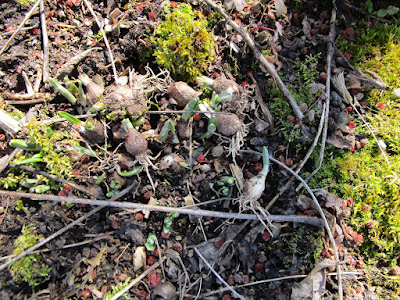
These plants were hastily dug on the day before Steve and Elaine moved away.  Wintergreen is visible at the top edge of the picture but the new growth appears to come from dark striped leaves that are somewhat different from those in the first photo.  The small leaves with a center white stripe belong to Partridge Berry.  There are several pink buds visible that illustrate a unique feature of this plant.  The base of the buds almost come together connecting with what will be a berry with two belly buttons.  Apparently Wintergreen and Partridge Berry are frequently seen growing together.  We are more than a little pleased having been permitted to dig these plants.  They do seem happy here.


This is another view of the plant shown in the first picture.  The plant in the lower right corner is a weed and will be removed.  Moving toward the center, dark green leaves are seen and may be the origin of the new growth.  Our resident authority thinks that the leaves in the upper left corner are violets.  There are hundreds of varieties of violets so we are hopeful that these will prove special.


This is the up to the moment condition of our Bloodroot patch. Supervised weeding protected as many as eight young plants.  We did briefly see flowers on tiny plants earlier but no seed pods were evident.  We have kept a careful watch on the woods across the valley but no seeds were seen there either.  The red flowers are on Columbine.  They are allowed to stay and spread since they were a favored plant of John Burroughs and none of these plants naturally grow without neighbors.

Thursday, March 17, 2022

Look Who's Back

Yesterday, it took almost all morning for the chilly fog to burn off.  Fun outdoor time seemed far off, but  after lunch Ed and I just had to go outside.  He used most his time to play in the mud, snow and water in the driveway and to inspect his Trailing arbutus.  I wanted to see if any of my plants were coming up. Wintergreen and  Partridgeberry are showing in this photo.  It is too soon to remove those oak leaves but     I 'm curious to see under there. 


These bulbs have been nibbled on and some bulbs have been pulled out of the ground.   I 'm pretty sure they are snow drops.  I am thrilled to see them again but not so delighted to see them uprooted.  When this bed softens I will replant  them.  Considering the voles we have had this year any bulbs that survive are a plus!


The tiny, fragile, pale green leaves in this picture are baby red columbine plants.  I love these as do the hummingbirds. 


This plant is a native.  It has small yellow flowers and blooms at a time when a little yellow color in a native plant garden is welcome.  I wish I could tell you its name, but right now it has slipped my tongue and my brain.  I am still thrilled that it is back!  This afternoon when Ed and I were on a bluebird house mouse eviction mission, more snow had melted.  I found the tag for this plant.  It is Golden Ragwort, Pakera aurea.  I bought it from the Fernery.


These are my fragrant lady's tresses.  This plant comes up early and blooms late.  It is wonderful to see this plant again.  Today perhaps the most exciting return of all to the garden is the bluebirds.  I watched them this morning checking out the bluebird houses and sitting on fence posts in the garden.  Watching bluebirds always makes me happy!


Saturday, June 12, 2021

Going Native


The whole idea of our native plant garden was to have native plants where they could be observed and appreciated by Ed and myself but for others too.  However going native is not easy!  My beautiful Miterwort plant is caged for protection from being eaten or stepped on.  But because of the cage this plant has had a chance to grow, flower and even go to seed.  Tiny black seeds sit in little green baskets.  When the wind blows and the seeds are ready Mother Nature will disperse them.  Wow I'm so happy that I got to see that!


Maidenhair spleenwort looks like a delicate wispy little plant but tucked into a rock crevice for protection it is doing beautifully.  This plant is lovely.  I never saw this plant in the wild or if I did I never noticed it.  I'm watching it now.  What a pleasure that is! 


Partridgeberry is a plant that grows wild here. When Ed last moved trailing arbutus here it was when long time friends moved away.  He never moved arbutus plants in October before.  He had no choice. It was his last chance. That was in 2019.  Sadly the Trailing arbutus died.  However, the Partridgeberry and the Wintergreen that came along with it are doing great.  Partridgeberry is to my way of thinking a perfect native plant.  The leaves are attractive.  The red berries are edible and have the unique mark of two navels.  I was delighted to see that the twin flowers are starting to bloom.  One flower is open here but there are more buds showing.  Knowing when your favorite wildflowers bloom makes them so much easier to find!


Wintergreen is also a perfect native plant.  It has a reputation for being somewhat difficult to transplant and that has been our experience.  It is almost three years later and finally we are finding new growth on these plants.  I love to chew on fresh wintergreen leaves, but these are forbidden fruit!  It was not until I saw the photo that I noticed the tiny beginning of wintergreen flowers.  If we have flowers we might have berries.  Wow I love teaberries!  These plants had beautiful berries when they were moved.  I will keep watching and perhaps see them again!

Friday, July 31, 2020

Finally Wintergreen Flowers


These are the first Wintergreen flowers that we have ever seen.  It is not uncommon for us to find the bright red berries that remain on the plant as snow melts but flowers have proven to be elusive.  A factor in never before having seen them is the timing of the flowering.  With so much to be done at this time of year, one simply is drawn away from this lowly ground cover.  As we discovered today flowers remain attached to the plant for merely moments.


When these two blossoms were discovered, one had been pulled free of the plant and was on the ground directly under the plant.  To get a closer look the flower cup was wiggled away from the plant and placed inverted on the moss.  Old eyes did not see the load of yellow pollen at the base of the blossom cup.  The photograph clearly displayed the pollen.  Based on our experience with Arbutus flowers where we saw bees pull the flowers apart to gain exit from their pollen gathering activity we suspect that is how this flower ended up on the ground.


Wintergreen has been a puzzle for us for decades.  A stem growing just below the surface sends up a stalk that sports a few leaves with limited roots underground.  Somehow nutrients travel through the buried stem from distance growth having a larger root system.  Attempts to transplant Wintergreen usually end in failure.  We have read about a method that is supposed to provide transplants that will grow.  The buried stem is exposed on both sides of the plant.  Two cuts are made one on either side of the leaf growth with the location marked.  A year or two later the severed plant might have grown more roots capable of supporting the plant.  If it is still green and growing, transplantation might be successful.

The two stems in the photo were moved the day that they were unearthed.  Both remain green and growing but they do not look like much considering the years that have passed since they were moved.  They have yet to produce flowers or new leaf growth.  Apparently there is some secret to moving this plant that remains unknown to us.


The plants shown in this photo are wild plants that have been given no interference by the hand of man.  Wintergreen is frequently described as a ground cover but in this instance a great deal of forest floor is visible with the Wintergreen growth sparse at best.  We would love to have a more traditional ground cover growth habit but this seems to be the best that can be found here.  Notice that there are no blossoms on any of these plants.  The flowering plant is closer to the river while these plants are on much higher ground.  We will check back looking for flowers.  We do find the red berries here so these plants must flower at least some years.

It may have been the Little House On The Prairie books that contained a description of a gathering of  women to quilt that included sampling Wintergreen wine.  That sounds delicious and the description in the book described the imbibers cheery mood.   I have never seen a wild occurrence of this plant that would have supplied enough leaves to make wine.  I can only imagine what the forest at that time must have looked like in its largely undisturbed natural state.


Our woods contained an impressive number of Wintergreen plants when we first walked this land but they are presently under attack from another native plant.  Canada Mayflower is relentless in its slow march across our woodland.  It is an attractive plant with white flowers contrasted by dark green glossy leaves but the final outcome is certain.  Only it will remain.  For the moment we have a few Wintergreen plants growing under our watchful eyes but their fate is already determined as is mine.  Nothing lasts forever.

Friday, January 3, 2020

Still Here Waiting For Spring


2020 is a year that I never expected to see.  In 2005 cancer was found on both kidneys.  I found in Albany a skilled doctor that used two procedures that removed only the cancer.  88% of my original kidney mass remains.  I have truly enjoyed the past fifteen years doing what I love.

This native  moss was moved this past year from our woods to our developing shade garden.  Only recently have we discovered the magic of mosses.  So far winter seems to have had no effect on these plants or the moss covering the rocks that define the walking path.


The day before the moving van was scheduled to snatch Steve and Elaine away, I was given one last chance to make some of their plants mine.  There is nothing appealing about the name slime mold but that day was a now or never situation.  Once home some quick reading resulted in placing well rotted wood in the acid soil previously lifted from our woods.  It may be that the pink spheres are reproductive organs.  They swell in response to moisture and nearly disappear when dry.  The grayish green blobs are the body of the mold.  Sumac berries are the deep red balls.  It appears that this slime mold intends to survive in its new location and we will carefully weed out any tiny trees that grow from the red berries.


This photo contains two recent transplants, wintergreen and arbutus, as well as a jumble of fallen plant parts.  The maroon colored leaves belong to wintergreen as do two red berries located at the junction of its top two leaves.  All of the other red berries are sumac.  Green leaves mark the location of arbutus.  These plants were hastily placed here on moving day.  Fortunately acid woodland soil was already in place.  Just what to do with these treasures is presently under consideration.  Our usual habit is to segregate our transplants but this looks like a more natural placement. An unseen wire cage keeps the wildlife from eating these still growing plants.  These native plants will serve as a reminder of the debt owed these two people for all that they have done for us.  Extra care will be given to keep these plants alive.


This does not look like much but it may hold great promise.  Disregard the sumac berries and find the reddish stem that still holds a leaf.  Fringed polygala has a history here.  Invasive native plants ended what had been a highly successful transplant.  Last spring we tried again.  This plant is still alive under its protective wire cage.  Just at the soil surface is the cleistogamous  flower that produces only seed.  Here we have two chances for a surviving plant.  Most people would never see the promise of a possible native plant returning here.  Check back around Mother's Day to see if the paired purple flower petals are on display here.

Saturday, October 12, 2019

Goodbye Good Friends


Earlier this week Elaine placed a phone call to us.  Her house had been sold and if we wanted to dig any more plants there, we had to get a move on.  All of our Arbutus plants were dug from her front lawn.  We thought about asking for more next spring so that we could have this wonderful plant in our new shade garden.  With the sale of their home we had to move now.  As has been our habit, we took a large patch of soil to lessen the transplanting shock.  Appropriate soil from under a white pine tree was taken since that has always resulted in a successful move.  We hope that this last chance ever will give us another Arbutus patch located where visitors can easily see it.


We knew absolutely nothing about this plant that grew at the end of Steve and Elaine's road.  Recent generous rainfall had pushed this Slime mold to sent up its fruiting bodies.  Contact with other bloggers indicated that this was a Slime mold.  We cannot say no to an interesting looking new to us plant.  We need to find a suitable location for this bizarre new arrival.  When the morning trip down the hill was made to water our new plants, this one looked quite sad.  It quickly responded to some water and puffed up its pink fruiting bodies.


Wintergreen has not been successfully moved here in the past.  Our last attempt is still alive but has not grown any new leaves.  We do not usually transplant this late in the year but it was now or never.  If the new plants do not survive their move, we will still have a chance for plants from seed.  Evergreen ground covers are frequently eaten as winter ends.  These plants have been placed under a hastily placed wire cage to protect against raids by hungry rabbits, deer or woodchucks.


All of these plants grow in acid soil.  These white pine needles will provide an appropriate acid mulch for all of these new arrivals.  They will be watered frequently until the ground freezes.  We do expect that not all of these plants will survive here but at least we tried.  Both Steve and Elaine have helped us on many occasions and we already have many of their plants growing here.  We will do our best to help these plants survive here.  This special couple will be missed and we wish them well at their new location.  Thanks to both of you for all that you have done for our family.

Saturday, January 13, 2018

Big Plans


These pictures were taken yesterday before the return of more normal January weather.  The ridge above the transplanted Cardinal Flowers is widely strewn with broken chunks of bedrock.  This edge  exposed rock caught my eye because of its unusual orientation.  The last glacier pushed these rocks around  with their largest face commonly resting in contact with the ground.  This rock was pushed into the ground with its thin edge topmost.  In my attempts to create a garden that looks somewhat natural, it never occurred to place rocks in this manner.  Many large rocks have been unearthed by me that remain unused because of their ugly wrinkled and twisted large flat surfaces.  If placed in the garden in this manner their ugliness will remain hidden out of sight and there will be more rocks for me to plant.


Wintergreen growing naturally between moss covered Birch tree roots is what I would like to see in my developing woodland garden.  To date Wintergreen has defied my attempts to move it.  A linear stem grows just beneath the soil surface with small roots penetrating the soil beneath each leaf cluster.  If there is a large system of roots under the central part of the plant, I have yet to see it.  It would be best to enjoy these wild plants where they now grow.


These pieces of rotted tree trunk have been levered out of the ground and carried to the developing woodland garden.  When the ground is free of frost this wood will be replanted.  In addition to adding a possibly natural look to the area, dead wood may hold the secret to successful placement of Lady Slippers.  These plants native to this region have recently become available for purchase.  Their price is steep and the catalogs promise that growing instructions will be shipped with each plant.  It makes no sense to me that the instructions will arrive with the plant.  Having the area properly prepared ahead of the arrival of the plant sounds like a better idea.  I intend to place the stump in soil taken from the area where the former tree grew.  One year will be allowed to pass so that the dead stump can settle in.  Perhaps then we will be ready to part with just under one hundred dollars for one
precious plant.


Partridge Berry is another native plant that grows somewhat freely here.  Each red berry is formed from two blossoms that were fused at their base.  This plant has the reputation of being easy to move.  We intend to include it in our new shade garden.


This monster was just discovered.  Its size guarantees that it will remain where planted.  Several cracks show where a chisel and hammer could split this rock.  Those cracks also show where an unusually hard section directs them downward.  Any attempt to alter this rock will just make a mess.  It makes more sense to bring some native plants to this rock.  White Trilliums  would look really good here.  We shall see just what happens here when spring returns.

Thursday, July 27, 2017

In Search Of Wintergreen


Our source of arbutus plants sent word to us today announcing the blooming of her wintergreen.  Despite the recurring showers, we set off to the back woods to check on the status of our plants.  We found new plant growth proudly displaying its smaller reddish leaves but no flowers.  Where the mature leaves depart from the stem, red areas can easily be seen.  The tiny white bump there may be the start of the flowering stem.  We will watch to see if flowers soon appear there.  This is an incredibly busy time of year in the garden and we have frequently failed to take the time to look for wintergreen flowers.


This piece of wintergreen was an unexpected gift to us when we were uprooting arbutus.  Its need for acidic soil matches arbutus so we planted the wintergreen near out transplanted arbutus.  When moved each leaf junction consisted of just three leaves.  As our gaze moves along the stem from right to left, new growth is seen.  We expected nothing from the transplant since our past efforts always ended in failure.  This time the new growth looks promising.  This plant will get a wire cage to protect it from foragers as winter approaches.  We have seen arbutus and wintergreen growing side by side in the wild and would be thrilled if that can happen here.


The Canada mayflower has, as its name suggests, already flowered.  This native must be classed as invasive here.  Where these woods drop downhill to meet the road, Canada mayflower has nearly totally displaced all other native plants.  We have watched as it closed in on our rather sizable wintergreen plants but could do nothing to halt its advance.  For now both plants grow under the black birch trees but the wintergreen will soon be only a memory.  The photo shows that many of the seed bearing berries have already been eaten possibly by turkeys and grouse.  Those seeds have been scattered and more new mayflower plants will grow.

Wintergreen has long been a part of my life.  As a child those dark chocolate covered pink colored wintergreen cream patties were a favorite after school treat.  I remember reading of early pioneer women breaking out the wintergreen wine at a quilting bee.  Imagine the size of a wintergreen patch that would have been needed to gather enough leaves to make wine.  Try to imagine the taste of wintergreen wine.  I eat the berries while walking about during mild winter spells and that always makes me wonder about the wine.


These Indian pipes were an unexpected sight today.  They grow just across the lane just uphill from the wintergreen and Canada mayflower.  The purity of the color suggests that these are newly emerged.  They were an unexpected gift on this day with no wintergreen flowers.

Saturday, April 15, 2017

A Gift Of Plants


Several decades ago when we began our serious gardening efforts, some female gardeners of age took us under their wings and supported our efforts with gifts of their plants.  Many of those ladies are now gone but their plants live on in our gardens.  We remember those caring people with sweet memories whenever we work among their plants.  The gift of plants is a tradition worth preserving and today we continue the practice.


These two arbutus plants were dug with the owners' permission today.  Located at the top of a north facing ridge, these plants were still covered with snow two days ago.  As we move toward summer and the sun climbs higher in the sky, these plants will exist in full sunlight.  Their response to this harsh environment is to keep their leaves small and reproduce freely.  They sense that they may soon die because of their poor for them location and desperately work to create the next generation.


Jane is one of the gardeners that has made  many gifts of plants to us.  Now well into her ninth decade we wanted to make it possible for her to once again enjoy the scent of open arbutus flowers.  We selected these two plants with the plan that they be planted out as soon as the flowers are finished.  Each of these small plants  are at least two years old.  A new plant from seed grows only three leaves during its first year.  The second year sees stem growth and additional leaves.  The flowers buds form at the end of the new stem growth.  Because these plants are small, they will very likely survive transplantation after their short time in the pots.  Jane will be able to raise the pots near her nose rather than going to the ground to catch a sniff of these unbelievable sweet flowers.


We have made countless attempts to grow bluets.  These plants grow like weeds in wet lawns.  They slowly fail for us because of our mostly dry ground.  This time around, we are placing this gift of plants at the base of the hill leading up to our home.  This is the wettest area that we have available to us.  Individual plants are either male or female.  We planted three in the hope that both genders are present.  Natural plant propagation is the goal.  Not only do we want them to live, we want them to prosper.


These four plants were left together because of their closeness to each other.  Dividing them might have increased the stress of the move.  Our rural mailbox is close by so a sprinkling can of water can make the trip down the hill to get the mail on rainless days.


Elaine was kind enough to allow us to take all of these plants from her home site.  Wintergreen grows abundantly there and she offered us a sample.  We have made numerous unsuccessful attempts to bring wintergreen under cultivation.  The growth habit of this plant makes moving it difficult.  An underground stem connects each of these clusters of three leaves.  A small amount of roots form at the point where the leaf stem leaves the underground stem.  Generally, this root mass is insufficient to sustain the part of the plant that has been separated from the crown.  We placed this wintergreen close by an arbutus planting.  Since we continue to bring water to the transplanted arbutus when rainfall is scant, we will remember to water the wintergreen.  The muddy plop is the remains of the soil that was moved today.  Nearby white pine needles were pulled in to cover the soil.  Now these plants look like they are growing in a wild natural location.

Wednesday, November 30, 2016

End of November Green


On occasion our gardening blunders can be attributed to ignorance.  In this instance, the choice to cultivate an invasive nonnative was made with full understanding of both the plants history and nature.  Sweet Rocket is a common roadside weed in our area.  It grew here prior to our ownership of this land and it will continue to call here home long after we are gone.  Its pleasantly scented flowers are also frequently colored an attractive purple.  Color and scent make this plant a sure winner.  It is easy to understand why early European settlers brought seeds of this attractive plant with them.

A biennial habit and a stout tap root present problems when trying to transplant Dame's Rocket.  These three plants were moved early in the year while they were still small.  Their color is unknown but we would like to see purple and perhaps a single white.  If these plants please us and if we cut them back after they flower, a second year of flowers might happen.  Cutting the immature seeds heads is prudent in one wishes to avoid weeding out many deeply rooted seedlings.


This area is our spearmint patch.  Three clove currants were also planted here.  Since the roots of the clove currants run deep and mint's roots hold the upper ground, we planted them together.  A couple of Dame's Rocket transplants were thrown in for good measure.  They dropped a carpet of seed so we will be weeding here.  Five minutes of timely pruning would have saved us much difficult weeding.


The low meadow in the back has been given over to goldenrod and milkweed.  Our considerate neighbors have two horses and little land that is suitable for grazing.  Last season some mowing was done here to discourage the weeds and favor the grass.  The first step in the process is to slowly drive my truck across the area searching out mower killing rocks and leg breaking woodchuck dens.  Next spring we will mow here with the blades set high.  When the growth is more suitable to the horses taste perhaps they can keep the grass short and the weeds gone.


Becky spotted this wintergreen berry from the truck.  It looks like there were several fruits on a single stem earlier in the year.  Neither of us recall seeing multiple fruits.  That will give us something to look for next year.  When there are more berries, we have been known to eat a few.  We are both  old Teaberry gum fans.  The reddish pink new spring growth is tasty as well, but we do not harvest them unless the patch is well established.


All of our attempts to cultivate wintergreen have failed.  Clearing the briers away from a wild patch made it easy for the deer to graze the plants into oblivion.  I throw light brush over the wintergreen to make it difficult for the deer to eat here.  The neighbor's dogs also help to protect these plants.  The wisest course of action would be to enjoy wintergreen as a naturally wild plant.

Wednesday, December 17, 2014

December Thaw


Our recent weather has not been kind to us or our plants.  Freezing rain falling on frozen ground quickly created a substantial coating of ice.  Trees remained only wet as the wood was not yet frozen. Electric power was uninterrupted but the roads were a nightmare.  More snow fell and soon it looked like winter.  This morning's warm air finally cleared the driveway and most of the snow cover elsewhere is gone.  Ever present clouds keep it gray, wet and depressing outside but a walk about was definitely in order.  Geese are still here and their honks filled the air as they flew north just above the river.


Any walk out of doors of necessity starts near the arbutus transplanted close to the house several years ago.  Temporarily removing the protective wire cage allows this native plant to appear wild and free.  A hungry rabbit was seen nearby and the cage was replaced following a quick look and a picture.  These buds look ready for an early spring opening.  We will not miss that.  The rabbit shall not find food here.


A walk up the lane took me to the arbutus transplanted this year.  They too live under a wire cage.  A larger cage, nestled in a low stone wall, is on the to do list for spring.  Spacing between the small transplants seemed adequate at the time but a natural location under a white pine tree and frequent watering when rainfall was scant resulted in impressive growth.  There is still no sign of new plants from the seed produced here but we expect to see new plants after their seasonal period of cold.


This appearance of wintergreen is totally wild.  Neither purchased plants nor transplants have survived my attempts to help this plant reestablish itself here.  Fallen leaves from the birch tree litter the ground but the wintergreen leaves remain above them and their life process continues without my interference.  That is as it should be.


Cardinal flower is a native plant that grows here only in a garden.  This clump of daughter plants is seriously overcrowded and without division will likely choke itself out.  Six brown stems identify this as a single two year old plant that multiplied to six plants this year.  Next year will see this clump try to support the growth of up to thirty-six overcrowded  plants already vying for space.  The way that cardinal flower multiplies may be a factor in why attempts to reestablish this plant in the wild have failed.  The tenacity of the escaped pasture grasses may simply overpower the slight native making reproduction by seed impossible.  Spring will find a dozen pots of cardinal flower waiting on the stone wall until the weather settles so that they can be planted out.