Showing posts with label Fragrant Lady's Tresses. Show all posts

Friday, May 27, 2022

Initial Disappointment


We have slowly come to realize that many native perennial plants need time to adjust to a new home.  In the recent past new Giant white trilliums have been unreliable to accepting their new home.  Some show no above ground growth in their first year with us.  Small flowerless plants sometimes appear in their second year.  Our harsh early spring weather really hammered many of our plants.  Yesterday we were cleaning up some weeds and finally took a close look at our collection.  Huge plants are absent but there are new plants growing close by older plants.  It is not hard to see the possibility of an impressive group of pure white blossoms on display here next year.


Cardinal flower apparently has always been mostly absent in this part of NYS.  More that one century ago, Roxbury native John Burroughs described his difficulty in finding at least a single flowering plant.  Our weather is the problem.  These plants overwintered as new growth.  Their emergence from the snow cover saw beautiful light green tender rosettes.  Given time to adjust to typical early spring cold snaps, these plants would survive.  Here we get winds from the south raising temperatures into the 60's followed by hard frost.  Our habit is to cover these plants with Chrysanthemum stems following snow melt.  Still the bitter cold blackened these leaves.  We were certain that these plants were dead.  Clearly they are alive and we will soon see their brilliant red flowers.  A nearby group did not experience that success.  More than half of them are now gone but seed is on the ground.  Plants from seed will not flower this year.


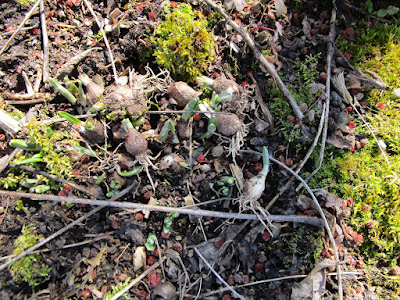
Bloodroot has been smacking us around for years.  The cage protected area where transplants have been placed for several springs did not produce a mature plant.  Extremely small leaves did appear this year but hard frost ended them.  These pictured plants first appeared here last year.  They are self seeded  and were tiny.  Perhaps four plants are growing here and we very carefully remove weeds.  At our age we are no longer buying plants.  What grows here is largely on their own.


 Fragrant ladies tresses
grew here for several years.  It is a southern plant and we felt lucky each year that it produced flowers.  It did send up several shoots this year but a severe frost ended them.  We will leave this ground alone after we remove the garlic mustard because it might be possible for us to see desired growth next year. 

Thursday, March 17, 2022

Look Who's Back

Yesterday, it took almost all morning for the chilly fog to burn off.  Fun outdoor time seemed far off, but  after lunch Ed and I just had to go outside.  He used most his time to play in the mud, snow and water in the driveway and to inspect his Trailing arbutus.  I wanted to see if any of my plants were coming up. Wintergreen and  Partridgeberry are showing in this photo.  It is too soon to remove those oak leaves but     I 'm curious to see under there. 


These bulbs have been nibbled on and some bulbs have been pulled out of the ground.   I 'm pretty sure they are snow drops.  I am thrilled to see them again but not so delighted to see them uprooted.  When this bed softens I will replant  them.  Considering the voles we have had this year any bulbs that survive are a plus!


The tiny, fragile, pale green leaves in this picture are baby red columbine plants.  I love these as do the hummingbirds. 


This plant is a native.  It has small yellow flowers and blooms at a time when a little yellow color in a native plant garden is welcome.  I wish I could tell you its name, but right now it has slipped my tongue and my brain.  I am still thrilled that it is back!  This afternoon when Ed and I were on a bluebird house mouse eviction mission, more snow had melted.  I found the tag for this plant.  It is Golden Ragwort, Pakera aurea.  I bought it from the Fernery.


These are my fragrant lady's tresses.  This plant comes up early and blooms late.  It is wonderful to see this plant again.  Today perhaps the most exciting return of all to the garden is the bluebirds.  I watched them this morning checking out the bluebird houses and sitting on fence posts in the garden.  Watching bluebirds always makes me happy!


Wednesday, October 21, 2020

Better Late Than Never


At this point it's not easy to find beautiful flowers hiding among the fallen leaves.  However my Fragrant Lady's tresses, Spiranthes odorata, did not disappoint.  Granted they were a bit earlier and a little larger last year, but this is 2020.  I am thrilled to just see these lovely little native orchids again.


The individual flowers are small, about one-half  an inch in length.  I love the way they spiral up the stem opening from the bottom to the top.  I wish I could tell you that I got a whiff of the fragrance, but the stems are short this year and I was lucky to get close enough to the ground the take the pictures.  Because we keep a cage around these flowers the wind and falling oak leaves have already mulched these plants.  So far they seem to ignore the cold so I still hold out hope that there will be flowers into November.  Whatever happens it sure made me happy to see my lovely orchids today.  It is only right I should share their beauty!

Thursday, August 6, 2020

After The Rain


Many of our plants have struggled to stay alive during this hot drought.  Despite the distance from running water, we have hauled water down the hill to the shade garden.  Our efforts preserved life but nothing brings plants alive like an all day gentle rainfall.  These   Rattlesnake Plantains have increased in number from last year's single purchased plant but have remained tiny.  Their response to the natural moisture was an obvious increase in the size of the leaves.  No flowers were seen last year.  Perhaps this year will be different.  This orchid does not naturally occur south of Canada in the eastern part of North America.  Its unique leaves are a visual treat and are reason enough to keep give this plant a growing area.


Fragrant Lady's-tresses grow naturally two climate zones warmer than here.  Out of place, it remained hidden in the soil for our harsh early frosts and freezes.  We were both surprised and pleased when three stalks finally appeared.  Last year the flowering spires wrapped themselves around each other creating a visual treat.  The USPS Wild Orchid stamps feature this plant.  None of the selected plants were identified by name but this one appears in the top row adjacent to the header.


Jacob's Ladder is commonly seen in established older gardens.  The lack of moisture had this specimen looking dreadful.  It is amazing how quickly recovery followed a generous rainfall.


These Cardinal Flower plants were bent over and withered prior to our water rescue.  Their short term recovery was made more permanent by the daylong rain.  The general lack of adequate moisture has limited growth to about one half of a normal year's presentation but the red blossoms are as vivid as ever..


Maidenhair Spleenwort is in its first year here.  As a new transplant, these have received more regular visits from the watering can.  Their natural growth habit places them in cracks and crevices of stone outcroppings.  We built a version of a stone ledge that seems to suit the plants just fine.  They are without question a tiny treasure.


This purchased fern was not an informed choice.  Its small size and rugged looking leaves made it a natural in front of our transplanted stump.  Yes, we do plant both stones and stumps.  How could a native woodland garden be complete without them?

Thursday, May 14, 2020

Where Do I Begin?


Ed and I have been waiting for today!  If NOAA's crystal ball is correct we are in for a warm, welcome change.  After a cold night our morning garden walk had Ed removing the covers from the plants while I walked along looking for something good to photograph.  The Smooth Solomen's Seal is back and spreading. That's great news!


Uncovered, my Fragrant Lady's Tresses  already look fantastic!  Just you wait until they get some  warm rain and sunshine instead of frigid nights!


The Hens and Chicks on top of Ed's stone wall are still red from winter's chill. I could not help but notice this baby milk snake right at my eye level!  A baby milk snake is a sure sign of warmth to come.  I love the way this little guy is woven in the  spiny plants.


The snakes eye is cloudy which means a change of skin is in the works.  That has got to itch! Hens and Chicks must make a terrific back scratcher.  It's time to get my garden cart and head outside. Where will I begin?  Does it matter?