Showing posts with label partridgeberry. Show all posts

Sunday, June 12, 2022

Help From Friends


Native plants are afforded some measure of protection by laws that prohibit their harvest from State Land.  With the permission of a property owner, they can be harvested.  We had the good fortune to be granted access to a tremendous wealth of several varieties of native plants.  The light bright green leaves pictured above are new growth on a transplanted Wintergreen plant.  If new growth is visible, then where is the old growth?  The dark green leaves at the left edge of the photo may well be Wintergreen.  Never before have we seen anything like these new leaves on Wintergreen.

One of the problems has been just how this plant grows.  Long stems at or just below the surface connect with roots that may be some distance away.  One author described a method to transplant in view of this unusual placement of critical plant parts.  He suggested finding the stem on either side of the leaves and cutting it while leaving the plant where it was.  Returning one year later to a carefully marked plant will reveal if the severed plant responded with new root growth.  If the plant was still alive, it might then be successfully moved.  That seemed like way too much trouble.  On one rare occasion, a small scrap of a plant was successfully moved.  It showed signs of life for three years, then disappeared completely.  A protective wire cage was not supplied.


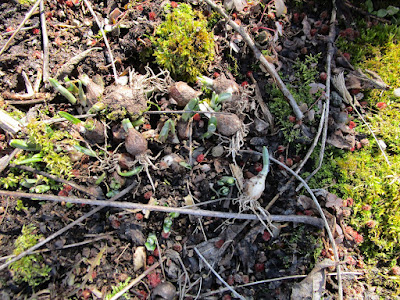
These plants were hastily dug on the day before Steve and Elaine moved away.  Wintergreen is visible at the top edge of the picture but the new growth appears to come from dark striped leaves that are somewhat different from those in the first photo.  The small leaves with a center white stripe belong to Partridge Berry.  There are several pink buds visible that illustrate a unique feature of this plant.  The base of the buds almost come together connecting with what will be a berry with two belly buttons.  Apparently Wintergreen and Partridge Berry are frequently seen growing together.  We are more than a little pleased having been permitted to dig these plants.  They do seem happy here.


This is another view of the plant shown in the first picture.  The plant in the lower right corner is a weed and will be removed.  Moving toward the center, dark green leaves are seen and may be the origin of the new growth.  Our resident authority thinks that the leaves in the upper left corner are violets.  There are hundreds of varieties of violets so we are hopeful that these will prove special.


This is the up to the moment condition of our Bloodroot patch. Supervised weeding protected as many as eight young plants.  We did briefly see flowers on tiny plants earlier but no seed pods were evident.  We have kept a careful watch on the woods across the valley but no seeds were seen there either.  The red flowers are on Columbine.  They are allowed to stay and spread since they were a favored plant of John Burroughs and none of these plants naturally grow without neighbors.

Thursday, March 17, 2022

Look Who's Back

Yesterday, it took almost all morning for the chilly fog to burn off.  Fun outdoor time seemed far off, but  after lunch Ed and I just had to go outside.  He used most his time to play in the mud, snow and water in the driveway and to inspect his Trailing arbutus.  I wanted to see if any of my plants were coming up. Wintergreen and  Partridgeberry are showing in this photo.  It is too soon to remove those oak leaves but     I 'm curious to see under there. 


These bulbs have been nibbled on and some bulbs have been pulled out of the ground.   I 'm pretty sure they are snow drops.  I am thrilled to see them again but not so delighted to see them uprooted.  When this bed softens I will replant  them.  Considering the voles we have had this year any bulbs that survive are a plus!


The tiny, fragile, pale green leaves in this picture are baby red columbine plants.  I love these as do the hummingbirds. 


This plant is a native.  It has small yellow flowers and blooms at a time when a little yellow color in a native plant garden is welcome.  I wish I could tell you its name, but right now it has slipped my tongue and my brain.  I am still thrilled that it is back!  This afternoon when Ed and I were on a bluebird house mouse eviction mission, more snow had melted.  I found the tag for this plant.  It is Golden Ragwort, Pakera aurea.  I bought it from the Fernery.


These are my fragrant lady's tresses.  This plant comes up early and blooms late.  It is wonderful to see this plant again.  Today perhaps the most exciting return of all to the garden is the bluebirds.  I watched them this morning checking out the bluebird houses and sitting on fence posts in the garden.  Watching bluebirds always makes me happy!


Sunday, June 20, 2021

Cleistogamous Found


This picture was posted in May.  Fringed polygala is the name of this elusive native wildflower.  We previously lost a large patch that grew impressively from a transplant.  Invaders finished it and we have not been able to move this plant since.


There is some question if the brightly colored blossom plays any part in the production of seed.  This developing seed pod at ground level has no connection to the May flower.  This is the first time that we have been able to find this secondary never opening flower that produces self pollinated seed.  Now we shall attempt to follow this treasure intending to discover when the seed ripens.  This tiny plant is across the lane but we have permission to meddle here.


We have followed this plant for several years.  It displays a more mature stem with several leaves.  It is highly likely that the pictured flower grew on this plant.  At this point in time we have found the locations of two cleistogamous seed pods.  If we can follow developments here, seed will be planted in our shade garden within sight of the highway when the time is right.  An important first step has been taken but much more investigation needs to follow if we are to see a successful move.


 This photo shows newly forming flowers on the more common Partridgeberry.  Aside from the two flowers joined at the base intending to form a single seed carrying berry, this plant will help us remember when Polygala begins its possibly summer long process of making viable seed.

Saturday, June 12, 2021

Going Native


The whole idea of our native plant garden was to have native plants where they could be observed and appreciated by Ed and myself but for others too.  However going native is not easy!  My beautiful Miterwort plant is caged for protection from being eaten or stepped on.  But because of the cage this plant has had a chance to grow, flower and even go to seed.  Tiny black seeds sit in little green baskets.  When the wind blows and the seeds are ready Mother Nature will disperse them.  Wow I'm so happy that I got to see that!


Maidenhair spleenwort looks like a delicate wispy little plant but tucked into a rock crevice for protection it is doing beautifully.  This plant is lovely.  I never saw this plant in the wild or if I did I never noticed it.  I'm watching it now.  What a pleasure that is! 


Partridgeberry is a plant that grows wild here. When Ed last moved trailing arbutus here it was when long time friends moved away.  He never moved arbutus plants in October before.  He had no choice. It was his last chance. That was in 2019.  Sadly the Trailing arbutus died.  However, the Partridgeberry and the Wintergreen that came along with it are doing great.  Partridgeberry is to my way of thinking a perfect native plant.  The leaves are attractive.  The red berries are edible and have the unique mark of two navels.  I was delighted to see that the twin flowers are starting to bloom.  One flower is open here but there are more buds showing.  Knowing when your favorite wildflowers bloom makes them so much easier to find!


Wintergreen is also a perfect native plant.  It has a reputation for being somewhat difficult to transplant and that has been our experience.  It is almost three years later and finally we are finding new growth on these plants.  I love to chew on fresh wintergreen leaves, but these are forbidden fruit!  It was not until I saw the photo that I noticed the tiny beginning of wintergreen flowers.  If we have flowers we might have berries.  Wow I love teaberries!  These plants had beautiful berries when they were moved.  I will keep watching and perhaps see them again!

Wednesday, April 1, 2020

April First Native Flowers


For some time we have been considering which native flower opens first.  It does not require a close look to spot these brazen yellow blossoms commonly seen in roadside ditches.  Note the complete lack of leaves which will appear later.  Coltsfoot cannot be in the running for first native flower since it is an European immigrant.


Eagerness to spot early flowers must be tempered with some reason.  Here the leaves are clearly Partridge berry but the flowers are Hepatica.  This presentation brings to mind a favorite story told by our elderly neighbor,  He saw an Arbutus plant apparently bearing purple flowers.  No one will suggest that what he actually saw was Hepatica growing close to Arbutus.  I intend to plant Hepatica close by one of my Arbutus plants in his honor.


Sharp lobed Hepatica presents blossoms of various colors and different petal counts.  This example bears eleven petals each colored a beautiful light violet.  It took me years to appreciate these first native flowers since early garden work kept me from wandering in the woods.


This nearby plant bears only six petals colored a near white blue.  In these woods Sharp lobed Hepatica is the first native plant to present flowers.


This Spring Beauty came in a close second.  Its bud will soon open revealing another early treasure.  Its growth habit makes transplantation nearly impossible.  From a pea sized corm a slender underground shoot travels a considerable distance before sending up its above ground leaves and flowers.  Removing a plant intact is highly unlikely.  As the plant is ending its growth cycle, following the then nearly dead underground shoot back to the corm is no simple task.  These plants grow wild in our back woods but are absent from our wildflower gardens.


Six lightly colored petals presented themselves above the jumble that is characteristic of natural forest floor.  We were unable to find any sign of Bloodroot plants today.  They will appear soon in this location but lost the race for first flower.

Mention must be made of the justification for leaving  the house during these trying times.  Just across the valley from our home is a bedrock ridge that slopes to the south.  Flowers appear first here in response to earlier warming.  Our walk took us along the dirt road that crosses this ridge.  We encountered no road traffic and saw no bikers or hikers while there.  Our outside time here endangered no one.  The land where all of these pictures were taken still carries tattered or fallen  posted signs bearing the name Haller.  A long ago phone call identified the land owner as Irma Haller.  We both taught at the Sidney Junior High School for its last decade of service.  My call was placed in an attempt to gain permission to explore these woods.  What I got was a sincere thank you for respecting her posted signs.  Becky and I frequently walk on this road while looking for flowers.  While there memories of Mrs. Haller always cross my mind.  In keeping with her high standards of expected behavior, we still respect the signs even though Mrs. Haller passed several years ago.

Sunday, May 10, 2015

Walking in Forbidden Woods


Down the road from us, there is a wooded area that we have driven by for more than fifty years.  Every spring I would try to see what was growing there, but wildflower identification at traffic speed is not among my talents.  The woods are on a curve, the shoulder is pretty much non-existent and the land is posted so we have never stopped.  We wondered if the landowner's described blue arbutus  might still be growing there. This spring we got permission from the landowner to walk in his woods.  We saw what my Mom always called Princess pine and Canada Mayflower but we found no arbutus of any color.


Partridgeberry seemed very happy there.  Close to home this native wildflower is rather common.  We still delight when we see its single red berry formed by two tiny white blossoms.  It continues to grow across a path in our woods that Ed frequently walks.  We have even seen it growing up an old decaying stump.


This Canada Mayflower is almost ready to open its tiny white flowers.  This plant is the source of most of the green seen from the road.


Starflower was the second most prevalent plant here.  It has beautiful  white star shaped flowers when its buds open.


Being a purple loving person I was delighted to find this lovely violet. In this woods it is a rare jewel.


I took a picture of both the flower and leaf in case I want to make a better identification later.  We had certain expectations about what we would find in these woods. We were surprised that there were no trout lilies.  They literally cover the ground at home.  It  seemed strange not to find them here.  It was fun to wander in the forbidden woods! Thanks to our neighbors for letting us do that.  We did discover that we have all of the wildflowers that grow there at home.  I guess we thought they had something we did not. Now we know the truth!

Sunday, September 15, 2013

Fallen Giant


Swamp Maple or Soft Maple are not names that inspire grand images of stately trees.  Red Maple may create a more favorable first impression.  Red is the color of their early spring flowers and we seek them out every year.  We discovered that one of our largest and oldest fell victim in part to the recent severe weather.

Our aged giant was structured much like the younger tree in the foreground.  Its main trunk splint into five not far above the ground.  Two of the trunks had previously fallen to the ground.  Once a large  branch broke off but became lodged in a nearby tree.  High above the forest floor this horizontal snag was a favorite perch for the great horned owls that sometimes nested here.  We know this to be true because of the large number of owl pellets scattered about under the snag.


Two trunks remain but the base of the tree looks well worn.  We shall watch and wait for the next trunk to fall.  This storm hit the tree from an unusual direction with pretty stiff winds.  The top of the fallen trunk neatly dropped between two trees at the forest edge.  Only one small branch was clipped off at the end of the fall.

John Burroughs wrote of making white sugar from the sap of Red Maples.  Maple sugar from Sugar Maples is brown much like the color of the syrup.   Late winter tree tapping has always been on our wish list but so far no action has been taken.  I boiled maple sap as a child and again early in our marriage.  Outside working in late February is more than pleasant.  The smell of wood smoke and sap steam add to the experience.  Somehow slogging through deep snow and spending the entire day tending a fire while stuck in the woods has sounded like more than I want to attempt. 


The two earlier fallen trunks are slowly being reclaimed by the forest floor.  Located in a wet valley, there was no practical way to remove the wood.  The twisted trunks would have been a nightmare to split so we left them where they fell.


Very close to the fallen tree trunk I found both Partridge Berry and Wintergreen growing.  Any attempt to remove the fallen wood would place boots on top of both of these groups of plants.  Our choice to leave the fallen tree to return naturally to woodland soil was strongly reinforced by the discovery of these two prized ground covers.

Sunday, March 27, 2011

Searching for Spring Color


It's still cold and not much is going on in the garden. Signs of spring are coming slowly. The familiar aroma of dead skunk in the road, big flocks of robins working the open green places, and turkey vultures circling overhead are all welcome signs of spring. Even so Ed had to take a long walk to the back to find something colorful to photograph. He found this partridgeberry berry left over from last year. The turkeys and grouse missed this one. Red partridgeberries have two belly buttons since a single berry comes from two pretty little white flowers. So distinctive, the berry and the leaves make it possible for positive identification. The berries are edible but don't taste like much. In my opinion they are definitely not worth a case of "beaver fever" unless you really are lost in the woods. Ed left the berry for a grouse or wild turkey that might happen by. Later when May arrives, we can look for flowers.


Ed took a couple of pictures as he found the plant. To confirm the identity of the plant, the berry was turned up revealing the twin buttons. The final picture, the one seen here, was snapped with both buttons up.