Showing posts with label Sharp-lobed Hepatica. Show all posts

Sunday, April 24, 2022

Open Bloodroot Flowers


Finally we can finally see open Bloodroot flowers.  This plant is in our shade garden and we were working there this morning when this flower opened.  If that happened in a moment we missed it.  A pollinating flying insect was seen close by before the petals spread but we have no idea just how long it took for this flower to open.  Its pollen load is massive but it will be short lived.  This may be a young plant growing here from seed since none of the larger older plants have put in an appearance this year.  Our deer herd spend a great deal of time on this ground last year.  A wire cage is now in place but the damage has already been done.


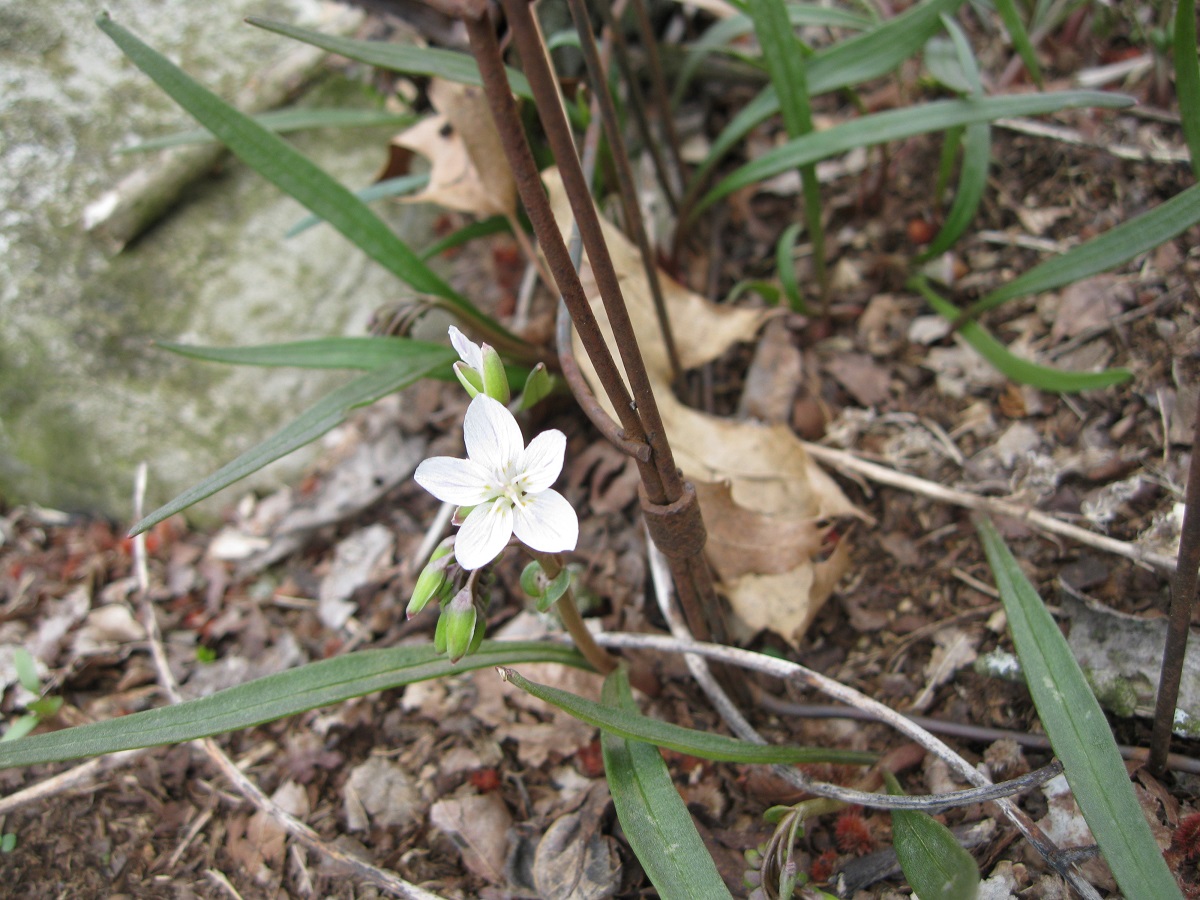
This Spring beauty also opened its first flower here today.  It shares a protective wire cage with the Bloodroot.  That protection may well be responsible for the increase in size of this plant compared with the tiny plant seen here last year.  The corner of the cage can be seen with the plant growing both on he inside and the outside.  Removing the cage now will damage the plant so these plants will remain untended until their growing period comes to an end.  Weeds will undoubtedly be growing here by then.


Three years ago we planted three Sharp lobed hepatica plants in this area of our shade garden.  They are just now making their appearance here.  Many times it takes several years for the transplants of a native plant to settle in.  We were pleased to find all three plants.  Some frost heave had taken place.  We chose to bring in new soil rather than resetting the plants.  This seemed less invasive than essentially digging them up and replanting them.  The fallen tree leaf mulch was reground last Fall.  Is it possible for a plant to look happy?


The remainder of today's pictures were taken today at Irma's woods.  We have been making daily trips here except for being trapped at home by the recent storm.  These plants displayed buds before the storm but some were open yesterday.  That these flowers are short lived can be seen by the condition of the flower in the upper right corner of the photo.  Despite being in only its second day open, both the pollen and some of the petals are gone.  It does not take much of a wind to dislodge these flower parts.  Neither ours at home or these plants show any sign of the unfurled leaf that will be soon be seen under the open flower.


These five plants are freshly opened today.  That can be said with certainty because  we found this quintet days ago and have been making daily visits here.  The color of these flowers is pure despite their rather small appearance this year.  Last year was hard on these plants and that may be the cause of the smaller than normal amount of visible plant.  Larger and taller is how they are usually seen.


These Sharp lobed hepatica plants have been growing here undisturbed for many years.  This is without question an impressive display.


Here are today's two stars side by side.
 

Thursday, April 21, 2022

After The Storm


We were well informed that a massive storm was heading our way but we did not call for an early  propane delivery.  Our power was out for twenty-four hours and the generator did its job leaving us with some propane.  The power just went out again.  NYSEG plans to have the power back on by eleven PM Friday.  Today is Wednesday.  This could be close.

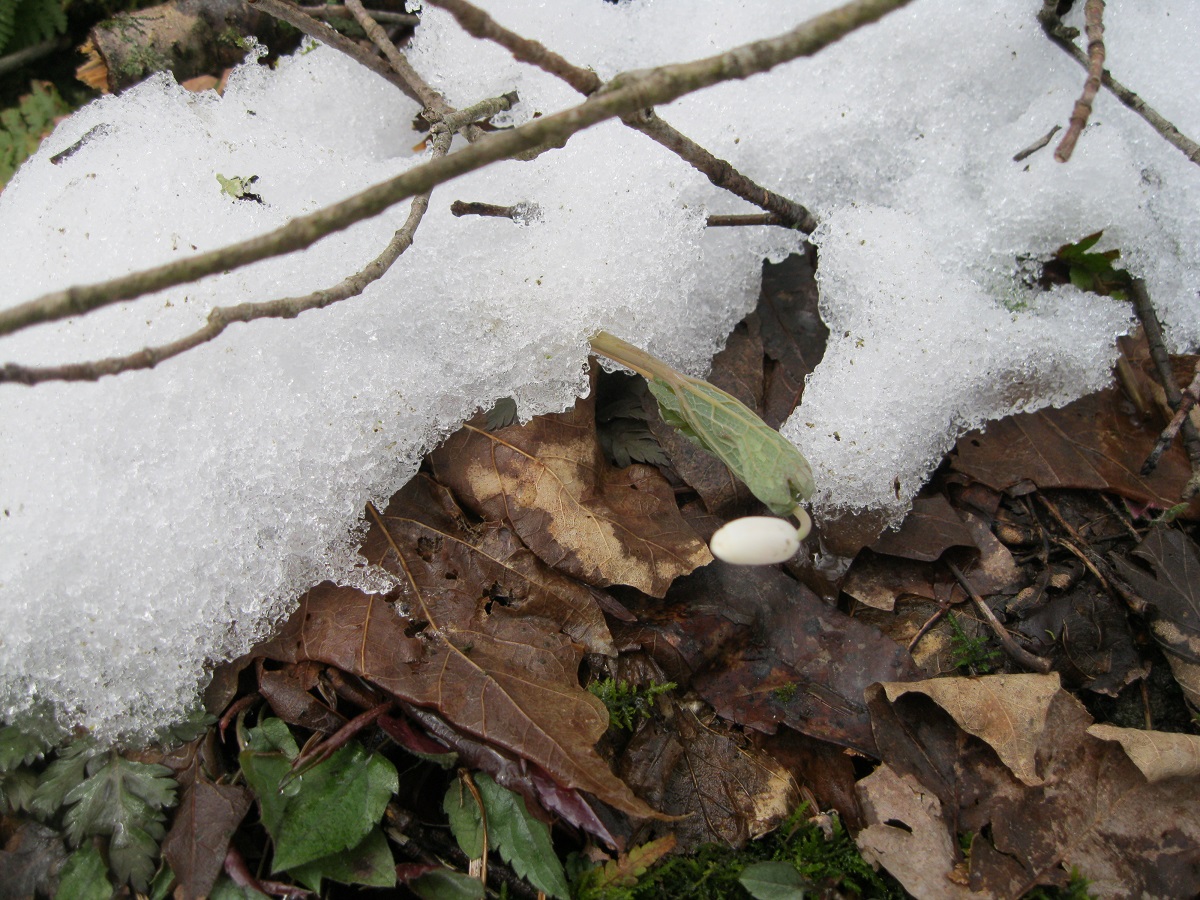
Another trip to Irma's woods was made.  Snow was still covering the ground but flowers were found.  This bloodroot still tightly wrapped by its protective leaf is visible because of the adjacent vertical stone.  It looks like it will survive the storm in fine shape.


This bloodroot has partially exposed its flower bud past the protective leaf but the snow has bent it.  We will wait to see if it is simply bent or actually broken.


The moss covering the stone provides an attractive background for the three lobed liver colored  hepatica leaf.  The white wood chip between the closed flower and the leaf is likely from one of the storm broken tree branches.  Many of the breaks occurred high up in the trees leaving long white scars on the remaining branches.


A Sharp-lobed Hepatica flower stem and the partially hidden leaf in the lower right hand corner of the picture are familiar.  However, it seems that we frequently encounter plant parts whose identity is not known to us.  The bright green leaves in the center of the photo is today's puzzle. 


Once again a moss covered stone edge reveals a sheltered plant.  Foam flower is frequently seen in our woods.  Long lasting leaves provide this glimpse of beauty for most of the summer.


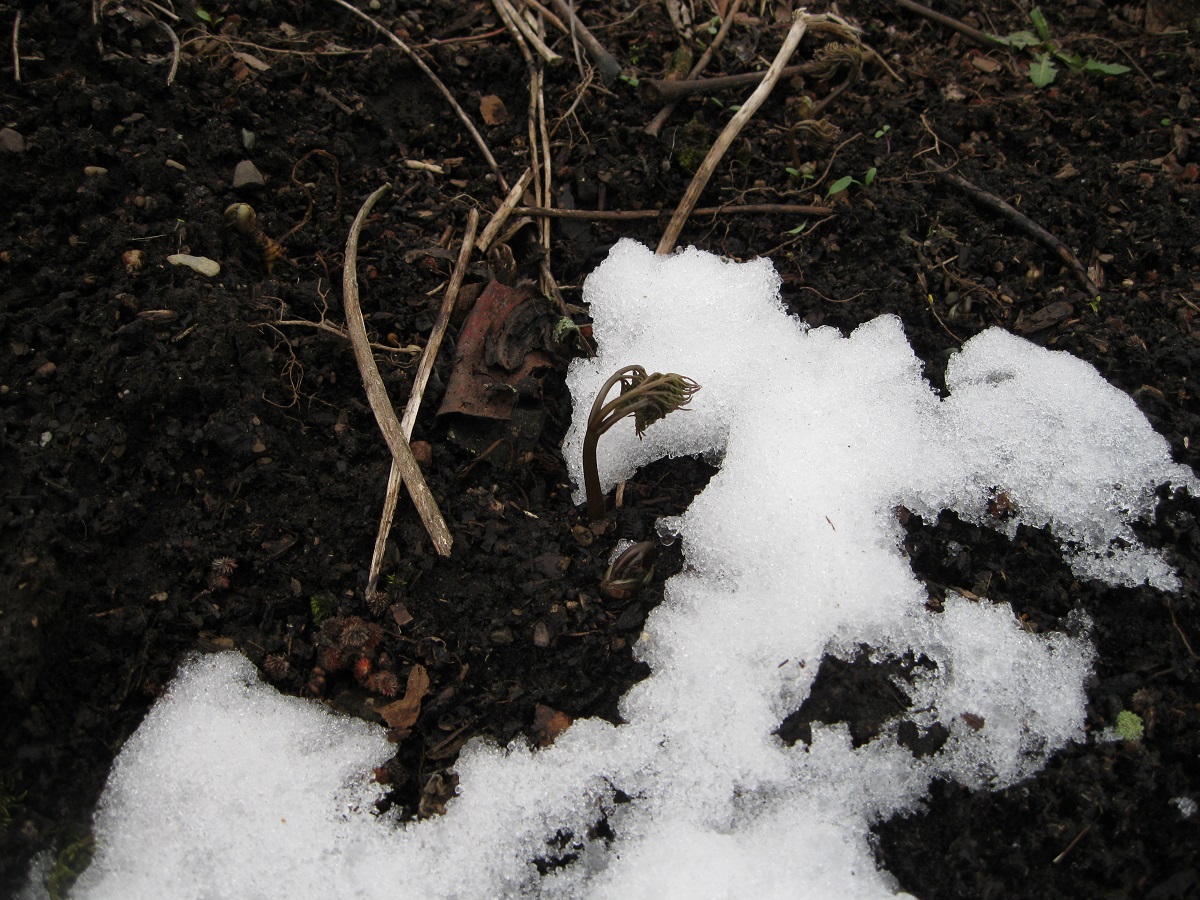
Back in our shade garden, the Black cohosh the was a gift from Jane has made an appearance.  No storm damage is visible at this time.  Many more shoots will soon be seen guaranteeing its survival.


This Lungwort is not native but was given to us by a Unadilla neighbor.  Its two color flowers and speckled leaves create an early visual treat.  The plant is somewhat invasive but is easily kept in bounds.


This is a long looked for treat.  Last year this ground next to our Bloodroot planting produced new plants from seed.  The parent plants had a difficult summer and have yet to make much of an appearance while these three emerging plants look ready to go.


This Summer sweet bush was flattened to the ground by the heavy wet snow as is evident by the bare ground.  I passed close by this plant several times as I made my way to the propane tank to see how its supply was holding up.  Shaking the snow from the bent branches might have helped but it also could have broken branches.  Sometimes doing nothing is a wise course to follow. 
 

Friday, April 15, 2022

Another Visit To Irma's Woods


Last night was clear and cold.  The gravitational pull of the full moon was a factor in the frost that formed.  Today is also clear and cold so a trip to Irma's Woods seemed like a productive way to spend the morning.  A normal person would likely see the ground covered with fallen tree leaves in this photo.  A close look may reveal two deep purple plant stems and possibly flower buds.  Our resident expert strongly believes that she has found Blue Cohosh plants pushing their way above the ground.


This is today's unknown plant.  We will see how much time and additional growth will be necessary for our resident expert to identify this one.


Why is there another photo of Sharp-lobed hepatica here?  This plants sports blossoms with twelve petals but frequently fewer petals are seen.  Just to the left of the center flower, a leaf grown last year rises above the forest floor.  Having seen the first one it is likely that several more will be found.  The moss covered stone adds interest to this scene.


The first common Trillium to appear here sports a red flower and goes by the local name Stinking Benjamin.  Trillium erectum is its proper name but its use for this plant remains a mystery.  This plant is located at some distance from the road but we used zoom not trespass to take this picture.


Memory has it that at one point in his career, John Burrroughs built a shed atop a larger and more level bedrock stone in his woods.  There it served as his writing studio.  I certainly understand the attraction of such an arrangement and have always admired this hunk of stone.  Burroughs also camped in the shadow of a similar stone at the top of Slide Mountain.  Were these woods mine, I would certainly be a frequent visitor near this stone.


This picture will also need clues to find the reason it was taken.  It has always taken Becky a long while to actually walk alongside of any road.  She is actively looking at things that I miss.  Today she saw a pollinator working Hepatica flowers.  By the time the camera was removed from its case, the insect had moved on.  It was found resting on a leaf in the center of the picture.  It is the size of a fly but can hover while feeding using rapid wingbeats.  By myself I would have never seen it.


Good fortune had it return to the flowers.  The large blossom in the upper left displays a dark spot that is actually the active pollinator.


Last year was difficult for both the Bloodroot plants in our garden and these restricted to a small section of Irma's Woods.  It was questionable whether either  would return.  Several tightly wrapped white blossoms were pushed from the soil this morning.  Tomorrow we will return to see both the open flowers and unfurled leaves.  Their time open is limited to just a few days so we will definitely return tomorrow.  So far our plants have made no appearance.  We did have several appear from seeds last year and anxiously await for any sign that any of these plants remain alive. 

Wednesday, April 1, 2020

April First Native Flowers


For some time we have been considering which native flower opens first.  It does not require a close look to spot these brazen yellow blossoms commonly seen in roadside ditches.  Note the complete lack of leaves which will appear later.  Coltsfoot cannot be in the running for first native flower since it is an European immigrant.


Eagerness to spot early flowers must be tempered with some reason.  Here the leaves are clearly Partridge berry but the flowers are Hepatica.  This presentation brings to mind a favorite story told by our elderly neighbor,  He saw an Arbutus plant apparently bearing purple flowers.  No one will suggest that what he actually saw was Hepatica growing close to Arbutus.  I intend to plant Hepatica close by one of my Arbutus plants in his honor.


Sharp lobed Hepatica presents blossoms of various colors and different petal counts.  This example bears eleven petals each colored a beautiful light violet.  It took me years to appreciate these first native flowers since early garden work kept me from wandering in the woods.


This nearby plant bears only six petals colored a near white blue.  In these woods Sharp lobed Hepatica is the first native plant to present flowers.


This Spring Beauty came in a close second.  Its bud will soon open revealing another early treasure.  Its growth habit makes transplantation nearly impossible.  From a pea sized corm a slender underground shoot travels a considerable distance before sending up its above ground leaves and flowers.  Removing a plant intact is highly unlikely.  As the plant is ending its growth cycle, following the then nearly dead underground shoot back to the corm is no simple task.  These plants grow wild in our back woods but are absent from our wildflower gardens.


Six lightly colored petals presented themselves above the jumble that is characteristic of natural forest floor.  We were unable to find any sign of Bloodroot plants today.  They will appear soon in this location but lost the race for first flower.

Mention must be made of the justification for leaving  the house during these trying times.  Just across the valley from our home is a bedrock ridge that slopes to the south.  Flowers appear first here in response to earlier warming.  Our walk took us along the dirt road that crosses this ridge.  We encountered no road traffic and saw no bikers or hikers while there.  Our outside time here endangered no one.  The land where all of these pictures were taken still carries tattered or fallen  posted signs bearing the name Haller.  A long ago phone call identified the land owner as Irma Haller.  We both taught at the Sidney Junior High School for its last decade of service.  My call was placed in an attempt to gain permission to explore these woods.  What I got was a sincere thank you for respecting her posted signs.  Becky and I frequently walk on this road while looking for flowers.  While there memories of Mrs. Haller always cross my mind.  In keeping with her high standards of expected behavior, we still respect the signs even though Mrs. Haller passed several years ago.

Saturday, March 28, 2020

Searching For Signs Of Spring


Yesterday morning Ed and I worked together at cleaning up the  bed down by the road.  We made a very small dent in what needs to be done. We were hoping to work until the mail was delivered but in a relatively short period of time our hands were throbbing.  Ed loaded the tools and our garden carts into the back of the truck and  we headed back up the hill to the warm house.  We decided then that we would take a trip over to Irma's woods to see if we could find some signs of Spring.

 Ed wanted to go right after lunch.  One of the really wonderful things about Irma's woods is that it is on a slope  with sunlight filtering through the trees.  You can see a lot of wildflowers without leaving the comfort of your vehicle,  Usually when we go to Irma's woods we take the truck and drive by while I try to  watch for  spots of color or groups of plants I can identify.  He was waiting for me in the car when I got outside.  This time to my delight, Ed parked the car and shut it off.  We both got out to walk  along the road.  First this moss and lichen caught my eye.  After we had walked away from the car I heard something.   I asked Ed if he heard anything and he said no.  Once we spoke the sound stopped.  We walked on searching for signs of Hepatica plants.


Hepatica is one our favorite early wildflowers.  The hairy flower buds are nowhere to be seen yet, but if one looks, last years reddish leaves can be seen.


Sharp lobed Hepatica, Hepatica acutiloba, is a wildflower that is abundant in Irma's woods. Here with the moss background the leaves are unmistakable!


This single Hepatica leaf is surrounded by Ramps also known as wild leeks.  They have just starting to push their way up through the forest floor of dried leaves.  It is March after all and most wildflowers are still hidden under the leaves.


Happy we walked back down the road to the car.  As we got closer, I heard the sounds again.  This time Ed could hear it too.  It was a quacking noise.  Ed was looking for ducks.  I was looking for frogs!  Following the sound Ed went far enough up the bank that he was able to see many small Duck frogs diving under the surface in a small vernal pool of water. They were so fast there was no time to get a picture.   It is not every day that someone who is 75 discovers something new he has never seen before.  Today it is raining but we took another quick trip over to Irma's woods to get a picture of the pool of water.  I think a little rain is exactly what is needed here!

Friday, May 4, 2018

Early May Wildflowers


The plant killing horrors of this year's March weather have been replaced with numerous native ephemeral treasures carrying out their spring life cycle.  This photo shows several stages of Blood-root flowers.  Upper left finds an older flower beginning to drop its petals.  Upper right shows a newly opened blossom.  Center left contains a mature bloom that has lost nearly all of its yellow pollen.  Center right has a perfect flower.  Lower left displays a young seed pod against the backdrop of a leaf.  Drought took Blood-root flowers from my garden while they flourish in Irma's woods. Our order of new plants will be here any day now.  The new woodland garden down by the road is waiting!


These early Arbutus flowers will soon be joined by many others that are still closed buds.  Transplanted on our land several years ago, these flowers are highly prized.  The major allure here is their scent.  The good news is that we can still stand up after dropping to the ground to draw in the memorable aroma.  The native stone was placed to support the protective wire cage that is the reason these plants still flourish.  Being evergreen carries some risks.  Rabbits devour unprotected Arbutus plants when the snow first begins to melt.  Insects ate the only partially destroyed leaves.


Irma's woods lie on a south facing sloped bedrock ridge.  The concentrated warmth of the sun there has these Trout Lilies at their height of bloom.  Our plants are just beginning to release their buds from the tightly wrapped leaves that safely carried them through several inches of forest soil.  Soon we will find similar flowers closer to home.


The steeply sloped roadside bank revealed flowers that we have never before seen.  Wild Ginger keeps its flowers hidden from sight close to the ground.  Looking uphill we finally got to see these flowers.  Flies are the pollinating agent so these flower's scent is much like rotting mouse meat.  We passed on a chance to sample that odor.  At home, our transplants have yet to open their tightly closed leaves.  The pictured leaves will soon be much larger hiding the flowers from prying eyes.


Here we see a single Spring Beauty flower behind a row of Hepatica flowers.  It is uncommon for the digital camera to capture the color of a Spring Beauty flower.  Usually all that is seen is white.  Most of the leaves in this picture are Ramps. Sharp-lobed  Hepatica flowers precede their leaves which can be seen here just beginning to unfurl to the right of the Spring Beauty flower.


These freshly opened Hepatica flowers show both their blue petals and white pollen.  Opening leaves surround the flower petals in three places.  Apparently, younger plants have fewer leaves with blue coloration.


Several of these multi-flowered stunning Sharp-lobed Hepatica plants occur singly across the roadside bank.  Their bright pure white color stands out in sharp contrast to the dull brown of decaying fallen tree leaves.  It is possible that older plants have many more flowers.  Some of these larger plants were growing up through the mud filled ditch at road's edge.  I really wanted to dig them up and give them a proper home.  Responsible reason prevailed and they remain where nature planted them.


This is the more common coloration of Spring Beauty flower pictures.  The camera misses nearly all of the delightful pink color. The plant in the upper left corner of the picture shows off  the plant's small  green  leaves.


This is the promise of more to come.  This white Trillium was fall planted in our new woodland garden.  Flower buds can be seen on this newly emerged plant.  It looks like two flowers will appear here during this plants first year with us.  We will need to return to Irma's woods as the Trillium there have yet to open their flowers.  Recent logging will have severely reduced the vast number of plants there but the opening of the forest canopy will aid in their return.

We found our spirits lifted by these early flowers.  Decline that accompanies age is making working in the dirt more difficult for us.  That reality may have heightened our pleasure in finding these flowering plants existing totally on their own.  Many more will follow as the month unfolds and we will try to see them all.  Their allotted time each year is short but they make the most of each day.  We will try to do the same.