Showing posts with label moss. Show all posts

Friday, March 5, 2021

Spring In 15


This winter has held its first snowfall on the ground right up to today.  The only soil that we have seen is the many time plowed driveway.  The sun is steadily climbing higher in the sky and its warmth is now sufficient to melt lane ice despite the still frozen ground.  We placed the long wall of the house facing south.  It is massive and white and both plants and soil are in view here as a result of reflected heat.

Rose Campion is a European native.  It prefers poor stony ground to carefully enriched garden soil.  Here it has seeded itself in the stone paths adjacent to garden beds where it spreads impressively.  Move it to rich garden soil and it will flower once then vanish.  Its bright purple flowers look great next to its whiteish green leaves.


We are not in agreement as to the identity of these plants.  Daylilies usually form large dense clumps but these plants grow in the shade of a Rose of Sharon tree.  Whatever they are, we welcome them.  They remain green despite temperatures in the mid twenties.


These green leaves may well be Coral Bells that are native to Arizona perhaps in the high country.  They are green and ready to grow and will soon be weeded and mulched.  Moss growing on stone walls looks great also.


These Sweet Williams look like they are suffering but are clearly alive.  My mood has brightened just with the idea that working among the plants will soon be possible.


This bright green belongs to my arch enemy Quack Grass.  Despite our decades long battle, this plant will quickly take over my gardens when I am no longer able to kneel on the ground to remove it.  Still, its early growth is bright, green and strong.


These Iris were a gift from Jane.  Sadly she is no longer with us but many of her plants and wall stones remain.  Royal purple will be the color of this plants huge blossoms.  Early division and replanting will help us maintain this treasure.  Of course, clearing last season's leaves will soon happen.  We believe that the insulation provided by last seasons leaves helps the plant survive winter.


 If anyone needs to mark the location of their septic tank, now is the time.  No close placement to basement walls melted this snow.  An underground organic heat source did that job.  That strange dark shape in the foreground is the end of a low stone wall.  Sunlight and heat absorbing stone melted some snow here.

Saturday, March 28, 2020

Driven Inside Early


We were outside early intending to complete some garden cleanup ahead of the promised rain.  Unaware that the temperature was a mere 36 degrees, cold hands soon ended that activity.  Riding about in the warmth of the truck took us up the lane and onto the back meadow.  Stopping near the Arbutus patch, we quickly spotted a ruffled grouse.  Usually they are seen scurrying away from us.  This one instantly spotted us but decided to wait while we passed.  This is the first picture that we have ever taken of this elusive bird.  As is usually the case, flight soon followed.


Passing close to the garlic planting revealed that nearly every planted clove was sending up new growth.  Our battle with root rot seems to have been finally won.  We continue to peel every clove before planting in order to remove the occasional infected clove.  A vodka soak follows.  This is time consuming but we simply must not reinfect our ground.


Becky discovered this unknown to her plant growing on the root mass of an upended tree.  We have spent 25 years walking on this land and I was certain that she had identified every plant growing here with the exception of the ferns and mosses.  She is presently searching her books but some time for the plant to present its summer growth may be needed before this plant is identified.


This body of water was impounded before this land became ours.  A group of horses spent their summers here and this was their water supply.  Glacial till was dropped here and the bedrock ridge hidden behind the trees disappeared into it.  Several springs drain onto the flat surface leaving the uneven ground wet in places.  All of this water seeps into the gravel soil left behind by the glacier before lower ground seen in the distance can be reached.  Later in the year wet feet sometimes result when I try to move into the forested ridge from the meadow.


All of these downed trees fell on our watch.  When we first came to this land it was possible to step from the dam across water to the ridge soil at he base of a now fallen tree.  Walking among these trees while so close to the impounded water was a thrilling experience for us.  That wonder has been replaced by a jumble of uprooted trees.  The thinness of their root masses show that these trees were growing close to the ridge bedrock.  Solid footing was simply not available here.

Searching For Signs Of Spring


Yesterday morning Ed and I worked together at cleaning up the  bed down by the road.  We made a very small dent in what needs to be done. We were hoping to work until the mail was delivered but in a relatively short period of time our hands were throbbing.  Ed loaded the tools and our garden carts into the back of the truck and  we headed back up the hill to the warm house.  We decided then that we would take a trip over to Irma's woods to see if we could find some signs of Spring.

 Ed wanted to go right after lunch.  One of the really wonderful things about Irma's woods is that it is on a slope  with sunlight filtering through the trees.  You can see a lot of wildflowers without leaving the comfort of your vehicle,  Usually when we go to Irma's woods we take the truck and drive by while I try to  watch for  spots of color or groups of plants I can identify.  He was waiting for me in the car when I got outside.  This time to my delight, Ed parked the car and shut it off.  We both got out to walk  along the road.  First this moss and lichen caught my eye.  After we had walked away from the car I heard something.   I asked Ed if he heard anything and he said no.  Once we spoke the sound stopped.  We walked on searching for signs of Hepatica plants.


Hepatica is one our favorite early wildflowers.  The hairy flower buds are nowhere to be seen yet, but if one looks, last years reddish leaves can be seen.


Sharp lobed Hepatica, Hepatica acutiloba, is a wildflower that is abundant in Irma's woods. Here with the moss background the leaves are unmistakable!


This single Hepatica leaf is surrounded by Ramps also known as wild leeks.  They have just starting to push their way up through the forest floor of dried leaves.  It is March after all and most wildflowers are still hidden under the leaves.


Happy we walked back down the road to the car.  As we got closer, I heard the sounds again.  This time Ed could hear it too.  It was a quacking noise.  Ed was looking for ducks.  I was looking for frogs!  Following the sound Ed went far enough up the bank that he was able to see many small Duck frogs diving under the surface in a small vernal pool of water. They were so fast there was no time to get a picture.   It is not every day that someone who is 75 discovers something new he has never seen before.  Today it is raining but we took another quick trip over to Irma's woods to get a picture of the pool of water.  I think a little rain is exactly what is needed here!

Sunday, March 8, 2020

Desperate For Plant Growth


At this time of year snow remains in the shadow of the kame terrace.  Open to full sun, these Snow Drops are the first plants to open flowers here.  These have remained tightly closed buds for days but today's warmth tickled them into opening.  We tend to prefer native plants but these early pure white flowers hold ground in several locations here.


Yellow Aconite is another nonnative that is here because its flowers appear early.  This display appears pitifully small but we know that many more blossoms will quickly follow these.


A recent heavy snowfall that included an ice layer brought down several mature Sumac trees.  Fortunately these old guys were growing on unused ground so they represent nothing more than a mess that needs to be cleaned up.  Working slowly and carefully, an embarrassing large number of days were used to tidy up.  These moss growths on a fallen trunk are attractive.  We will find a way to move then to the shade garden down near the road.  A wood chisel and hammer might result in movable chunks.  We do not know the name of this unique moss since moss names tend to involve a huge number of letters.  If we knew Latin the proper name might translate into Moss Balls.


Another fallen tree trunk is home to this interesting growth.  Here again the name is unknown to us but we do know that this growth wildly responds to moisture.  Even a very cold rain will push this plant to enlarge and open its then reddish pink reproductive organs.  That display is usually brief unless it rains for several days.  In any event that display always impresses.

We are working outside for rather short periods of time.  Cold air and ground quickly turns old hands white but we return after a cup of something hot to drink.

Sunday, March 31, 2019

Finally Seeing What Has Always Been There


This last day of March has been a disappointment.  With rain in the cold air, we have largely resisted the temptation to work in the garden. While we were out there, protective cages were placed over emerging plants to keep the deer away.  Because we hunger for early color in the garden, these Winter Aconites hold a prominent spot in our shade garden despite their nonnative origin.  So far our deer have shown no interest in these early plants.  Cold rain is pulling many plants to finally appear above the soil.


This Hemlock tree fell across the lane two decades ago.  Our neighbor at the time had a camping trailer where a house now stands.  He also had a chain saw and removed the fallen tree.  The pieces of tree were thrown on my side of the right-of-way regardless of the tree's original position.  Now this rotting wood supports a generous growth of moss.  For the past twenty years I have failed to see the beauty that was directly in front of me.  I feel fortunate to have finally really seen these amazing plants.  Soon this rotten wood will be carefully moved to our developing woodland garden.  There it will edge a path intending to keep careless feet from walking on native plants.


A careful look at any of the dead leaves will reveal tiny dark dots.  These are Springtails so named after their means of moving about.  Their rear mounted appendage snaps sending them airborne with absolutely no control over direction.  An enlargement of the photo will reveal their presence everywhere.  They live in moss and can be seen there but they also are on every pictured surface.  We have known about Springtails for many years since their newly emerged bodies fill every foot print left in warming late winter snow with black wiggling specks.


We did drive to the garden near the forest to repair the ties fastening the protective fence to the posts.  The garlic is emerging and fortunately no animals entered the garden through the opening.  While we were back there we did take a drive to have a look around.  A huge section of the meadow adjacent to the bedrock ridge was flooded.  This water does not travel to nearby lower ground but slowly disappears into the thawing deep gravel deposit left by the last glacier.  We found this stone higher up in the woods and moved it to the garden down by the road.  We are finally seeing the beauty on moss and lichen covered rocks.  Previously, I have only seen stones that could be used to build solid walls.  I cannot be bothered with finding their proper moss and lichen names but have become aware of their diversity and tenacious growth habits.  Fortunately we did not miss getting to know and appreciate these ancient life forms.

Tuesday, March 26, 2019

Ticked Off Again!


Honestly all I did yesterday was put on my coat and hat and gloves and walk around taking a few pictures.  It was pretty cold out.  There is still lots of snow to be found.  Very few plants are showing growth.  My pink Trout Lilies and a chickweed shown above are definitely the exception to the rule.


I stopped and took a few moss pictures.  The one above is called Moss Falls and Sumac Balls.  Poetic isn't it?  I'm a poet and don't know it.  I rhyme all the time.


I snapped this cool lichen picture too.  When I started to  get cold I came inside.  It was all so much fun who would have thought that I would be so ticked off this morning?  Certainly not I!  When I got up and looked in the mirror I couldn't believe my eyes.  Right there where I could see it, just about where you put your hand to say the Pledge of Allegiance was a tick.  Now I am careful about wearing light colors, tucking my pants into my socks and using some kind of repellent when I walk in the garden.   I thought it was too early and too cold.  Duh!  Now the tick is gone, removed, annihilated but my disgust lingers on.  I'l be watching that sore spot for any signs of trouble.  I'll be going back out there, but today I am so ticked off again!

Sunday, March 10, 2019

Truly No Care Gardening


My standard gardening fantasy involves no work required to have beautiful plants.  Many books have been written and perhaps small fortunes made describing how to grow flowers with little effort expended.  For years we have been growing way more plants than we can respectfully care for and have just now discovered green beauty growing and reproducing here without any help from us.

This wall cap stone has both lichens and moss growing on it.  Names have been assigned to these natural wonders but the labels have altogether way too many letters and microscopic examination is needed to correctly make identifications.  We have settled on two names.  Lichens in this photo are flat whitish gray objects.  Mosses have thickness and are green.  Some of these pictured mosses are visually different from the others and likely have individual proper names.


Despite just having been released from the snow cover, this moss has sent up the structures that conventional gardeners would call seed heads.  Mossers, properly labeled bryologists,  call them capsules and more words are added to describe their unique forms.  These are clearly not droopers but here is where the microscope is needed.  Seed is not the proper name for the reproductive  part but spore might be correct.  This moss was recently covered with snow but  some liquid moisture and daylight have moved this moss to procreate now.


This moss resembles our native giant salamander known locally as Hellbender.  The white beads to the right may be this mosses fruiting body.  We will look here again tomorrow to see any changes that might follow.


This clump is a total mystery.  What looks like a group of dead sticks reveals individual depressed tip circles that certainly look like they served some useful purpose.  We cannot be certain that these are growing from moss.  The nearby out of focus red moss certainly catches the eye.


We are quite sure that this multicolored growth on a dead stick is neither moss nor lichen.  It may be a mushroom.  We have no plans to explore the effects following drying and smoking this little beauty.  We prefer functioning kidneys.


This destroys our claim of having discovered no effort gardening.  Weeds and desired flowering plants are growing with this moss.  The flat green blades belong to Blue Eyed Grass, a wonderful plant in its own right.  The oval leaves mark an unknown weed that will require the use of tweezers for its removal.  Clearly we have been denied entrance to our gardens for far too long.  We really need to place our gloved hands into some thawed ground soon.

Friday, February 8, 2019

Is Anybody Home?


After warm temperatures and last night's rain, much of our snow has melted.   It was so nice we just had to go outside in search of moss and adventure.   By tonight we will be back to winter weather.
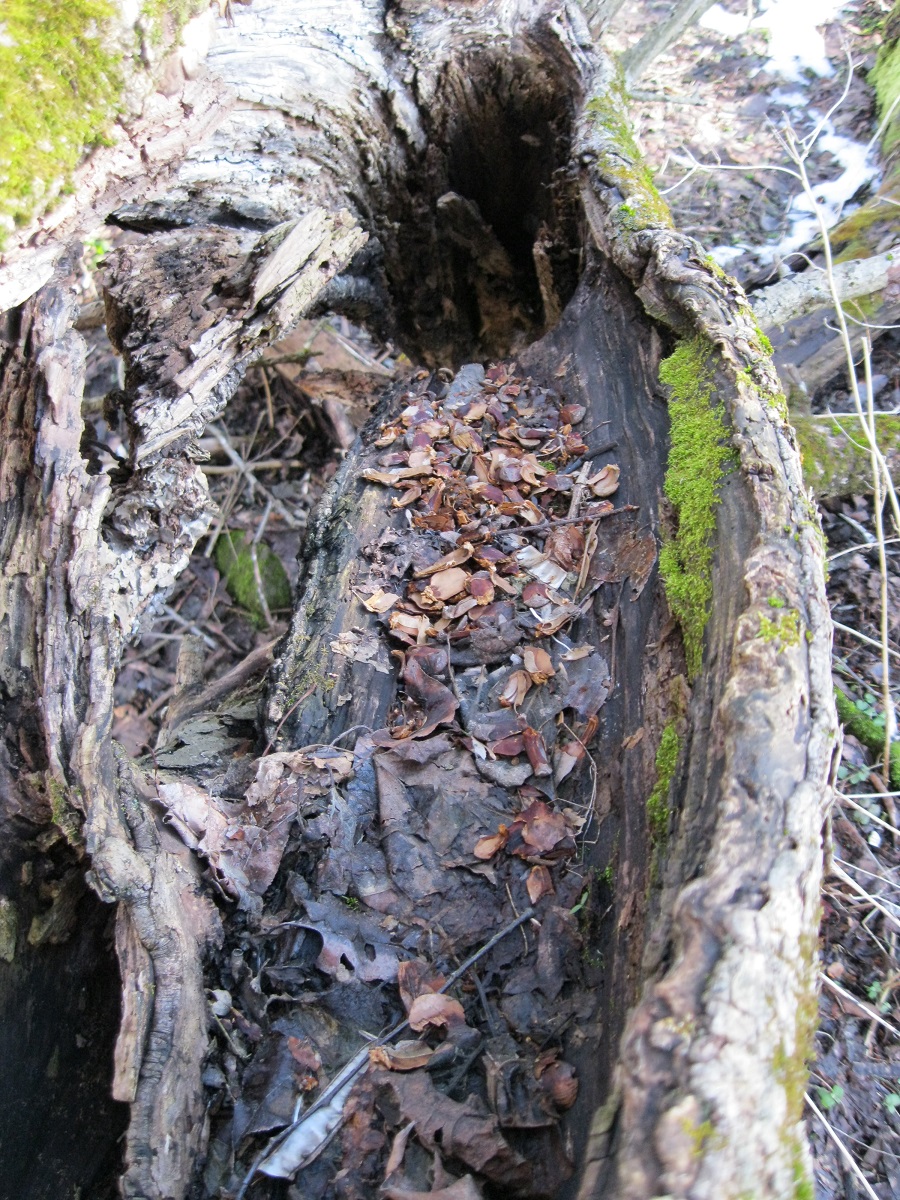
What could be more fun to explore than the fallen remains of an ancient apple tree.  I could see moss from a distance so I climbed up the slight incline to take a closer look.


The base of the tree had lots of green moss, but I was immediately drawn to the moss surrounding this hole.   Anyone who has seen movies knows that it can be dangerous to stick an appendage into a dark hole.  These remains of a long ago broken branch might be similar to what inspired Disney artists.


I peered into the hole and could see that it was empty.  The opening was exactly the right size for my index finger.  I couldn't resist calling Ed over so I could show him the hole in the tree.  Of course I stuck my finger in the hole and pulled it out quickly as if I had been bitten just so that he could see it.  We really know how to have fun like a couple of kids in the woods!


Ed was able to get this photo taking advantage of his height. From that vantage point you can see the inside and outside of that hole.  Light entering the well rotted trunk from the end makes the interior visible.


Judging from the remnants of pine cones in the log, I think it's safe to say that sometimes a squirrel calls this old tree home.  Lucky for me he was out scampering about in the woods looking for  nuts elsewhere when my finger entered the nearby hole.  The wind picked up sending a chill down my spine and reminded me that it is still February. Ed and I  were ready to head for the warm house.  At our age it's best if we don't have too much fun in the woods.

Wednesday, February 6, 2019

February Walkabout


Prior to the polar blast, large amounts of water were present in the soil or driveway.  Ice like never before seen here made walking dangerous.  My lawn tractor fitted with a snow plow could not make it back up the hill without moving back and forth across the slope plowing nothing.  The pros were summoned and opened a path to the road.  Unseasonably warm days finally cleared the ice from the gravel road and we can now safely walk on a squishy surface.

When daughter Amy first went to NYC to live and work, she spent considerable time in botanic gardens there.  One grassy slope was home to a large number of Magnolia trees.  When their flowers were open, Amy would stretch out on the lawn and look up at the flowers against a sky background.  We were able to keep a northern variety alive but few flowers were ever seen.  We knew that this tree formed its flower buds in the fall and that winter starved deer would feast on flower buds.  This year a longer fence was placed that has so far kept a large number of buds safe.  The worn fence is truly ugly but easily removed.  We are looking forward to a massive display of favorite flowers soon.


We knew little about moss before we were directed to Robin Wall Kimmerer's book about moss.  Now we know just enough to gaze in wonder at plants that quickly come back from appearing dead following exposure to some light and water.  This rock is about the size of a bowling ball and new moss is growing from numerous dings and cracks on the surface.  We do not know the names of any mosses but this growth resembles carpet in texture.  A book has been ordered that will assist in finding names for these plants.  Soon we will be able to attach names containing way too many letters to these wonderful plants.


Any winter walk near exposed ground must detour to an Arbutus planting.  These two plants are the last that we moved and their growth habit is somewhat sparse since they were planted in deep dirt free soil consisting of mostly rotted pine needles.  If these plants were not protected by wire, rabbits would have eaten them clear to the ground by now.  With our help flowers will appear in the not to distant future.  I can remember how they will smell.


This stone is smaller than a breadbox and was moved to our developing shade garden from the back woods.  We were fearful that the move might kill the moss.  Moss peels easily from stone so we were careful handling it.  We now know that moss will dry out and appear dead but quickly revive if watered.  Robin Wlll Kimmerer described taking a boxed specimen out of a closet.  After opening the box to allow light to strike the surface of the moss and a generous watering, the moss quickly turned green and resumed its life.  The lower left corner shows differently appearing growth which might mark the return of reproductive function following recent time locked in snow and ice.


I walked up the hill to a spot where Partridge Berry flourishes.  The moss covered rock was an unexpected bonus.  Partridge Berry will be moved to our developing shade garden.  It transplants easily and appears not to be on the rabbit's menu.  Initially it will receive a wire cage cover.


This flat rock appears to be home for several different mosses.  Time spent with a magnifying glass will aid in identification.  Four different mosses may call this stone home.  The really great news is that I was able to stand up after kneeling on the ground to snap this picture.  My move was not graceful nor did I cry out in pain.  Cannot wait for warmer weather.

Tuesday, February 5, 2019

My Latest Obsession: Moss and Lichens


I can become incredibly absorbed in some things very easily.  Plants have been a fascination for me for  years.  Recently, while all of my garden plants were buried under the snow,  a  blogging friend suggested  I read Gathering Moss: A Natural and Cultural History of Mosses by Robin Wall Kimmerer.  I did.  It captured my imagination and I have been impatiently waiting for the ice and snow to retreat and reveal some moss for me.  Finally the snow level dropped below the bottom rail on Ed's split rail Locust fence.  Here I think lichens outnumber mosses.  Still wet from snow melt the lichens expand to show their colors.


I leaned over the snow bank and got as close as I could.  I had been reading about the amazing tiny world of moss and I wanted to see it for myself but little was above the snow.   When the snow is gone I want to see if there are tiny little springtails living in the moss.  I wanted to see it now  but  there is still too much snow to kneel down and look at it with a loupe. 


Another spot to the East on that same rail has just a small lichen and lots of moss. Is it one kind of moss that has more than one growth habit or more than one kind?  It seems that there are at least two completely different types of stems and leaves.  In the moss world stems and leaves are not the correct words but they do describe where I am looking.


Here is a little closer look.  I might get closer still, but not until the ice and snow has receded.  Before I go down to the ground I like to be able to at least have some chance to get up by myself!  I wonder if the two stalks that resemble miniature cattails are actively producing reproductive cells at this time.  Who knew there was so much going on in the moss?

Wednesday, January 2, 2019

Focus On Some Plants


Yes, it is only January 2nd and some of us are already raring to go.  This tiny little moss bump on an apple tree branch has a nice little start.  Despite the weather realities of January in New York, both the moss and the lichen are actively growing.  The moss ball is doing a nice job of covering evidence of a deer pruned branch.  The presence of the lichen may be a sign that the tree is under attack and will die.


Ingeborg is responsible for the existence of Hazelnuts in our garden.  Our first plant was a gift from her.  This second one was purchased to guarantee that two different plants were here so that pollination would occur.  When the gift tree was delivered, the suggested growth habit of an untrimmed bush rather than a tree with a single trunk was intended to increase the size of the harvest.   Additionally, just letting things grow suits the style of the workman here.


Our foray into gardening several decades ago drew several ladies of years to encourage our efforts with gifts of plants.  This yellow flowered sedum was a gift from Thelma H.  It grows here with weed like tenacity.  We try to limit its growth to the edges of the paths but buckets of it are weeded out every year.  Its yellow colored flowers are a welcome reminder of both Thelma and her impressive garden.  That it is evergreen is a huge bonus.


Coral Bells and Foamflower are related native plants.  Both of them are in the Saxifrage family. When these were purchased we were unaware that Foam flower grows freely in our back woods.   The reddish flowers appear on a thin tall stem providing easy access for hummingbirds.  Attracting hummingbirds and an evergreen growth habit make this plant a winner.  We divide the ever increasing clumps frequently since one can never have too many Coral Bells.


For years the plant Catchfly grew in limited numbers reseeding itself among carefully chosen plants.  It was a gift from Mary Jo and carried on with no help from us. Its flowers are a vibrant pink and a mass of these plants seemed to be in order.  Seed stalks were carefully cut and placed on prepared ground.  A mass of plants resulted.  This patch will provide many plants for placement in other spots.  In addition to the bright flowers, sticky brown rings appear on the stems.  We have no idea how captured flies benefit the plant but that is an interesting bonus.


Foxglove is another plant that makes its own way here.  They freely reseed themselves and some are moved to grow in specific locations.  Several different people provided gifts of this plant.  Its leaves were the original source of the drug digitalis and the leaves are widely recognized as poisonous.  The flowers are attractive and so far no leaves have accidentally appeared in my morning tea.