Showing posts with label foamflower. Show all posts

Thursday, April 21, 2022

After The Storm


We were well informed that a massive storm was heading our way but we did not call for an early  propane delivery.  Our power was out for twenty-four hours and the generator did its job leaving us with some propane.  The power just went out again.  NYSEG plans to have the power back on by eleven PM Friday.  Today is Wednesday.  This could be close.

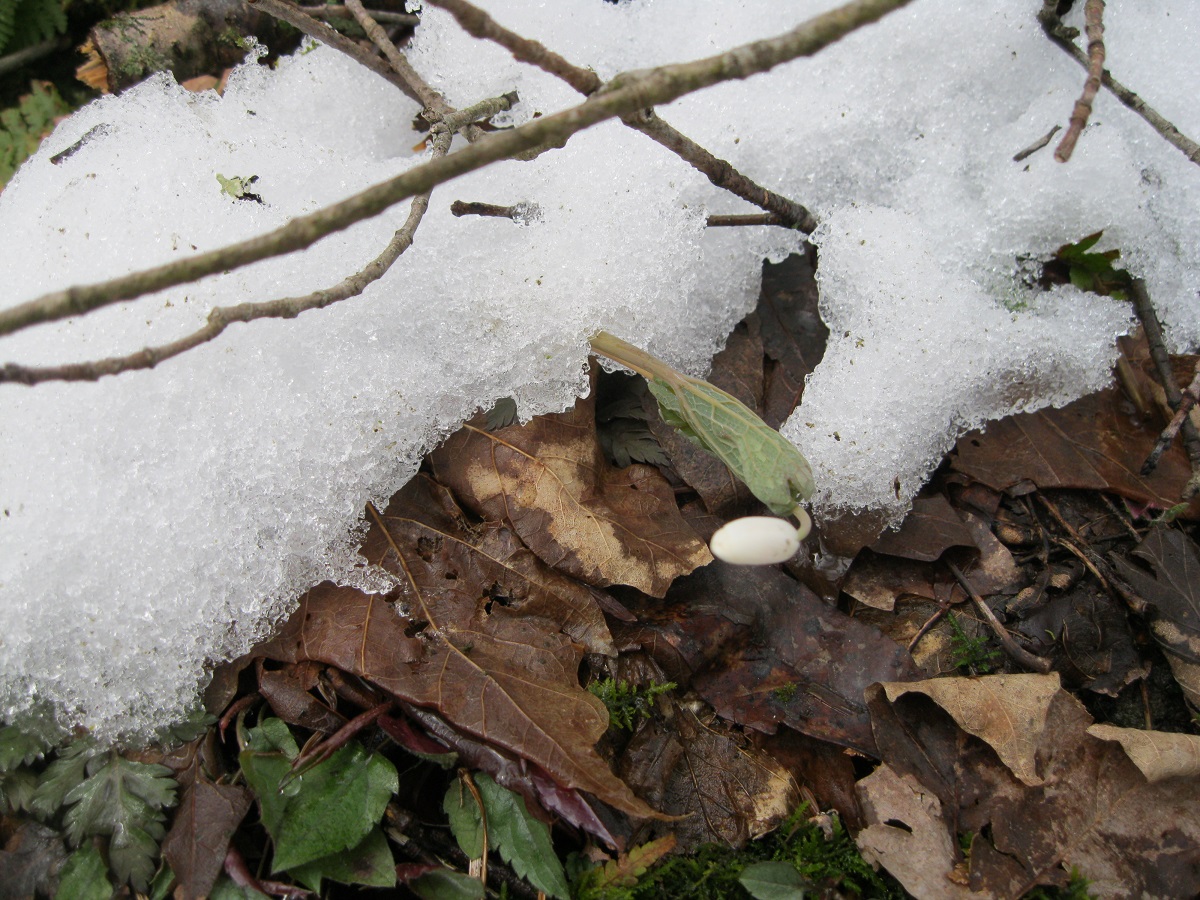
Another trip to Irma's woods was made.  Snow was still covering the ground but flowers were found.  This bloodroot still tightly wrapped by its protective leaf is visible because of the adjacent vertical stone.  It looks like it will survive the storm in fine shape.


This bloodroot has partially exposed its flower bud past the protective leaf but the snow has bent it.  We will wait to see if it is simply bent or actually broken.


The moss covering the stone provides an attractive background for the three lobed liver colored  hepatica leaf.  The white wood chip between the closed flower and the leaf is likely from one of the storm broken tree branches.  Many of the breaks occurred high up in the trees leaving long white scars on the remaining branches.


A Sharp-lobed Hepatica flower stem and the partially hidden leaf in the lower right hand corner of the picture are familiar.  However, it seems that we frequently encounter plant parts whose identity is not known to us.  The bright green leaves in the center of the photo is today's puzzle. 


Once again a moss covered stone edge reveals a sheltered plant.  Foam flower is frequently seen in our woods.  Long lasting leaves provide this glimpse of beauty for most of the summer.


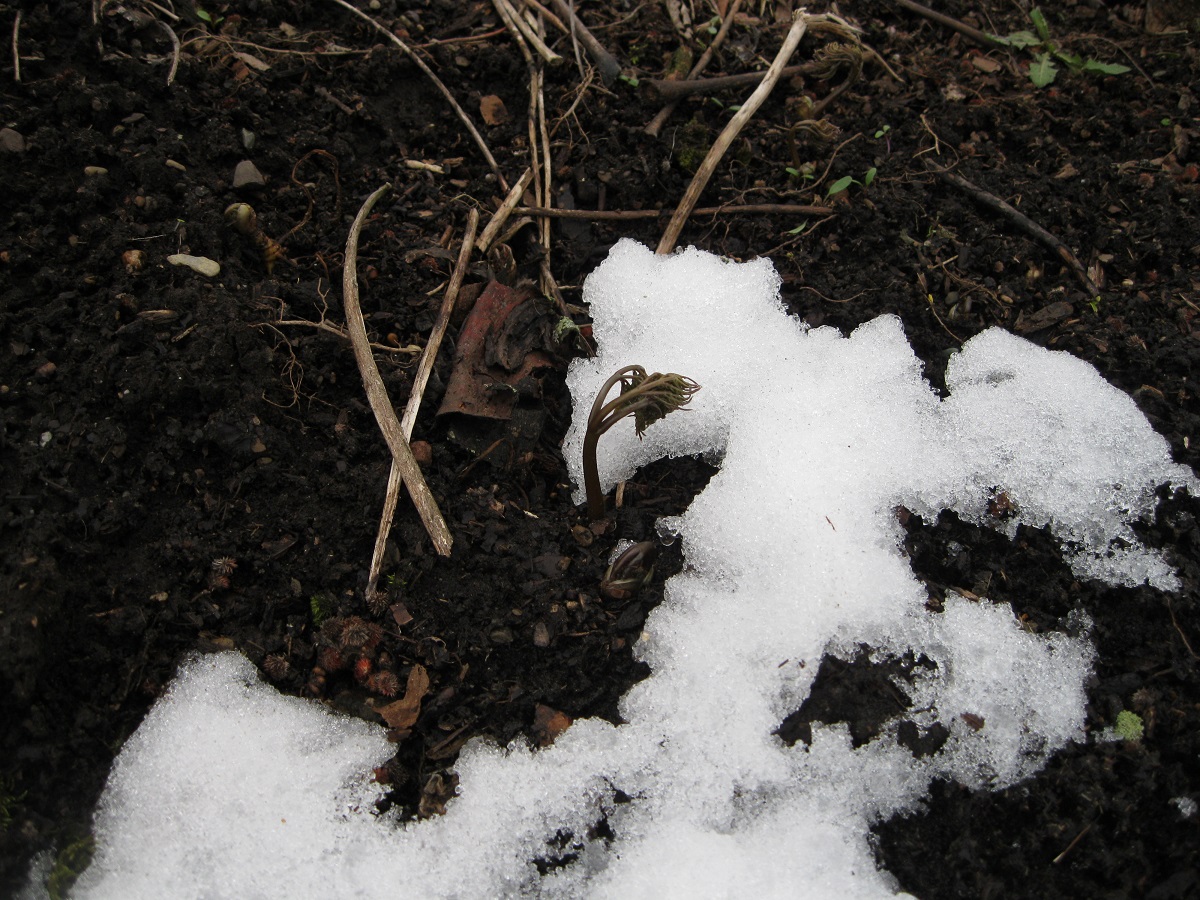
Back in our shade garden, the Black cohosh the was a gift from Jane has made an appearance.  No storm damage is visible at this time.  Many more shoots will soon be seen guaranteeing its survival.


This Lungwort is not native but was given to us by a Unadilla neighbor.  Its two color flowers and speckled leaves create an early visual treat.  The plant is somewhat invasive but is easily kept in bounds.


This is a long looked for treat.  Last year this ground next to our Bloodroot planting produced new plants from seed.  The parent plants had a difficult summer and have yet to make much of an appearance while these three emerging plants look ready to go.


This Summer sweet bush was flattened to the ground by the heavy wet snow as is evident by the bare ground.  I passed close by this plant several times as I made my way to the propane tank to see how its supply was holding up.  Shaking the snow from the bent branches might have helped but it also could have broken branches.  Sometimes doing nothing is a wise course to follow. 
 

Tuesday, May 4, 2021

Another Return To Irma's Woods


Once again the written words of John Burroughs introduced me to a must have plant.  He described a frequently taken detour into the woods while walking to school.  His goal was to harvest some Toothwort planning to eat it with his lunch.  By his own account, the plant parts were usually gone by lunch time.  This plant lives happily in Irma's woods and we aspire to create a natural setting similar to this one.


We know of two different forms of Toothwort and subtle differences in both flower structure and leaf shape are clearly visible.  We would like to use Toothwort as a background plant with some of our more showy plants.  We have yet to find extensive numbers of this plant in local markets but now that we understand its gentle growth habit, we plan to buy in large numbers should we run across it.  One of its characteristics that would make it an excellent companion plant is its close to the surface long root.  That is the source of the other popular name Crinkleroot.


Whole fallen leaves mark these plants as growing in Irma's woods.  On this day, we also had two white Trilliums with open flowers.  It seems that the solar advantage of her land that slopes to the south east is less of an impact at this point in the season.


There are two dead giveaways to these being cultivated plants.  Finely chopped fallen tree leaves clearly reveal the gardener's hand here.  He does not have ten thousand years to build natural woodland soil so some shortcuts must be taken.  Also, there are no rusty wire protective cages in a natural forest.  The companion plant is Winter Aconite, a moderately well behaved nonnative plant.  Some thinning of it will likely be needed to allow sunlight to strike the Trillium leaves.


These days there aren't many places where wild native plants cover the ground in large numbers.  Irma's Woods is one of those locations.  Choose any small spot like this photo.  You can see beautiful violets, spring beauty leaves, a single trout lily leaf, foam flower leaves, moss and maybe even Hepatica.  Over the years we have tried to be careful sharing Irma's woods only with those who will appreciate it and take away only photographs snapped from the road.  I have a friend I plan to invite as soon as the white trilliums add their flowers to the green sea of ramps extending up the hill.

Friday, October 4, 2019

Frost Warning


NOAA has warned of frost for tonight all week.  Their sensors for our area are located at the Binghamton airport with our temperatures usually running four degrees colder than forecast.  If that holds, we will see temperatures in the mid twenties tonight.  Cleaning up basil, pepper and tomato plants that been frozen and frosted is unpleasant.  We avoid handling that black slime by removing these plants before the cold hits them.

Our gardens will not be totally wiped out tonight.  Many of our plants will take the freeze without damage.  Fringed polygala is evergreen so it will take tonight's freeze in stride.  The pictured plant is among several transplanted from our woods earlier this year.  Its leaves will survive the winter and supply nourishment early next spring while the plant sends out new leaves.  This plant grows two types of flowers.  Beautiful purple butterfly like flowers float above the ground while the seed producing flower is active nearly underground.  That tiny green dot where the stem enters the ground may prove to be a new plant.  Polygala dies without warning so we are eagerly waiting to see if they will survive being moved and appear here next year.


Herb Robert, the H is silent, came here uninvited in with a potted plant of another variety purchased at Catskill Native Nursery.  Many of the early spring native woodland plants complete their above ground growing cycle before the trees leaf out.  That results in wide patches of barren ground for the remainder of the year.  We are considering allowing Herb Robert to widely spread across ground that will also send up Trillium, Bloodroot and Jack In The Pulpit.  It may be that the special plants can easily manage being inter planted with this lasting spot of green.  It is shallowly rooted and easy to remove.  We will watch and perhaps learn.


The tag identifies this Foamflower as a purchased plant.  It also grows in our back woods with several of our plants growing nearby.  Familiar weeds are also neighbors and that dandelion really needs to go.  One of our transplants has sent out impressively sized runners.  We will see just what spring will bring us with regard to these plants.  We do not expect that tonight's frost will end the growing season for Foamflower.


We moved Summersweet and Cardinal Flower to the western edge of the new shade garden this year.  The new rosettes of Cardinal Flower are evergreen and will continue to grow under the snow.  Each single stalked plant is producing several new plants around the base of the old soon to die stem.  We expect to see the brilliant red Cardinal Flowers growing among the white flowered Summersweet next summer.  If these plants survive next spring's fierce changeable weather, the combination of red and white flowers should be amazing.  It is interesting that the coming death by freezing tonight has us looking at plants that will take it without harm.  In some instances attitude is everything.

Wednesday, January 2, 2019

Focus On Some Plants


Yes, it is only January 2nd and some of us are already raring to go.  This tiny little moss bump on an apple tree branch has a nice little start.  Despite the weather realities of January in New York, both the moss and the lichen are actively growing.  The moss ball is doing a nice job of covering evidence of a deer pruned branch.  The presence of the lichen may be a sign that the tree is under attack and will die.


Ingeborg is responsible for the existence of Hazelnuts in our garden.  Our first plant was a gift from her.  This second one was purchased to guarantee that two different plants were here so that pollination would occur.  When the gift tree was delivered, the suggested growth habit of an untrimmed bush rather than a tree with a single trunk was intended to increase the size of the harvest.   Additionally, just letting things grow suits the style of the workman here.


Our foray into gardening several decades ago drew several ladies of years to encourage our efforts with gifts of plants.  This yellow flowered sedum was a gift from Thelma H.  It grows here with weed like tenacity.  We try to limit its growth to the edges of the paths but buckets of it are weeded out every year.  Its yellow colored flowers are a welcome reminder of both Thelma and her impressive garden.  That it is evergreen is a huge bonus.


Coral Bells and Foamflower are related native plants.  Both of them are in the Saxifrage family. When these were purchased we were unaware that Foam flower grows freely in our back woods.   The reddish flowers appear on a thin tall stem providing easy access for hummingbirds.  Attracting hummingbirds and an evergreen growth habit make this plant a winner.  We divide the ever increasing clumps frequently since one can never have too many Coral Bells.


For years the plant Catchfly grew in limited numbers reseeding itself among carefully chosen plants.  It was a gift from Mary Jo and carried on with no help from us. Its flowers are a vibrant pink and a mass of these plants seemed to be in order.  Seed stalks were carefully cut and placed on prepared ground.  A mass of plants resulted.  This patch will provide many plants for placement in other spots.  In addition to the bright flowers, sticky brown rings appear on the stems.  We have no idea how captured flies benefit the plant but that is an interesting bonus.


Foxglove is another plant that makes its own way here.  They freely reseed themselves and some are moved to grow in specific locations.  Several different people provided gifts of this plant.  Its leaves were the original source of the drug digitalis and the leaves are widely recognized as poisonous.  The flowers are attractive and so far no leaves have accidentally appeared in my morning tea. 

Sunday, August 13, 2017

Batterson Bower


We presently have more garden than we can properly care for so the creation of more might be difficult to understand.  A no care woodland space filled with mostly native plants is our goal here.  Since the young sumac trees have not been growing here very long, soil from our woods and bags of fallen leaves were trucked in to rot down creating a natural woods soil.

Batterson is the surname of the family that operated an inn here in the distant past.  Their business came from travelers making the trek from Sidney to Gilbertsville.  The railroad came up the other side of the valley and Mr. Batterson built a bridge across the river in an attempt to keep his inn afloat. A nearby pine covered picnic area on the bank of the Unadilla River was a popular outing destination.  The Batterson Inn was just a short walk away and he could sell food to those enjoying a day nearby.  Batterson Crossing is still recognized as the name of this spot despite the removal of the bridge almost 40 years ago.  We respectfully borrow their name for our developing garden in the dappled shade.


The large stone is intended to serve as a water source for the moisture craving bunchberry.  Warm stones gather moisture from cool night air so the area around the stone will be more moist.  The stone was also placed to divert rainfall but that water will drain away from the bunchberry.  Those plants were placed so that they were in full view.  They can always spread toward the wetter soil.


This is the view looking to the west.  Our neighbor's well tended former field begins where our sumac trees end.  A strip of bark mulch will be installed as a barrier for his grass.  It will need to be weeded and renewed but it will be effective in controlling the naturally spreading grass.

The stones in the foreground are in storage.  They will be placed to define planting areas that at least suggest a natural setting.  The bags of leaves await their trip through the mower.


There are four plants that we placed in this area.  The larger two plants with spotted leaves was gifted to us under the name trout plant.  It is actually a Pulmonaria native to Europe.  It has no proper place in a native plant garden but is  a well behaved alien.  Its flowers open pink colored then turn to purple.  How neat is that?  The spotted leaves look good for months.  It is hardy and spreads generously but does not claim large areas for itself.

Foamflower is a native that grows in our back woods.  Three newly purchased specimens complete the planting under this cluster of sumac trees.  Foamflower is described as a spreading ground cover but that is not its habit in our dry woods.  We will watch and wait to see how it grows in this location.

The leaves were collected last fall and have been stored in their plastic bags.  Two trips through our hand mower has produced a fine mulch that will not blow into our neighbor's lawn.  A winter under the snow pack will reduce these bits of leaves to a dark rich looking  soil that could have come from a forest.  We will renew the leaf mulch in the spring to smother unwanted weeds.  For now we really like the way this looks.