Showing posts with label summer sweet. Show all posts

Thursday, April 21, 2022

After The Storm


We were well informed that a massive storm was heading our way but we did not call for an early  propane delivery.  Our power was out for twenty-four hours and the generator did its job leaving us with some propane.  The power just went out again.  NYSEG plans to have the power back on by eleven PM Friday.  Today is Wednesday.  This could be close.

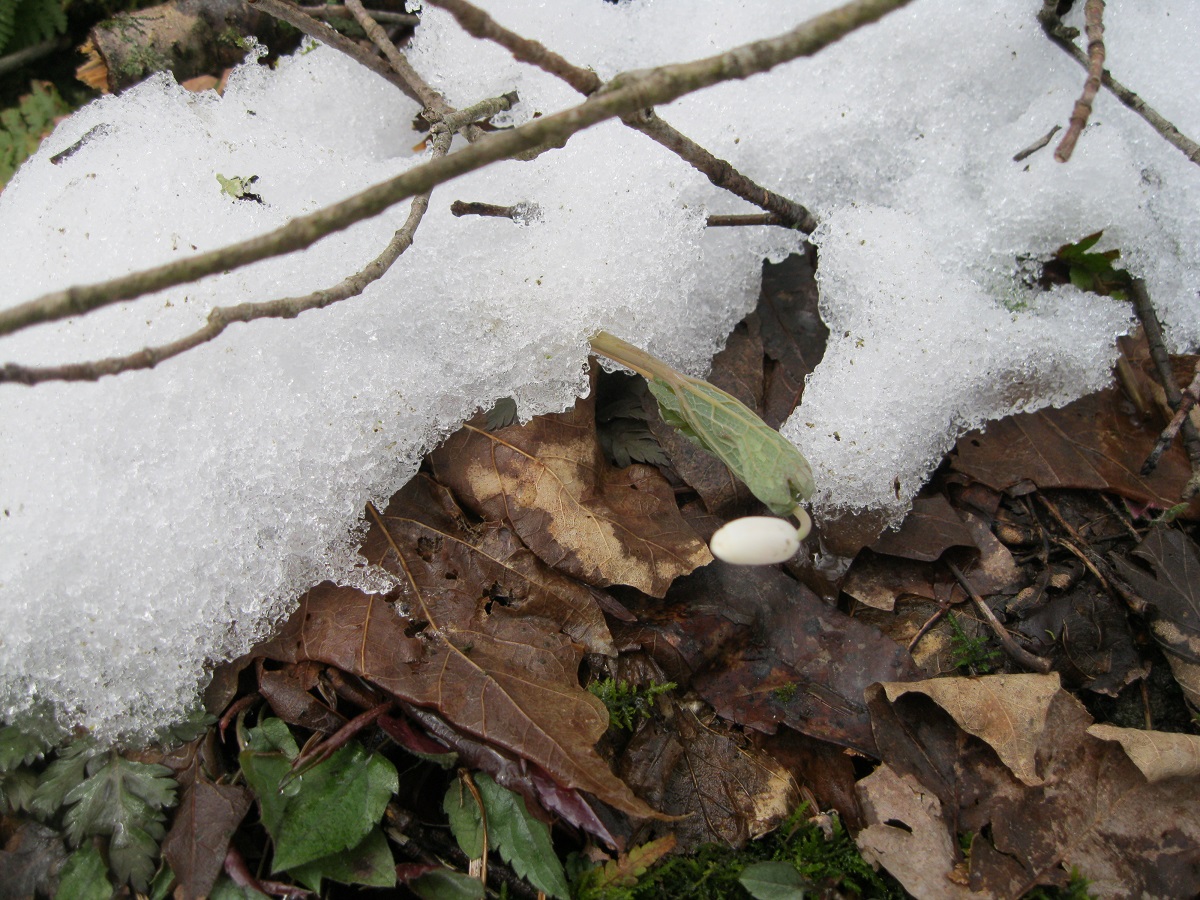
Another trip to Irma's woods was made.  Snow was still covering the ground but flowers were found.  This bloodroot still tightly wrapped by its protective leaf is visible because of the adjacent vertical stone.  It looks like it will survive the storm in fine shape.


This bloodroot has partially exposed its flower bud past the protective leaf but the snow has bent it.  We will wait to see if it is simply bent or actually broken.


The moss covering the stone provides an attractive background for the three lobed liver colored  hepatica leaf.  The white wood chip between the closed flower and the leaf is likely from one of the storm broken tree branches.  Many of the breaks occurred high up in the trees leaving long white scars on the remaining branches.


A Sharp-lobed Hepatica flower stem and the partially hidden leaf in the lower right hand corner of the picture are familiar.  However, it seems that we frequently encounter plant parts whose identity is not known to us.  The bright green leaves in the center of the photo is today's puzzle. 


Once again a moss covered stone edge reveals a sheltered plant.  Foam flower is frequently seen in our woods.  Long lasting leaves provide this glimpse of beauty for most of the summer.


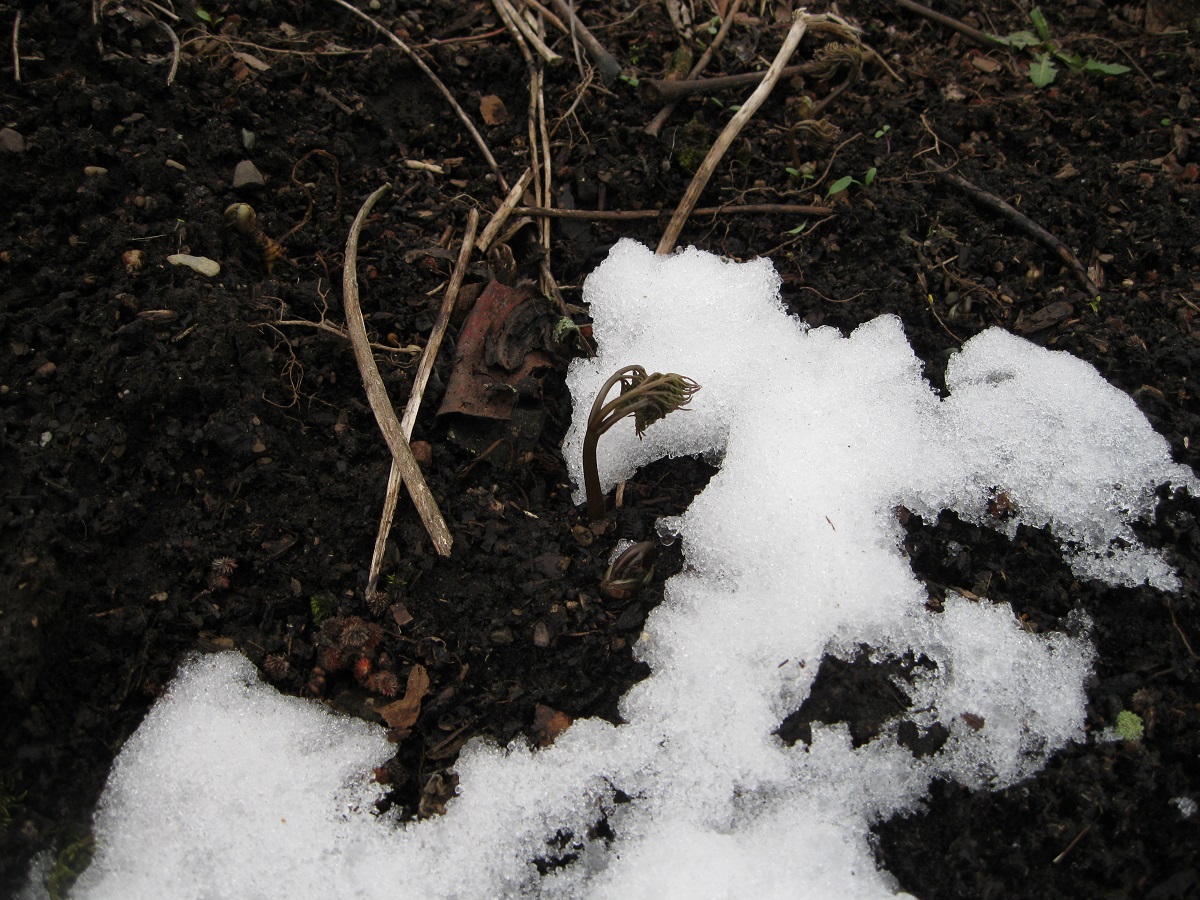
Back in our shade garden, the Black cohosh the was a gift from Jane has made an appearance.  No storm damage is visible at this time.  Many more shoots will soon be seen guaranteeing its survival.


This Lungwort is not native but was given to us by a Unadilla neighbor.  Its two color flowers and speckled leaves create an early visual treat.  The plant is somewhat invasive but is easily kept in bounds.


This is a long looked for treat.  Last year this ground next to our Bloodroot planting produced new plants from seed.  The parent plants had a difficult summer and have yet to make much of an appearance while these three emerging plants look ready to go.


This Summer sweet bush was flattened to the ground by the heavy wet snow as is evident by the bare ground.  I passed close by this plant several times as I made my way to the propane tank to see how its supply was holding up.  Shaking the snow from the bent branches might have helped but it also could have broken branches.  Sometimes doing nothing is a wise course to follow. 
 

Wednesday, August 11, 2021

Dream Coming True


Neither of the native plants shown here have been encountered by us in the wild but we are well within their required climate zones.  The white flowered Summer Sweet has expanded wildly in the gardens near the house where the Cardinal Flower continues but struggles.  These two treasures needed to grow together so that the brightest red flower and the sweet smelling pure white flower could enhance each other.  Transplanted last year, all three have survived and the size of this display will increase yearly if this site proves friendly.  A huge patch of pine trees covers the hillside to the south of these plants.  Late winter shade lingers here delaying snow melt.  The raised lane traps water runoff meeting the moisture needs of both plants.  Wire cages help us find these plants as Goldenrod also flourishes here.  Some of that will be uprooted each year and at some point the cages will be removed.  This planting is supposed to appear natural after all.


A drive to the back was made early to avoid the searing heat forecast for this afternoon.  This Joe Pye Weed grows totally on its own with no help from us.  This ground between the bedrock ridge and the flat meadow has never been farmed.  Streams of water from the springs ooze along between sizeable rocks but a downhill run to the river does not exist.  All of this water disappears into the gravel loaded glacial till that fills the flat areas.  The two Fritillary butterflies display different markings suggesting that they are different species.  We do not know their proper names.


This view looking eastward shows the rising ridge that contributes to our land's interest.  Goldenrod flourishes here but all of these plants are on their own.  We do not have the time to interfere and this ground is dangerous to walk on.  Muddy depressions, jutting rocks and low growing vines almost guarantee a fall but still the pictures just had to be taken.  Once more my luck prevails with the solid ground found.


This Boneset is another plant that is totally on its own.  These flowers are a little past their prime so they fit right in.  A late afternoon trip down the hill to fetch the garbage cans and get the mail will be quickly made but otherwise we are in for the day.  Neither one of us can endure the heat anymore.
 

Saturday, August 8, 2020

Long Time Coming


Daughter Amy and I discovered both of these native plants while hiking in the Shawangunk Mountains.  The red flowered Cardinal Flower was growing in full sun next to a year round stream.  Summer Sweet was found in full shade under widely spaced Oak trees.  Both plants present unique issues concerning their willingness or ability to grow in the same spot year after year.  Both of these plants were transplanted here this year.  Our hope is that they will grow on this spot without much interference from us.  We plan to enlarge the area free of Goldenrod when outside temperature moderates allowing us to remain outside for more than a few minutes.  If it is not kept at bay neither plant will survive.

This photo does not do justice to either plant.  Cardinal Flower is well known for its presentation of incredibly bright deep red flowers.  This afternoon full sun caused problems for our old point and shoot camera..  We will try again when the sun is lower in the sky.  We know that, but we were here at the wrong time today and thrilled to see new flowers..


Amy and I walked into a deliciously sweet invisible cloud of plant fragrance on our long ago hike.  Woodland flowers are scarce in August and we reluctantly left the trail to find this plant.  All that we took away from our encounter was mental images of dark glossy green leaves and pure white flowers.  Once home identification of the plant was quickly found.  Now it grows in several locations here since we view it as a native treasure.

As we developed an understanding of the needs of each of these plants, I wanted them growing in close proximity to each other.  Brilliant clear red blossoms near pure white flowers would be an image of lasting beauty.  Hopefully both plants will return next year.  Their low area between the lane and the wooded hillside traps water runoff.  This generous supply of moisture should help the Summer Sweet survive half day exposure to sunlight.  The Cardinal Flower will also benefit from a moist location.  Early spring cold presents survival problems for Cardinal Flower but if we can remove the Goldenrod its survival is possible here.


Growing squash and pumpkins next to a wire fence is not a smart placement.  Frequent visits are made to keep the vines headed toward open ground.  The vines passed under the sunflowers with no apparent problem.  Both plants look fine.


Since we drove to the back, I did not bother with my usual sun protection clothing or even a hat.  It would be helpful if more of the vines had headed toward this open ground.  I explain this to them on every trip back to keep the vines out of the fence but like some unruly eighth graders from my past it may take time for the advise to register.  Expecting to be ignored, I plan more trips to pull the plants out of the fence.

Friday, August 16, 2019

Super Sweet Summer Scent


Here is one of the great treats of summer in our garden.  Amy and I discovered this native plant while hiking in the Gunks.  Our first plant for the garden was a small plant taken from a friend's garden.  Summer Sweet multiplies freely with each clump consisting of many single shoots with no large trunk to be found.  Its scent is wonderful beyond description and carries for considerable distance on the wind.


Any attempt to approach this plant when its flowers are open guarantees other life forms on the plant.  These two White Admiral butterflies were so intent on feeding that my close approach did not cause them to fly away.  This picture would have been better if I had taken a moment to snap off the brown remains of last year's flowers.  I was quite certain that motion would have sent the butterflies away.


This bee is carrying a heavy load of yellow pollen.  Its color puzzles me since the open flowers show brown where the pollen forms.  Here again a really close approach was not even considered despite the fact that a pollen carrying bee is incapable of assuming a stinging posture.


One of my goals for this year was to have the native plants Cardinal Flower and Summer Sweet growing close together.  Bright red blossoms close by nearly pure white flowers could present a perfectly beautiful scene.  For some unknown reason the entire center section of the Summer Sweet had no flowers this year.  For some time it looked like there might not be leaves on this section of our original plant.  We still have much to learn.

In our shade garden down by the road, both Summer Sweet and Cardinal Flower were planted together.  As mentioned Summer Sweet grows with single stalks.  The transplants are all alive and in flower but their scraggly appearance will be diminished with another year's growth.  Several Cardinal Flower transplants were set around the outside of the bushes.  If all goes as planned, a stunning photo should be possible next year.

Friday, August 25, 2017

Dew Spider Webs Add Beauty To The Garden


This spider web on the coral bells is one of those interesting ones with a tubular hole in the center.  I don't see a spider lurking in there, but if I were a spider and could build a web like this, that is exactly where I would hang out!
 

The spider web on the Rose of Sharon looks all relaxed and curvy.  I have to wonder if when the dew dries this one will tighten up.  Perhaps some spiders are more laid back than others!  Without the dew droplets these small webs  are nearly impossible to see!


The Summer sweet bush holds a  small rather chaotic looking web.   Perhaps it met with an accident after it was spun or maybe not all spiders follow the plans exactly.  I still like the way the dew drops look on this one!


Next to a single Clara Curtis chrysanthemum flower is a classic spider web.  This spider might be small and brown, but she is a talented spinner. If I were a spider, I would be tickled pink if I made a web like this one!  These are only a small sampling of the spiders' traps that lie waiting for bugs in the garden.  I for one wish them good hunting.

Friday, May 5, 2017

The Scent Of Clove On The Breeze


These native Buffalo Currant bushes make this one of the truly special times of the year.  Their small bright yellow flowers are cheery enough but the scent they emit is sweet beyond description.  A light breeze will carry this smell of cloves for a considerable distance.  Walking into that cloud is always an unexpected pleasure while working in the garden.

The pictured plant was transplanted two years ago.  Our plan was to combine spearmint with clove currants in a circular bed in the middle of the pasture.  Since the bushes send out deep runners while the mint runs nearer the surface, we felt that both would prosper together.  As an added bonus, Dame's Rocket was planted in the center between the three currant bushes.  It appears that every seed grew so now we have considerable weeding that needs to be done soon.  We find the evening scent of the rocket pleasant so we will put up with this aggressive roadside escapee from colonial gardens.


This plant has held this location for many years.  It as well as our mature trees suffer from the same affliction.  A pale grayish green growth grows uncontrollably on old wood.  It spells a certain death for both the trees and the bushes.  The process is slow so we have years to enjoy both the bushes and the trees.  They will likely outlast us here.


Despite good intentions, it seems that there is always at least one potted plant that spends the winter above ground.  An unrecognizable dead stick is the usual result.  In this instance we have a clove currant that patiently awaits placement somewhere.  Perhaps a spot along an old fence line near the arbutus wall would meet this plants requirements.  If a couple of Summer Sweets were also planted there we would have three of our favorite scents in one location.

Friday, August 12, 2016

Super Sweet Scents Of Summer


Daylilies hold a great deal of space in our gardens now and are likely to expand their holdings next year.  Fragrant flowers with ruffled edges are personal favorites.  Mid morning walks focused on snapping off yesterday's spent flowers are made pleasant by the sweet scents of the newly opened flowers.  The first round of blossoms are coming to an end.  We will enjoy some re-blooming but those flowers will be few in number here.

The plant in the portrait is an unnamed variety that was included as a free gift.  It has so many favorable characteristics that it is hard to understand why it remains a cast off.  Its white petals are tinged in yellow near the green throat but the plant is tall, hardy, scented and produces many flowers over a long period of time.  Divisions of the original plant have been placed in the garden down by the road.  This remains high among our favorites despite its humble origin.


Oriental lilies still hold places in our garden despite their preference for warmer climates.  Pollen stains and a petal knocked free by the weeder mar the visual presentation of this Muscadet but its scent fills the area.  Working near this plant is incredibly pleasant even when the wind blows from the neighboring cow barn!.  This is its first year in our garden.  We hope that next year the blossoms will be closer to the height of our noses.  We can still bend over but going down on one knee is now an issue.


Casa Blanca's are also in their first year here.  Simplons had held this spot for several seasons but disappeared after I separated their huge bulbs.  They were also a white flowered lily that had exceeded six feet in height.  We hope that the new variety attains taller growth next year.  These flowers are also huge and sweetly scented but we would like the plants to be taller.

The nearby purple Heliotrope also features a pleasant aroma.  The only negative is its nearness to the ground.  One must assume the position of a prayerful bow to enjoy this beauty.


Summer sweet continues to fill the area around the garden with its aroma and cover the wall with spent flowers.  Out early this morning to try and get some work done before the heat knocked me out, I found a honey bee sleeping among its flowers.  I know that she was sleeping rather than dead since she moved when another bee already at work walked across her.  That was when she awakened, moved and started to work the flowers.

A summer sweet sucker plant is visible on the near side of the stone wall.  All that can be done is to cut off the new growth year after year.  These suckers will continue to appear long after I am no longer working here.  The nearby milkweeds are another testimony to my inability to ruthlessly garden.  Milkweed roots run deep and long.  They are impossible to remove so why do I allow them to grow in the garden?  Someone's fascination with butterflies and caterpillars is at the root of this dilemma!

Speaking of milkweed, I do mow a large area of wild given over to this important plant.  The plants continue to regrow after each mowing.  My purpose in repeated mowing is to supply tender new leaves favored by Monarch butterfly caterpillars.  The wild leaves are tough and falling now but the Monarchs need them as a food source.  Another bonus to me is late milkweed flowers.  Their scent is sweet beyond description and I get a second chance to enjoy them.


Saturday, August 6, 2016

Evening Walk About


At this time of year the scent of summer sweet fills the garden.  Gentle breezes carry the understated aroma for great distances.  One never knows when they will walk into an unexpected cloud of sweet aroma.  Diluted by the wind, the smell is unmistakable and pleasant.  It might be overpowering if brought into the house as a cut flower.  We prefer to enjoy it where it grows.  Even this close to sunset the bees were furiously working the flowers. These two were so intent that they did not respond as I brought the camera close.  Despite their calm demeanor, we look twice before bringing our noses close to the flowers.
.

The eye sees the dill as different in color than the grass.  The camera does not record this difference.  The dill marks the location of our new asparagus bed.  Self seeded, the dill was simply too splendid to weed out.  We will watch to see if these two plants will grow together without harm to the other.  Dill is usually scattered around the garden.  We have long wanted a dill patch but we also want an asparagus bed.  The smart thing would be to prepare soil for a dill bed now and cut the seed heads moving them to the new ground.


Late Morning is new to us this year.  Despite the challenges of covering lilies to protect them from late frosts, I cannot stop myself from buying more bulbs.  Spring planted, this variety should bloom earlier next year.  We also hope it grows taller.  We would like to sample its fragrance, but cannot get our noses this close to the ground.


Princeton Silky has been with us for several years.  Many other varieties of day lilies present tattered flowers this late in the day but this one is presently perfect.  Slow to open, this flower will still look good tomorrow morning.  We need to have more days when the tools are put away early and we take the time to savor the beauty that is all around us.

Saturday, July 30, 2016

Favorite Summer Natives


Searching for a native plant in bloom is commonly a spring activity.  Summer sweet first came to our attention while Amy and I were on a hike.  Walking into a cloud of incredibly sweet scent led us to this flowering bush.  Our captive specimen came to us from a friend's garden.  She objected to a root runner spoiling the balance of her plants.  The offshoot came home with us and has since taken over a huge section of our planting bed.  One of its daughter plants will anchor a foundation planting at the south west corner of the house.  The glossy dark green foliage looks great when not hidden behind numerous white flowers.  Having the wonderful scent near the house will be an added bonus.


Most of the flowers have yet to open.  Even so a tiny spider has found the pollen on an early flower.  When more of the flowers have opened, the brown pollen stains will detract from the bright pure white mass of blossoms.  I try to see the stains as golden in color but that helps little.  In addition to the sweet aroma, there is the remembrance of that special time together when Amy and I discovered  this native treasure.


We were introduced to Cardinal flower in the writings of John Burroughs.  A single purchased plant deposited seeds and produced six new plants at its base many years ago.  Now we have these brilliant bright red flowers throughout the garden.  Late frosts are hard on these plants and those pictured were among the eighteen that were potted up and carried into the basement when cold threatened.  That may be overly protective but it does allow me to plant these where I want them.  Their red flowers near a stone wall creates an unbeatable picture.  Hummingbirds also find them irresistible!


For years I have been trying to get a clear photo that shows the unusual structure of a single blossom.  A long upward red tube opens into five petals.  Three droop down while two curl upwards.  Between the up pointing petals is a white tipped tube.  This photo shows single blossoms in profile in addition to the centered star of the show.

We do have fall asters to look forward to but for me the season of brilliant native plants has reached its peak with these two wildly different plants.

Tuesday, July 29, 2014

Winter's Lingering Impacts


Few of us that experienced it have forgotten the severity of last winter.  A not so gentle reminder came in the mail in the form of the gas supplier's terms for budget and price protection plans covering the coming heating season.  A much more pleasant result of the past cold was this freshly opened tulip tree flower.  Its seasonally correct blossoms were few in number this year.  We do not know if this plant is likely to re-bloom but that is exactly what is happening here now.  It would seem somehow right if these new flowers are a positive response to the past bitter cold.


Dwarf phlox more commonly set a second flush of flowers.  Still, the coincidence of these flowers appearing the same day as the tulip tree flowers must be a day brightening experience.  Many more buds are about to open so a picture taken in a couple of days would be more impressive but why wait?


Our Summer Sweet really took a beating last winter.  We know that it is two zones out of its comfort area but try to include it here anyhow.  Our original plant was placed directly in the path of frost rolling downhill.  All of its top stems were winter killed but now it is covered with new growth.  No flower buds can be found on that bush but at least it is still alive.  This plant is sited just over a gentle knoll.  Our frost river does not flow here.  Further protection from the stone loading ramp made possible this generous set of buds.  We are just days away from what may be the sweetest scent of summer.  We will have to kneel on the ground to really enjoy the fragrance but the effort will be worth it.

Fortunately for everyone there is no picture of the next event.  Scented daylilies are planted near the stone wall next to the road.  If one wants to inhale their scent, a walk across the planting bed is necessary.  We try to limit foot traffic across our beds so another solution was found.  It is possible to bring one's nose close to the flowers if a kneeling position is assumed atop the wall.  Finding hand holds among the lower wall stones has so far prevented a tumble into the plants as the flowers are lower than the top of the wall.  With knees and hands firmly anchored one's head can be lowered toward the plant.  That movement sends the backside skyward.  That was my position when a neighbor rode by from the rear on his bicycle.  His greeting consisted of a friendly wave accompanied by a huge smile or more likely an actual laugh.

Monday, October 7, 2013

An October Walk In The Garden, Photos By Amy


The garden is winding down, but yesterday was a beautiful autumn day.  I watched two Monarch butterflies sail past me, flying over the roof of the house heading south.  Amy and I took advantage of the beautiful day to walk around in the garden and I gave her the camera as I often do.  Here are some of the things she saw.  An American copper  butterfly  could still find a Clara Curtis mum to drink a little nectar.


The summer sweet has turned a brilliant yellow.  A Grandpa Ott morning glory  is wound around its branches. The colors are gorgeous.  I never thought morning glories would winter over here. This one self seeds with abandon!  This clinging vine no matter how lovely has nearly achieved weed status!


The shapes, colors and textures of the top of Ed's stone wall make an interesting picture.  All too soon the plants will fade into the background and the walls will be the dominant feature in our garden.


It was surprising to see this woolly bear caterpillar atop a Chinese forget-me-not plant.  I wonder if those sticky seed pods will stick to him like they do to me?  These rust and black caterpillars bring back fond childhood memories for all of us.  It's always a delight to catch sight of one and this fall there have been many.


This spring the toad lily got frosted hard. I really wondered if it would be back, but here it is blooming in October.  It's flowers may be small, but they make up for it with their intricate pattern and lovely colors so perfect for a close up!


A stroll over to the hazelnut bush caused me to squeal with delight and surprise.  In all the years since we planted the hazelnuts we have picked at most 5  tiny nuts.  This year the bush is  covered with the intriguing papery husks that contain the hazelnuts inside.  You can see next year's catkins are already in place.


We got a basket and picked the nuts that we could easily reach. There are even more still on the bush.


It was wonderful fun to harvest this unexpected treasure.  Beautiful weather, flowers, stones, butterflies, fall colors and hazelnuts.  Who could ask for more than that!