Showing posts with label Lobelia cardinalis. Show all posts

Wednesday, March 16, 2022

Beautiful March Day


More than one decade ago, we flew in the face of conventual wisdom and attempted to transplant Trailing Arbutus.  Writings spanning the previous century described this native wonder as impossible to transplant.  We discovered the hard way that these plants could be moved but their evergreen sweet foliage would likely be eaten by starved rabbits or woodchucks early in the year.  A beneath the surface dry stone wall extending up along the wire cage edge has to date solved that problem.  The appearance of this native plant's apparently wild placement  is destroyed by the wire cage.  In the past we would carefully remove fallen pine needles and oak leaves.  Our treasured babies were given extensive care with the hope that they would survive.  Not only have they survived, plants now extend past the limits of the cage.  That exposed growth may be eaten but these plants are otherwise mostly on their own.


Many of the early flowering plants form their flower buds ahead of winter's arrival.  A cursor click on the image will enlarge it and if you look just to the right of center near the lower edge of the photo you will see a cluster of buds.  We find this promise of early flowers both exciting and reassuring.  Why the squirrels or chipmunks did not carry off the acorn remains an unanswered question while the Arbutus looks great.


Cardinal Flower is another incredible native plant that is not commonly found in our area.  The loss of snow cover has revealed a sizeable group of plants.  The dead stems mark the location of last year's flowering plants and their need to increase the number of new plants now holding their spot.  When the ground thaws these clusters can be unearthed.  Gently pulling apart the plants, individuals can be transplanted into pots.  When the snow cover first disappeared  great looking plants are on display.  The bitter cold that will surely visit here will likely turn these plants into dead mush.  More to the north, snow cover exists for a longer period of time and the warm Georgia winds do not blow there.  Here southern warmth followed by bitter cold often ends these native treasures.


We considered working among the plants but the ground is still frozen.  This section of the driveway has taken a real beating.  Where we can direct the running water to flow in the higher ditch, the situation improves.  Flowing water softens the frozen soil and a deeper channel can  then be established.  We need to continue widening and deepening the ditch ahead of serious rainfall.  With persistence and luck we may be able to at least reduce the amount of water roaring down the driveway.  Last year we were able to use a shovel and lawn cart to move enough gravel to raise the road surface above the level of the ditch.  We plan to do the same thing on this side after new gravel becomes available.  For now it is dig, dig, dig. Happiness is being outside, working, getting the spring runoff to run downhill my way. 
 

Sunday, October 24, 2021

Native Promises Of Spring


If there is a native plant that has inspired more written words than Epigia repens, I am totally unaware of it.  In our early days as a new nation, personal hygiene was severely lacking especially during winter.  One of the women of years that influenced and helped us with gifts of plants shared an experience she endured at the one room schoolhouse that she attended as a child.  One late winter day she fell through ice completely soaking her clothes during recess.  Back inside she was seated near the stove soon filling the room with the scent of both her clothes that had been worn for some time and her body that had not seen a bath recently.  Soon she was moved away from the stove and her classmates.  Needless to say, that stinky experience stayed with her for the rest of her years in that school.

Everyone's home, church or place of business needed sweet scented air as Spring took hold.  Great expeditions into the forests where Trailing arbutus grew were made to harvest the unbelievably sweet scent of these early flowers.  Unfortunately the flowers grew from the stem necessitating the removal of much of the plant when the flowers were gathered.  Concerned that these massive harvests were endangering the survival of this plant, a group of Massachusetts woman used several years of political activity to push for a law outlawing the harvesting of this plant.  Their organization became known as the New England Wildflower Society and this plant still grows in the wild today.


It is common to find written words describing Trailing arbutus's resistance to transplanting.  Mrs. William Star Dana wrote that this plant should be left alone.  Not one to blindly follow conventional wisdom, these pictured plants were moved here in a carefully selected location.  Soon the woodchucks and the rabbits demonstrated their need for food as Spring approached by chewing to the ground these evergreen plants.  Carefully laid low field stone walls hold the protective wire cage in place and so far have discouraged all attempts to get under the wire.  Other than this necessary protection, these impossible to transplant treasures have been on their own here for several years.  They have reached the edge of the cages and new growth will of necessity be available to the animals.

This photo shows flower buds now forming ahead of the Winter snow.  This seems risky to me but how else can flowers open so soon after snow melt?  Nothing will prevent us from dropping to the ground to sniff their fragrance without harming the plants.  Getting back up will not be graceful but the memory of their scent will once again get me past winter.


Lobelia cardinalis is a native treasure that has demonstrated its difficulty surviving in the Southern Tier or Catskill regions of NYS.  John Burroughs wrote about its scarcity more than one hundred years ago.  This plant is an evergreen that has already started next season's  growth.  These bright green new leaves will emerge from snow cover undamaged and ready to grow.  Early southern warm weather will push these leaves to fill with moisture.  Then the freezing night air will turn this water into ice exploding the leaf cells sometimes killing the entire plants.  We have seen many of our plants die and are searching for locations that will insulate survivors from death.  These plants are growing on our impossibly small piece of river bottom land.  Sheltered by sloping ground, the snow cover lingers here.  River fog helps to soften the freezing nights.  So far so good although one year we did have one close call with frost blackened leaves.  New leaves appeared and these plants still survive here.


Cardinal flower is hard to categorize.  The almost dead stems mark the complete disappearance of this year's plants.  Young growth around the base are totally new plants.  In the past we would dig up and separate these young plants and place them in pots in early Spring.  Moving them inside on cold nights gave us new plants to try again.  Now we have found protected areas where these plants have survived without attention from us.  Our time here is limited but we want these two native treasures to hold this ground after we are no longer here.
 

Saturday, August 7, 2021

Another Native Going Wild


Cardinal Flower may well be my all-time favorite native plant despite its apparent scarcity in upstate New York.  The written words of John Burroughs introduced me to this treasure and he also found it scarce where he lived in the Catskills.  I believe that the wildly variable late winter weather so common in our area is the problem.  Extremely warm days followed by hard freezes so common here may be the cause of the frequent  die outs while in the Adirondacks this plant grows in huge numbers.  This evergreen plant can handle uniform cold there while here it frequently is destroyed.

An independently surviving patch is our goal and we may have found a sheltered spot.  Behind these plants is a sizeable glacial deposit that limits sunlight as winter is receding.  Snow cover lingers protecting these plants.  The only impact of human hands here this year was the removal of Garlic mustard.  We did plant the Cardinal Flower but the Blue Flag in the foreground appeared here on its own.  The nearby road to the gravel bank traps water.  Both plants prefer extra moisture.  We will weed again later in the year and renew the layer of ground tree leaves intending to help create a natural woodland soil with some help in the fight against weeds.


Some might feel that plants growing in our shade garden cannot be called wild.  The group in the foreground was transplanted here and continues to receive the human attention so common in a garden.  We delay the removal of the previous season's dead stems intending to leave a natural protective mulch.  Snow pushed or blown from the driveway lingers delaying exposure to harsh elements. To date, these plants have eluded the perils of late winter weather extreme temperature swings.  

The growth habit of this plant causes confusion.  Each fall the plant dies to the ground leaving only the new growth of low rosettes that with luck will flower the following year.  We are uncertain if the label perennial is appropriate.  The low rosettes are all new growth retaining no part of the now dead plant.  These new plants also presents a long term problem.  As many as six rosettes grow at the base of a now dead single plant.  As years pass, these plants become overcrowded.  Some that we have left alone for years have become small somewhat pathetic plants with insufficient room to grow.  We will be watching this group as we intend to not interfere with this native plant. 


These plants can be seen in the background of the above picture.  Cardinal Flower also produces a huge number of seeds that are rather picky about growing.  Given adequate moisture and warmth, a low rosette very similar to what is described above constitutes the first year's growth.  A mature flowering plant follows the next summer.  We had nothing to do with the placement of these plants.  Fortunately we did not unknowingly weed them out.  It may be that this plant with two totally different methods of reproduction is likely to survive the natural overcrowding previously described but the evergreen plants from seed face the same perils of our late winter harsh weather.


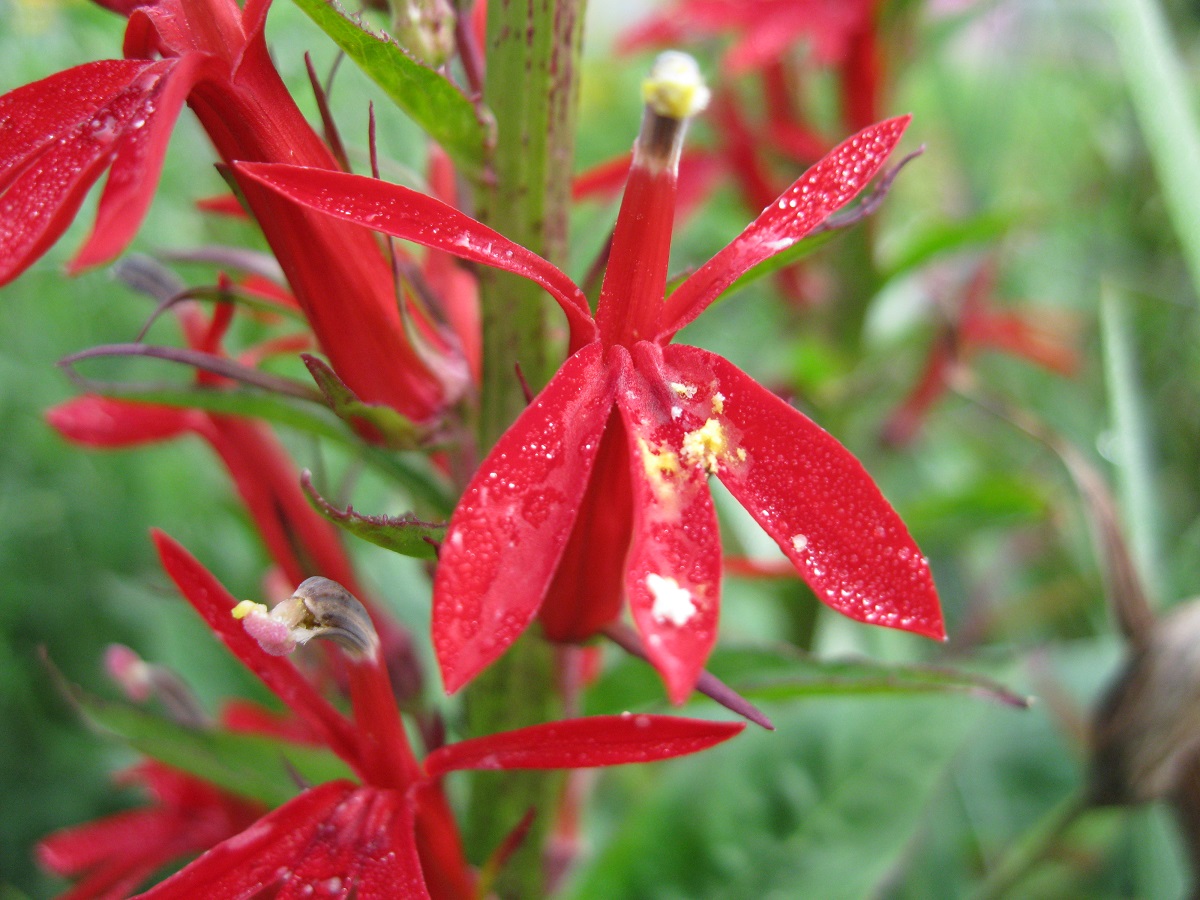
This closeup shows the method used to produce seed.  The limp white organs presented themselves just this morning.  Pushing past the at the time pollen laden white beard, completes the transfer necessary to produce viable seed.  While hummingbirds love these red flowers, they play no part in the transfer of pollen.


In his essay dealing with Cardinal Flower, Burroughs offered red Monarda as a possible more common source of brilliant red flowers.  Bee Balm is a native plant but the red blossoms are not.  When we buried our electric supply wires decades ago, I marked the location of the underground wires with these plants.  We have never given these plants any attention since they were planted so in a sense they are surviving native plants.
 

Saturday, August 8, 2020

Long Time Coming


Daughter Amy and I discovered both of these native plants while hiking in the Shawangunk Mountains.  The red flowered Cardinal Flower was growing in full sun next to a year round stream.  Summer Sweet was found in full shade under widely spaced Oak trees.  Both plants present unique issues concerning their willingness or ability to grow in the same spot year after year.  Both of these plants were transplanted here this year.  Our hope is that they will grow on this spot without much interference from us.  We plan to enlarge the area free of Goldenrod when outside temperature moderates allowing us to remain outside for more than a few minutes.  If it is not kept at bay neither plant will survive.

This photo does not do justice to either plant.  Cardinal Flower is well known for its presentation of incredibly bright deep red flowers.  This afternoon full sun caused problems for our old point and shoot camera..  We will try again when the sun is lower in the sky.  We know that, but we were here at the wrong time today and thrilled to see new flowers..


Amy and I walked into a deliciously sweet invisible cloud of plant fragrance on our long ago hike.  Woodland flowers are scarce in August and we reluctantly left the trail to find this plant.  All that we took away from our encounter was mental images of dark glossy green leaves and pure white flowers.  Once home identification of the plant was quickly found.  Now it grows in several locations here since we view it as a native treasure.

As we developed an understanding of the needs of each of these plants, I wanted them growing in close proximity to each other.  Brilliant clear red blossoms near pure white flowers would be an image of lasting beauty.  Hopefully both plants will return next year.  Their low area between the lane and the wooded hillside traps water runoff.  This generous supply of moisture should help the Summer Sweet survive half day exposure to sunlight.  The Cardinal Flower will also benefit from a moist location.  Early spring cold presents survival problems for Cardinal Flower but if we can remove the Goldenrod its survival is possible here.


Growing squash and pumpkins next to a wire fence is not a smart placement.  Frequent visits are made to keep the vines headed toward open ground.  The vines passed under the sunflowers with no apparent problem.  Both plants look fine.


Since we drove to the back, I did not bother with my usual sun protection clothing or even a hat.  It would be helpful if more of the vines had headed toward this open ground.  I explain this to them on every trip back to keep the vines out of the fence but like some unruly eighth graders from my past it may take time for the advise to register.  Expecting to be ignored, I plan more trips to pull the plants out of the fence.

Friday, March 13, 2020

Cardinal Flower Rescue


Cardinal Flower has been with us for nearly one quarter of a century.  The words of John Burroughs introduced us to this native puzzle.  These brilliant red flowers were hard to find in the Catskills where he lived.  This is hard to understand as the plant has two different methods of creating the next generation.  Following blossoms, the entire plant dies.  Around the base of the dead stem up to six daughter plant begin to grow before the onset of winter.  Spring snow melt reveals low rosettes of bright green plants.  In this part of New York State, days of incredibly warm temperatures are frequently followed by hard freezes.  Moisture filled plant cells sometimes burst killing the new growth.

The second method of reproduction involves seeds.  When cutting away the dead stems recently, we discovered many fully packed seed clusters.  These seeds need warmth and moisture to germinate.  This usually occurs in late June.  In our gardens the greatest risk to these seedlings is inadvertent removal by the mad weeder.  If allowed to grow, these seedlings will enter winter with a low rosette of leaves very similar to new growth around the base of the flowering stem.

To our north in the Adirondack Mountains, Cardinal Flower grows in impressive stands alongside of the small rivers that connect lakes.  Temperatures there are much colder that here so it seems that death by cold is not the problem.  Our unusually warm days are the result of Alabama air that works its way here but passes east of the Adirondacks.  To enjoy this plant it seems that we have two choices.  We could move or we could work to rescue plants.  A goal of our work with native plants is to restore naturally occurring stands.  In this case that seems unlikely but we do enjoy seeing it in our gardens.


This is the same clump of plants pictured above.  Everything seen here is new growth that began last fall.  Last year's rotted stems are hidden among these new plants but the roots are all new.  Considerable patience is needed to wiggle free individual plants.  Working among the roots avoids crushing the crowns of these densely packed plants.  When set free, the size of the root mass is impressively large.  On occasion a transplant will die as a result of crushing damage to the crown.


The clump of plants in the first photo have enjoyed growth in that spot for several years as is shown by the number of plants.  With frost just recently having left the ground, we were able to dig up the entire clump without finding ice.  Working carefully but with some forceful twisting and pulling, fifteen pots became the new homes for these plants.  They will remain outside until hard freezes threaten.  Then the entire tray will by carried inside.  We will continue this dance until late May when hard freezes are not likely.  Then these treasures will be given new homes around the gardens.


Last summer one dozen plants were placed in one gallon pots.  Actually it was 12 clumps of plants since it is the natural habit of Cardinal Flower to grow in dense groups.  These plants had an interesting summer.  Many deer call our garden home.  They showed no interest in eating these plants but bent or broke several stems as they walked by.  We were able to experience the flowering habit on shortened stems.  Masses of red blossoms looked great but the plants looked more like carefully pruned plants that one might find is the garden of a wealthy landowner with staff than a wild native plant.  We will likely go with the wild look again this year.

Carrying twelve one gallon pots into the basement to avoid frost sounds like a task more suited to a younger gardener.  Becky put together this heavy cover to see if it will protect against cold.  It would come as no surprise if one or two of the pots found themselves inside on really cold nights.  NOAA predicts overnight lows in the teens this weekend so we will soon know just what happens here.

Click on the first sentence of this post to see Cardinal Flower in bloom.

Friday, August 16, 2019

Super Sweet Summer Scent


Here is one of the great treats of summer in our garden.  Amy and I discovered this native plant while hiking in the Gunks.  Our first plant for the garden was a small plant taken from a friend's garden.  Summer Sweet multiplies freely with each clump consisting of many single shoots with no large trunk to be found.  Its scent is wonderful beyond description and carries for considerable distance on the wind.


Any attempt to approach this plant when its flowers are open guarantees other life forms on the plant.  These two White Admiral butterflies were so intent on feeding that my close approach did not cause them to fly away.  This picture would have been better if I had taken a moment to snap off the brown remains of last year's flowers.  I was quite certain that motion would have sent the butterflies away.


This bee is carrying a heavy load of yellow pollen.  Its color puzzles me since the open flowers show brown where the pollen forms.  Here again a really close approach was not even considered despite the fact that a pollen carrying bee is incapable of assuming a stinging posture.


One of my goals for this year was to have the native plants Cardinal Flower and Summer Sweet growing close together.  Bright red blossoms close by nearly pure white flowers could present a perfectly beautiful scene.  For some unknown reason the entire center section of the Summer Sweet had no flowers this year.  For some time it looked like there might not be leaves on this section of our original plant.  We still have much to learn.

In our shade garden down by the road, both Summer Sweet and Cardinal Flower were planted together.  As mentioned Summer Sweet grows with single stalks.  The transplants are all alive and in flower but their scraggly appearance will be diminished with another year's growth.  Several Cardinal Flower transplants were set around the outside of the bushes.  If all goes as planned, a stunning photo should be possible next year.

Sunday, August 11, 2019

Edge Of The Woods


Our latest attempt to find a natural home for Cardinal Flower is pictured here.  Some weeds were cleared before the transplants were set one year ago.  Bags of fallen leaves taken from the front area of nearby village homes are in use to both smother weeds and rot down forming a more natural woodland soil.  We have come to understand that Cardinal Flower prefers both moist soil and shade.  Garden placement usually results in only one year's growth while we are looking for a place where this plant will return year after year with no more help from us.  Some of these plants wintered over here while many  more were set out this spring to empty the pots.  Except for the new plants, adding leaves was all that we did for these plants this year.


Our gravel bank hill rises to the south behind these flowers. The height of the hill and its trees keeps this area in shade most of early spring days.  Snow lingers longer here than any other location on our land offering protection when it is needed most.  The road to the gravel bank crosses in front of these plants trapping water runoff keeping this ground moist much of the time early in the year.  Moist and well drained ground results from the deep gravel deposit under this ground with water frequently running down hill to this spot.  We did not see any new plants from seed here but some time is needed for the rotting leaves to form more suitable soil.  We remain more than willing to wait since it appears that this location will help Cardinal Flower survive independently here.


Stepping away from our natural ground at the edge of the forest, twelve sizable pots each containing one overwintered plant were placed in a garden bed.  We expected to find up to six daughter plants in each pot come spring.  It would be a simple task to pull these pots next spring if protection from hard frosts became necessary.  Our plans were working well until the deer herd visited.  Two plants had their tops nipped off very early on.  Recently at least one of the deer walked across this area knocking over several soon to flower stems.  This pictured plant is sending up three or four daughter plants inside of the pot rim.  They appeared here much earlier than normal in response to the flattened stem.  That stem is sending up new stalks that look like they will flower.  If soil was placed along side of the now horizontal stem, roots would begin to grow.  We want the daughter plants already in pots for next year and are in no way prepared to deal with the excessive number of plants that with help would appear here.


This picture shows the entire planting.  Some plants remain as they were planted.  Some are sending up new vertical stems in response to earlier trimming by inexperienced fawns.  Others were recently knocked over and we will watch to see just how they will grow.  It will be interesting to see just what grows here next spring.


Sunday, July 28, 2019

Native Reds


Sumac trees get worse press coverage than our current President.  They are messy, short -lived and spread invasively.  We had three growing on the property line but a strong wind toppled all of them.  New trees quickly growing from seed is how this cluster came to be.  Their shade allows us to grow native woodland flowers.  This may be the only occurrence of plants like trillium and hepatica growing under sumac.  We do import hardwood leaves in an attempt to establish a more natural woodland soil and so far that is working.  The Audubon Society identifies sumac as the only native tree or shrub that grows in all 48 contiguous states.  Perhaps that fact will influence an improvement in how this tree is viewed.
 

Cardinal Flower is highly prized here because of the pure brightness of its red blossoms.  As a native plant that flourishes both to our north and south, it presents a huge problem here just keeping it alive.  Two rather mild late winters is the reason this cluster looks so impressive.  Anyone living near the Grasse River would see this group as pathetically small since these plants grow in abundance there.
 

Bee balm is our native red that spreads each year forming huge clumps.  It is deserving of a better reputation.  Perhaps if was more difficult to grow it would be seen as a treasure.


This is the first Royal Catchfly flower ever seen here.  Our past attempts to simply have this plant survive all failed.  Perhaps the river bottom soil under this specimen retains more moisture that the stony soil up the hill.  Whatever the reason we hope that this red flower will be seen here next season.

Wednesday, July 24, 2019

Procreation In The Morning


Taking action to give promise to the existence of the next generation is the primary goal of every living organism.  Beautiful flowers sometimes exist to draw in pollinators and their scent adds to the effect.  This reality sometimes results in confusion.  These pictures allowed us to really see for the first time just how Cardinal Flower produces its seed.

Today holds the first appearance this year of these unbelievably bright red flowers in our gardens.  This fresh display will continue for many days as new flowers continue to open higher on the stem.  Their color absolutely catches the eye making looking for detail a difficult task.  The reality that the first task of a freshly opened flower is to complete its fertilization ritual was never noticed until today.


Despite the early hour of my trip down to the mailbox, most of this flower's business has already been completed.  The packed tube rising above the five petals was initially capped with a white collection of white filaments that resemble a neatly trimmed human beard.  Yellow pollen grains quickly appear there.  The stigma pushed outward collecting pollen in the process.  Some white pieces of filament and yellow pollen grains fell on the petals during this process.


That pink swollen mass shows the state of the stigma after she gathered a full load of pollen.  It will soon go limp as the pollen grains are moved to the base of the flower.  There many seeds will grow to maturity. 

We have seen these events unfold countless times but failed to realize that all of this happened on the morning that each blossom first opened.  Only early risers with access to Cardinal Flowers have the opportunity to see this miracle of creation.  Flowers remain intact for several days attracting both hummingbirds and butterflies.  The purpose of these visits remains a mystery since pollination can only happen early in the morning with the flower parts quickly completing their tasks unaided.

Saturday, July 20, 2019

Inside By 9


An intolerance of heat is increasing in severity as the years pass.  We tried to get in some garden work early in the day, but dry and dizzy quickly sent me inside.  We are fortunate in that the high temperature forecast for today has been lowered by three degrees to a mere 90.  That is within a degree of yesterday's high and we survived that so today looks like another inside the house day.

My large potted Cardinal Flowers needed weeding.  We intend for these plants to take the place of early spring potted plants.  Each of these will come out of winter with up to six daughter plants growing around the long dead stem of this year's flowering plant.  Planting out multiple young plants should increase the display next year.  I will also be spared carrying in four heavy trays of potted plants when frost threatens.  These twelve pots will likely require six trips to the basement.

A red flower can be seen growing close to the stone wall. Bee Balm is another native plant.  In his writings about the scarcity of Cardinal Flower, John Burroughs suggested the substitution of Bee Balm for a red flowering garden plant.  Its red is a great looking one and the plant spreads invasively.  That said, I do not know why I continue to try and reintroduce Cardinal Flower into the wild and carry it over in the gardens.  Bee Balm would require much less work and both the hummingbirds and hummingbird moths freely feed from its flowers.


Keeping these potted plants free of weeds has allowed me to see things never seen before.  At the end of the growing season, new plants are present around the old stem.  Perhaps these new plants are already up and growing.  Not every pot shows this early growth so we intend to watch and learn.  This pot contains two stems that will flower this year because the choice was not to pull them apart when they were transferred to pots early this spring.


Some time ago the discovery of deer footprints close by and a nipped off stem did not make me happy.  While weeding here today, the footprint was obvious but the cut stem could not be found.  Unable to fiercely trust the accuracy of my memory, I could not find the deer damage but remained shakily sure that it was present.  Becky quickly found it under the three new stems growing close to the damaged stem.  I have seen pictures of the results of pruning Cardinal Flower.  Knee high plants densely  covered with brilliant red flowers left a lasting impression.  Reluctant to prune a native treasure, tall thin natural displays are all that grow here.  This year that pesky fawn will allow me to see first hand the results of pruning Cardinal Flower.


This is the dry stone wall that lines the curved ramp to the basement.  Snakes are sometimes seen both inside of the wall and outside on level ground.  A garter snake and I have had numerous recent encounters.  This morning we found its shed skin and once again wondered just how the serpents use our stones to rub off their old skin.  This snake is already larger than most seen here.  Can't wait to see the larger version dressed in bright new skin.

Sunday, June 2, 2019

A More Natural Setting


Cardinal Flower is a native plant that does not grow freely in our area.  North or south of  the Southern Tier of New York, this plant flourishes but here it is rarely seen in the wild.  Despite the low chances of success, we continue to search for a wild location that will meet the needs of this treasure.  The time between initial snow melt and somewhat stable temperatures is when this plant dies out.  A naturally protected location is what we are searching for.

Here at the base of a north facing slope, snow melt comes later than nearby places.  Additionally, water drains down the hill and is trapped by the nearby road to our gravel bank.  Cardinal Flower needs generous amounts of moisture in addition to protection from early hard frosts.  Last year ten of our potted plants were set out in this wild ground.  A generous mulch of fallen tree leaves was placed to try to limit the growth of undesirable weeds.  All ten plants survived.


What actually survived was the new growth that appears in the fall as the flowering stem dies.  Under the best conditions, six new daughter plants will appear long before snow season.  These evergreen young plants will flower the following summer if all goes well.


This photo taken in August shows the beauty of Cardinal Flower.  A single blossom consists of three downward pointing petals with two additional ones spread upward looking like wings.  A white beard tops a tubular structure that leads to the ovary where seeds may form.  Hummingbirds find these flowers irresistible and visit them often even while we are working close by.  It is not uncommon for a hummingbird to momentarily hover close to Becky's face as if thanking her for providing these flowers.

Seeds formed and dropped last year will not germinate on this moist ground until the soil has warmed.  It may be as late as July before the from seed basal rosettes are seen.  They look much like the new growth seen in the first picture.  That is the form that they will take into winter.  If this year's new growth is killed by frost, there is still the possibility that from seed new plants will survive next winter.  Even with two different methods of providing for the next generation, this plant remains uncommon here.


These blades of green new growth may belong to another native treasure Blue Flag.  If that is the case these two plants will look good together.  It is possible that what is actually here may prove to be Yellow Flag.  If that is the case our removal efforts will focus on both the Yellow Flag and the Garlic Mustard.  Neither of these highly invasive aliens will be allowed to grow freely here.  In the long run both will likely survive but it will not be because we did not try to end them.

Sunday, May 19, 2019

Still Learning


Considering the time spent both reading about Cardinal Flower and working with it, my lack of understanding this plant seems limitless.  Just finding a name to describe its growth cycle is futile.  It may be perennial in effect but no part of the plant lives longer than a single year.  My suggested name is recurring annual.  We shall see if that term becomes used by anyone else.

This picture shows the usual totally dead remains of last year's flower stalk and the new daughter plants that grew around the long dead stem.  Never before have we seen uprooted plants.  It may be that this location near the driveway combined with last winter's heavy snowfall resulted in plowed snow pushing over the tall stem.  This year we will cut away the spent stem before snowfall becomes abundant.  For now the stem has been removed and the remains of the daughter plants have been pushed back into the soil.


Whether from seed or new growth, Cardinal Flower sends low rosettes of evergreen plants into winter snow.  Usually, bright light green stemless leaves are revealed when the snow disappears.  These tender plants did fine under the snow but ours are frequently destroyed when exposed to severe frosts.  My habit to avoid this outcome has me potting up the new plants just as soon as the ice has left the soil.  This year sixty plants were split between four carrying frames.  When a freeze is threatened, these plants are carried into the basement.  That system would be perfect were it not for the difficulty now experienced carrying the heavy load of fifteen plants per tray.

When we were clearing away Siberian Iris leaves, bright green Cardinal Flower rosettes were uncovered.  How these young plants maintained function when left totally in the dark surprised me.  Just recently one of the ladies given plants last year asked me what she should do next.  Carefully pulling away a thick covering of slimy wet fallen tree leaves, she found bright light green Cardinal Flower plants.  It appears that a solid covering of mulch saved these plants.

This photo shows six of my plants that were just set out releasing them from their pots.  These protected plants are sending up the stalk that will bear flowers well ahead of any of our plants that were left in the garden.  I still do not understand how some of these unprotected plants survived frost while others were ended.


This picture shows just how close these plants are to the driveway.  My habit is to plow snow toward the center of the lane then use the snowblower to send it clear of the plants.  This past winter the plow truck was called three times and that is when the pushed snow may have uprooted plants.  The brilliant red flowers look great at the edge of the new shade garden and survivors or potted plants will keep this display an annual event here.

Friday, April 5, 2019

Cardinal Flower In Trouble


This is how Cardinal Flower looked here on August 2nd last year.  Last year in April it looked  Mostly Dead.  John Burroughs described this native plant as difficult to find in the Catskill Mountains more than a century ago.  It remains a seldom seen plant in this area today.  We have spent two decades  trying to reestablish this beautiful  native plant but most still require our assistance.  Two plantings at the base of north facings slopes hold the best chance for unaided natural survival.


This is the present condition of what was a sizable clump of about one dozen plants last year.  Our brutal March weather has turned nearly all of the evergreen leaves to crisp, brown, dead leaf litter.  These plants are not totally dead yet but warm days followed by frosty nights are just ahead.  It is not likely that many of these plants will survive.


This clump spent the past few years on the north side of a stone wall.  Chrysanthemum stems fell over providing some loose mulch protection for these Cardinal Flowers.  Snow cover lingered  protecting these plants from brutal exposed cold.  I chose this clump to rescue because of their condition.  Two nights in the basement allowed the frozen root mass to thaw.  Warm inside air allowed some natural healing of damaged leaves.  Driven by a strong desire to save these plants, I carefully wiggled fifteen free and placed them in individual pots right after they were dug.  Some damage was done and not all of those plants will survive.

Today these plants were placed in a dishpan containing cold water.  With both the ice and the soil washed away, the task of separating individual plants still required patient, persistent effort.  Successful transplants are a more likely outcome today.


This is one of today's transplants.  Frost damaged leaf tips can be seen but the time in the basement allowed this plant to repair itself.  All of today's plants are expected to survive with generous amounts of new growth visible.


This is the present condition of the best looking plant transplanted two days ago.  Much more frost damage can still be seen and the overall color is not good.  This plant is expected to recover and it will likely look as good as its neighbor by August.  Four of fifteen is my best guess of the number of dead plants potted up two days ago.  When that outcome becomes obvious, new transplants will take their places.

Last year four trays containing a total of sixty protected plants were ready to set out.  Many of those plants were given away to increase the chances that some would survive on their own.  We will try to repeat sixty plants again this year.  I am finding the trays of plants uncomfortably heavy to carry in and out of the basement.  Perhaps cutting the number back to twelve per tray will solve that problem for this year.