Showing posts with label Sanguinaria canadensis. Show all posts

Sunday, April 24, 2022

Open Bloodroot Flowers


Finally we can finally see open Bloodroot flowers.  This plant is in our shade garden and we were working there this morning when this flower opened.  If that happened in a moment we missed it.  A pollinating flying insect was seen close by before the petals spread but we have no idea just how long it took for this flower to open.  Its pollen load is massive but it will be short lived.  This may be a young plant growing here from seed since none of the larger older plants have put in an appearance this year.  Our deer herd spend a great deal of time on this ground last year.  A wire cage is now in place but the damage has already been done.


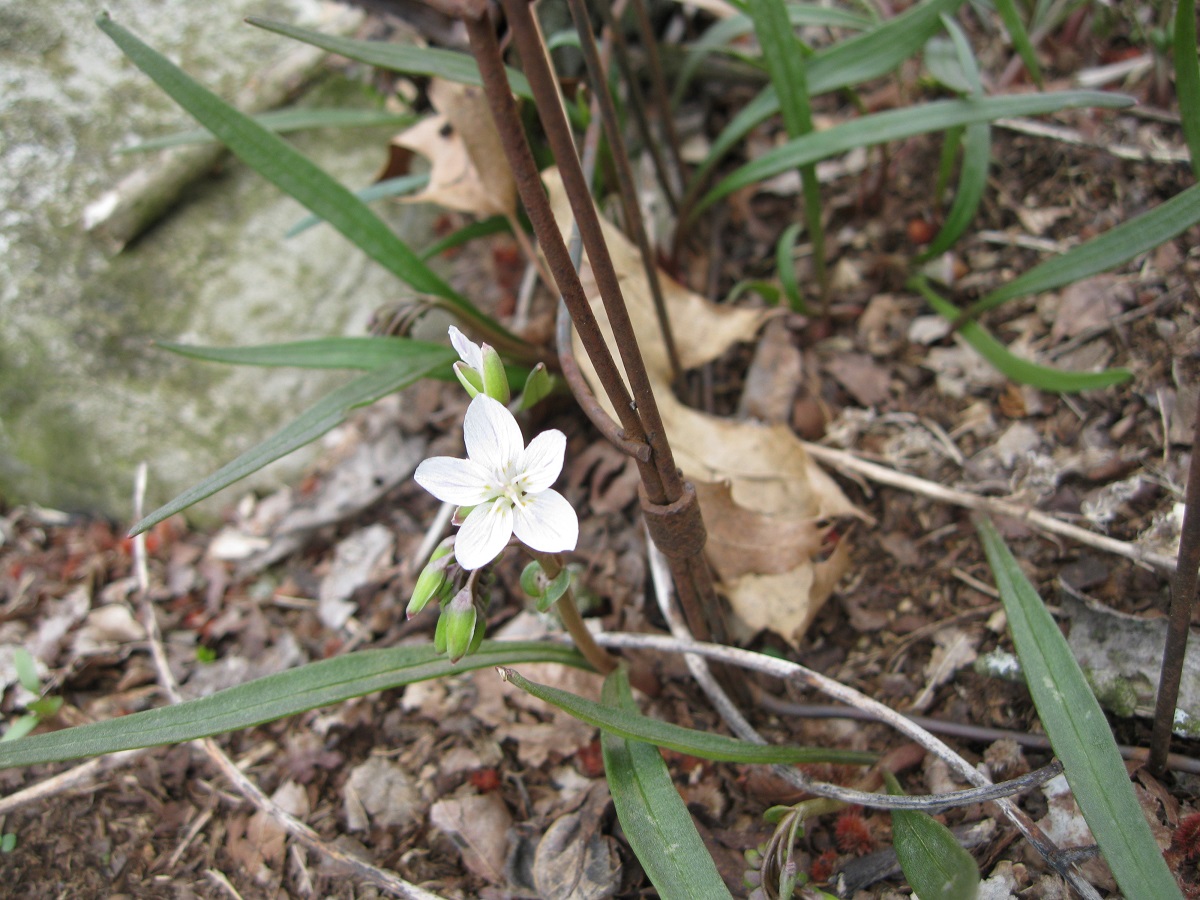
This Spring beauty also opened its first flower here today.  It shares a protective wire cage with the Bloodroot.  That protection may well be responsible for the increase in size of this plant compared with the tiny plant seen here last year.  The corner of the cage can be seen with the plant growing both on he inside and the outside.  Removing the cage now will damage the plant so these plants will remain untended until their growing period comes to an end.  Weeds will undoubtedly be growing here by then.


Three years ago we planted three Sharp lobed hepatica plants in this area of our shade garden.  They are just now making their appearance here.  Many times it takes several years for the transplants of a native plant to settle in.  We were pleased to find all three plants.  Some frost heave had taken place.  We chose to bring in new soil rather than resetting the plants.  This seemed less invasive than essentially digging them up and replanting them.  The fallen tree leaf mulch was reground last Fall.  Is it possible for a plant to look happy?


The remainder of today's pictures were taken today at Irma's woods.  We have been making daily trips here except for being trapped at home by the recent storm.  These plants displayed buds before the storm but some were open yesterday.  That these flowers are short lived can be seen by the condition of the flower in the upper right corner of the photo.  Despite being in only its second day open, both the pollen and some of the petals are gone.  It does not take much of a wind to dislodge these flower parts.  Neither ours at home or these plants show any sign of the unfurled leaf that will be soon be seen under the open flower.


These five plants are freshly opened today.  That can be said with certainty because  we found this quintet days ago and have been making daily visits here.  The color of these flowers is pure despite their rather small appearance this year.  Last year was hard on these plants and that may be the cause of the smaller than normal amount of visible plant.  Larger and taller is how they are usually seen.


These Sharp lobed hepatica plants have been growing here undisturbed for many years.  This is without question an impressive display.


Here are today's two stars side by side.
 

Tuesday, May 5, 2020

Hope


This certainly is a time when finding a reason for hope is a good thing.  Actually finding it in the image of Arbutus blossoms where the sweetly scented flower cups have been pulled away from the plant might bring my judgement into question.  The first time I was confronted with this mess, devastation was the emotion that presented itself.  Now I know that pollinating bumblebees pull the outer flower part away as they exit.  That part of the flower is no longer needed.  Seeds are almost guaranteed to form on these seemingly damaged flowers.  Just why huge insects are part of the pollination process of these rather tiny blossoms is a question without an obvious answer.


That this image greatly lifted our spirits requires explanation.  Last year this ground held an impressive planting of Bloodroot plants.  They experienced a fantastic season of growth with huge leaves and mature seeds.  Then the deer herd walked or danced across our shade garden.  Broken plants littered the ground and it appeared likely that deer hooves had pierced the corms.  Many days have passed with our daily inspections finding no sign of these special plants.  Then this single leaf, possibly wrapped around a flower bud, pushed itself above the soil.  More may follow but if this is the only plant that appears at least our Bloodroot is still alive.


Trilliums end their growth cycle soon after the trees open their leaves.  The deer's later visit might have pierced the corms and any sign of growth here was long in coming.  These leaves show signs of frost damage but appear to remain functional.  Circular wire cages now surround nearly all of these plants.  Our hope is that the congested area will prove unpleasant for the deer.


 Right now living in New York State is not ideal.  As a red-blooded American I bristle at the idea that the government gets to decide what is necessary for me.  That being said, I agree with the "Do no harm!" directive.  Before Covid-19 when only the winter cold kept me housebound, I ordered some native plants  intending to plant my treasures in the spring. Anyone reading this blog knows that our plant addiction is serious.  So we donned our masks and went to a place where we knew we could find the plants we wanted.  Everyone stayed outside in the fresh air and sunshine. We got the plants we needed and paid the money that was due.  Where is the harm in that? 


New York's travel ban has left us confused.  Despite instructions that I am to stay home, Greyhound buses still travel from the Port Authority in NYC to Syracuse.  The Binghamton mayor has asked that these buses not stop in his city and that request has been honored.  We have been limiting our car use to grocery shopping.  Liquor stores remain open under the State travel ban regulations but many plant nurseries remain closed.  Somehow thirty-one new plants have appeared here.  I do not consume alcohol but remain addicted to new plants.
.

Monday, April 27, 2020

Tiny Leaves No Flowers.


This year has been brutal in so many ways.  It is our habit to begin searching for native plant growth long before its likely appearance.  This year has been disappointing in that some species of plants have yet to push above ground a single green leaf.  For reasons that are not clear to us we continue to try and grow Bloodroot.  Its pure white flowers last for only a few days even in a good year.  This year has seen fierce cold winds, little rain and not much in the way of plant growth.  Today another short drive to Irma's woods finally featured Bloodroot.  We have not been able to find it on our earlier trips since it remained underground longer than usual.


What we found today was plants with much smaller leaves than those seen here in the past.  Only tattered remains of flowers were scattered on the forest floor.  This pictured open leaf was the only one seen today.  It is smaller than usual but a seed pod formed.  Many other tiny plants had damaged flower parts with seeds unlikely.

We have come to believe that our dry cold weather is the cause of small or no plant growth this year.  Plan on us returning next year to see just what grows from these stunted plants.


Trilliums are personal favorites.  Those planted in our garden have been slow to appear and few feature a flower bud.  These wild plants display those same problems with leaves that are much smaller than usual and no flower buds.  Their small leaves will feed the underground tuber making possible normal sized plants next year weather permitting.


Even the Trout Lilies are displaying stunted leaves and few flowers this year.  All of these pictures were taken in a largely untouched woodland.  In the recent past we have enjoyed impressively broad displays of native plants here.

Sunday, April 21, 2013

Bloodroot


Bloodroot, Sanguinaria canadensis, has a long sad history here.  Numerous unsuccessful attempts to find a place where it will grow and multiply have been made.  Moisture seems to be the critical issue. Soil needs to be well drained but not too well drained.  Ample moisture is needed but not too much moisture.  In Irma's woods a solitary large patch of bloodroot  flourishes but it only grows there in that one place. That location is near but higher than a wet rocky spring run.  Since rocky spring runs are common in that area, there must also be some specific soil condition necessary for bloodroot to grow.

All of these bloodroot flowers will be gone in little more than one week.  Leaves remain until early summer when this spot will become a patch of bare ground.  Despite the complete lack of any visible plant then, underground life forces continue.  When dry spells hit I must remember to carry water here.  That is a real problem.  Taking time to water bare ground when the garden is full of withered dry plants is no easy task.  Last summer I placed the bloodroot patch on the must water list.  The only other plant on that list was arbutus.

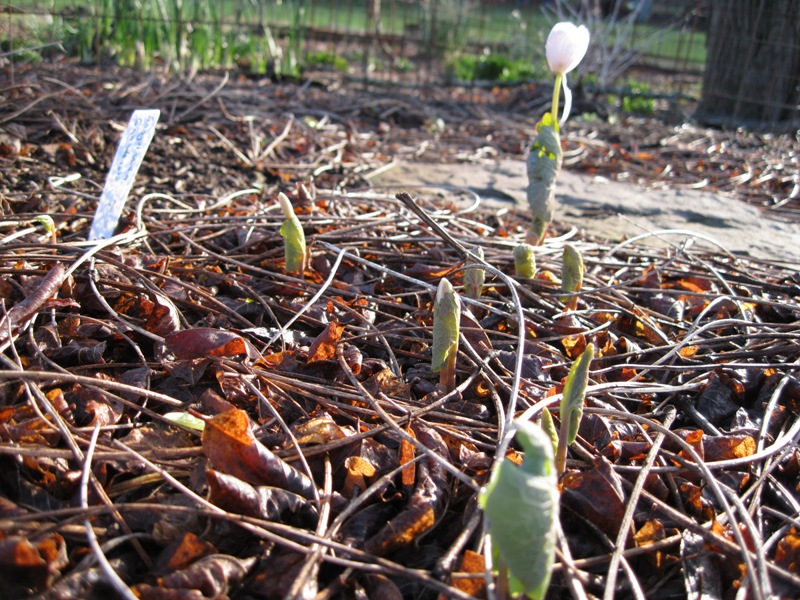
The photo shows varied stages of how bloodroot gets above the soil litter.  A tightly wrapped sharply pointed leaf protects the flower bud as it pushes itself above ground.  Then the leaf begins to unwrap while the bud climbs higher.  The flowers close every night.  They also close on cold days.


Why is a simple white flower worth all of this fuss?  I cannot begin to find an answer to that question.  These flowers are among many that mark the beginning of another season in the garden but none have been more difficult to grow here.  Still, the nine plants showing in the picture are more than the number planted.  We will need another good year if we are to equal the number of plants that have died here under our care.