Showing posts with label ferns. Show all posts
Monday, May 16, 2022
After the Thunder Storm
Wednesday, April 1, 2020
April First Native Flowers
For some time we have been considering which native flower opens first. It does not require a close look to spot these brazen yellow blossoms commonly seen in roadside ditches. Note the complete lack of leaves which will appear later. Coltsfoot cannot be in the running for first native flower since it is an European immigrant.
Eagerness to spot early flowers must be tempered with some reason. Here the leaves are clearly Partridge berry but the flowers are Hepatica. This presentation brings to mind a favorite story told by our elderly neighbor, He saw an Arbutus plant apparently bearing purple flowers. No one will suggest that what he actually saw was Hepatica growing close to Arbutus. I intend to plant Hepatica close by one of my Arbutus plants in his honor.
Sharp lobed Hepatica presents blossoms of various colors and different petal counts. This example bears eleven petals each colored a beautiful light violet. It took me years to appreciate these first native flowers since early garden work kept me from wandering in the woods.
This nearby plant bears only six petals colored a near white blue. In these woods Sharp lobed Hepatica is the first native plant to present flowers.
This Spring Beauty came in a close second. Its bud will soon open revealing another early treasure. Its growth habit makes transplantation nearly impossible. From a pea sized corm a slender underground shoot travels a considerable distance before sending up its above ground leaves and flowers. Removing a plant intact is highly unlikely. As the plant is ending its growth cycle, following the then nearly dead underground shoot back to the corm is no simple task. These plants grow wild in our back woods but are absent from our wildflower gardens.
Six lightly colored petals presented themselves above the jumble that is characteristic of natural forest floor. We were unable to find any sign of Bloodroot plants today. They will appear soon in this location but lost the race for first flower.
Mention must be made of the justification for leaving the house during these trying times. Just across the valley from our home is a bedrock ridge that slopes to the south. Flowers appear first here in response to earlier warming. Our walk took us along the dirt road that crosses this ridge. We encountered no road traffic and saw no bikers or hikers while there. Our outside time here endangered no one. The land where all of these pictures were taken still carries tattered or fallen posted signs bearing the name Haller. A long ago phone call identified the land owner as Irma Haller. We both taught at the Sidney Junior High School for its last decade of service. My call was placed in an attempt to gain permission to explore these woods. What I got was a sincere thank you for respecting her posted signs. Becky and I frequently walk on this road while looking for flowers. While there memories of Mrs. Haller always cross my mind. In keeping with her high standards of expected behavior, we still respect the signs even though Mrs. Haller passed several years ago.
Tuesday, September 17, 2019
Moss or Fern?
Our ignorance of both ferns and mosses is nearly complete. Moss covered stones widely litter spots that they find suitable for growth across our acres. We have been moving some to our developing shade garden intending for them to clearly mark what is path from what is growing ground. Nearly every recent trip across out acres has us looking for suitable stones. In only one area of our woods does this tufted moss grow. It is far different from our other mosses because of its bright green spheres growing some distance above the ground. Yesterday marked my need to move five of these plants into the recently filled planting island. In time they may grow together from path to path.
A closeup of this transplant reveals each hairless stalk sporting spherical growth at its tip. Most people commonly picture moss as a flat close to the ground plant of no distinction. We wondered if this plant might be a fern. Each uprooted clump sported roots that penetrated into the soil much in the manner of ferns. Mosses frequently cement themselves to some favorable rock while displaying little resembling roots.
This plant is undisturbed growing as it has into the forest soil. Two more typical mosses can be seen on the right edge of the photo. We wanted to know more and purchased a copy of Common Mosses Of The Northeast And Appalachians. Its three hundred ninety two pages quickly revealed to us that we were in way over our heads. An early statement in the book pointed out the absolute need to purchase a microscope if one is serious about learning mosses. No microscope exists here but we have a tentative identification of our moss. Juniper Haircap Moss may be its name. Perhaps I am not alone in seeing some contradiction in the scholarly technical description using the word haircap in a proper name.

This picture of the forest floor in the general area where our treasure was found shows both ferns and mosses growing close by each other. I may be nearly alone but I find this scene peacefully beautiful.
Tuesday, December 20, 2016
Searching For Green
This year's gardening season ended with unexpected suddenness. Knowing that many weeds will spend the winter reclaiming our garden beds spread a pervasive gloom. To disperse the dark clouds despite hand numbing cold, it was necessary for me to get outside, have a long walkabout and look for plants that continue to conduct their business despite adverse winter conditions. That is exactly how the past two hours were spent. I feel better already!
An evergreen ground cover is always a morale booster. This is our single patch of wild arbutus. Two years ago a winter starved rabbit ate all of the above ground plant growth when the snow cover retreated. We messed with nature by installing a sub-ground flat stone barrier and a wire cage. Safe from large foragers, these plants have regrown once again and will flower this spring. Small foragers have left their marks on two large leaves.
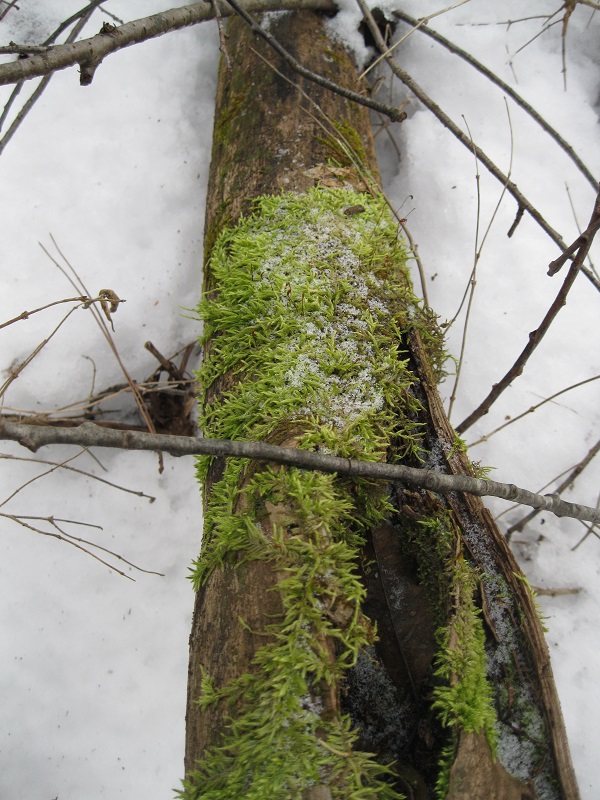
Moss growing on a fallen tree is a welcome sight. I wonder if the hole in the trunk is an entrance to some rodent's home? No tracks are visible but this log is large enough to hold a large cache of stored food making trips outside unnecessary.
Moss growing on rocks that are in contact with the ground always deserves a second look. A recent rereading of an old college geology text found an explanation of how broken rectangular chunks of sedimentary deposits were made round. According to Richard J. Ordway, a memorable college professor, the action of repeated freeze thaw cycles is most severe at the thin corner edges causing them to break and fall away. Cracks in the stones show the orientation of the original horizontal layers of deposition. The farmer that cleared these stones from his field threw them down without regard for which side should have been up.
This evergreen ground cover continues to exist on its own. Partridge Berry is growing mixed in with pasture grass. There is little doubt that the grass will soon have exclusive ownership of this ground. The single berry formed from two fused at the base flowers always catches the eye.
This deer dig reveals the former location of a wild fern. Pieces of the fern were broken off as the deer pulled the snow clear of the plant. Then the fern was eaten to the crown.
Any attempt to plant here unearths vast quantities of stone. These were haphazardly piled so the the actual work at hand could continue. The top of this wall had developed a serious lean. As I walked by I wondered if I could push the upper part of the wall back into place. It turns out that I could do just that. With the mass that was holding them in place removed, the central portion of the wall fell to the ground. It was more luck than my cat like reflexes that prevented injury from the falling stone. Having learned nothing from that experience, I think that I can rebuild the hole while the upper stones remain mostly in place.
Subscribe to:
Posts (Atom)