Showing posts with label shooting stars. Show all posts

Monday, May 16, 2022

After the Thunder Storm


NOAA gave us ample warning that severe weather was headed our way.  From the comfort of the living room we watched lightning strikes hit behind the ridge that we could see.  We did not know what to expect to see when we walked down to the mail box.  The difference in the plants was absolutely stunning considering that the rain had just ended.  These transplanted ferns benefited from water that was carried here.  That water protected life but today's heavy rain caused these plants to fully open.  Visible buck rubs on the tree trunks clearly show that wild animal life consider this ground their home.


Here we have a mix of transplants and naturally sown plants.  Jack In The Pulpits were transplanted here several years ago while the Early Meadow Rue grows from naturally spread seed.  Deer broke off all of the Jacks before their seed had ripened.  Hoof prints were everywhere so the fate of the Jacks was uncertain.  Additional cages will soon be added.  We needed to wait until all of the plants could be seen.


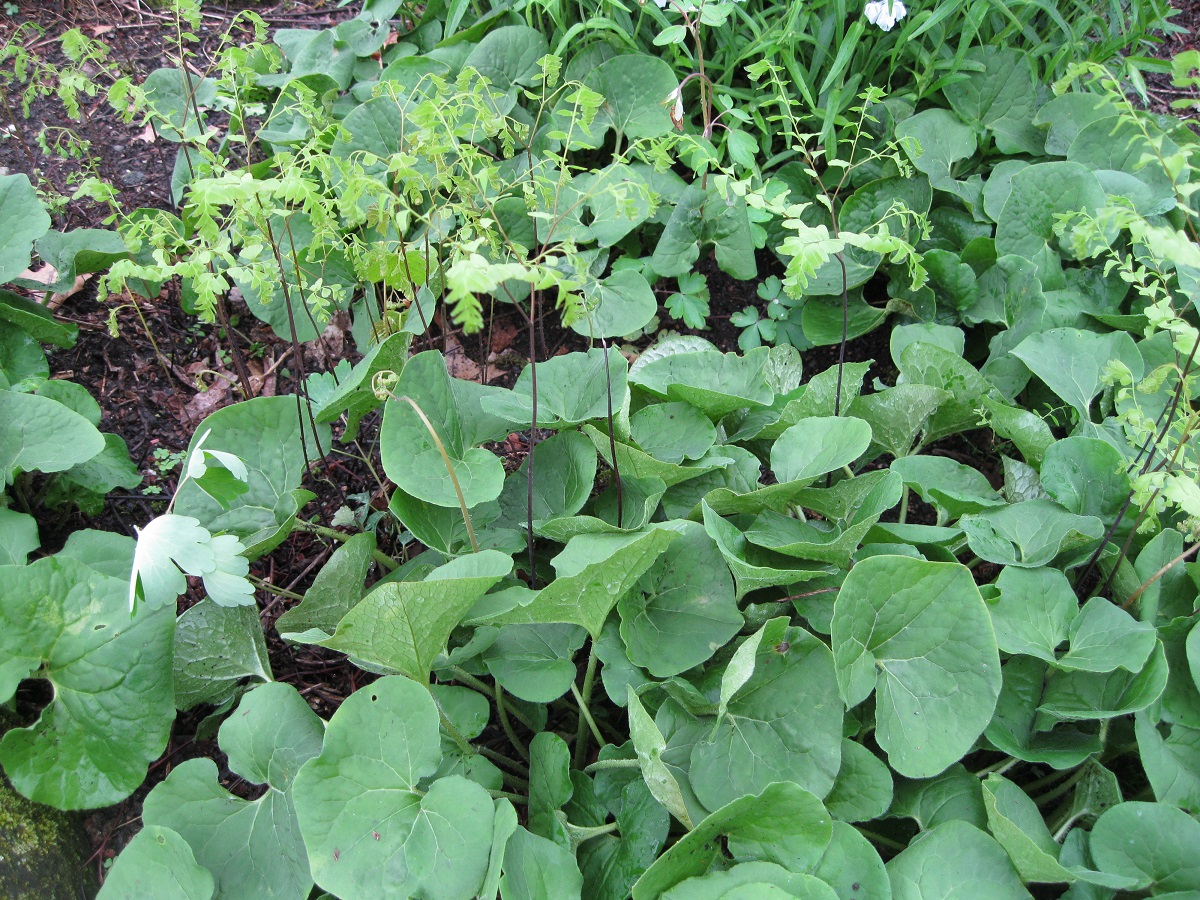
William Cullina suggested planting Wild Ginger and Maidenhair ferns together.  As always, the Ginger has an early start but the ferns will soon catch up.  We find this combination attractive while the underground plant parts occupy different depths.  Soon this display will be stunning.
 

These Shooting Stars were moved here from the shade garden near the house.  The more attractive blue flowered plants are less hardy  and have basically disappeared but these are firmly claiming ground.  Perhaps they prefer more sunlight.


The recent frosts severely hammered these Bleeding Hearts.  The damaged foliage was quickly hidden by new growth with today's rain drawing out the flowers.


Two years ago, Daisies were moved from the gravel bank lot here.  Flowers were seen but this year there was no sign of these plants here.  These were moved from nearby ground and several days saw water carried here as transplanting them looked like a failure.  Today's heavy rain made all of these plants look alive.  Perhaps Daisies are a biennial and we will have to adjust to them claiming new ground leaving weed filled ground behind.


Cardinal Flower has truly struggled to hold onto life this year.  Repeated warm days were followed by hard frosts.  Yesterday these plants appeared to be dead and we found comfort from the fact that this ground held seed from last year's flowers.  Water was also carried to these plants but it made little obvious difference.  Today's rain seems to have brought them back to life.
 

Monday, May 17, 2021

Finally Underway


When the Trilliums fully open their blossoms, the wild flower season is well on its way.  These transplants have been growing here for a decade or more.  Single plants have expanded now sending up several flowering stalks.  Bare ground does not predominate but plants considered to be weeds are evident.  They were cleared out earlier but as always they must return.  They will be removed again after the Trilliums have completed their growing season's work.


This shade garden within sight of the road is a more recent project.  Most of the moved plants are still alive but few have advanced beyond a single shoot.  Just to the right of the flat stone at the bottom of the picture perhaps one dozen Jack In The Pulpits are pushing up new growth.  We were concerned that our crowd of deer had ended these plants with repeated deep hoof stabbings.  If nothing else, the scattered wire cages have made it difficult for the deer to walk here.  The Woodland Phlox in the upper right corner is densely covered with white blossoms.  A favorite snack of the deer required the placement of a circular wire cage.  A curved swath of recently planted Trilliums fills the center of the photo.


Our point and shoot camera does not accurately capture the color of this Jacob's Ladder flowers.  In the upper left corner find the Twin Leaf plants now encased in a wire cage.  It took far longer then it should have for us to focus in on predation as the cause of this plant's repeated disappearances.  Slowly we catch on.  The wire certainly detracts from the natural look that we strive to create but at least the plants remain alive now.


To most people this might not look like much but we finally have two Painted Trilliums that appear determined to open flowers this year.  The purpose of flowers is to produce seed intended to establish the next generation of plants.  We are wildly pleased with the prospects of open flowers and intend to remain above this land long enough to at least see an increase in the number of these plants growing here.


This Woodland Phlox was seen in the background of an earlier photo but we feel that it deserves no less than a picture of mostly it.  This is a hardy plant despite of its attraction of the deer but we expect to see numerous plants scattered about garden.


This is not the first picture of our Bloodroot.  No flowers were produced this year but there is a fairly large number of new plants growing from old seed.  If the weather cooperates, we should see perhaps three blossoms here next year accompanied by several small second year plants promising future flowers.


This planting of Cardinal Flower has been left largely alone.  Some Chrysanthemum stems were scattered about following snow melt but otherwise these plants have been on their own.  The remaining Wild Geraniums need to be removed.  Their above ground growth appears small and attractive but the underground root mass is huge.


 This is the northern tip of Moss Island.  The white flowered Shooting Stars have settled in nicely but the moss clumps barely cling to life.  These plants simply need more moisture and denser shade.  A heavy rain will turn them green but only for a short period of time.  Still, their determination to remain alive is at least inspiring.

Our digital camera is outdated and showing signs of rigor mortis.  It worked today but I don't know about tomorrow.  Eight pictures is perhaps excessive for a post but who knows when its replacement will actually arrive?

Friday, March 27, 2020

First Transplants


Our recent weather has kept us inside but the forecast of an afternoon high of 55 degrees drew us outside.  We found the ground free of frost but tight fitting gardening gloves resulted in cold hands despite the early temperature of 44 degrees.  Moving plants was our plan and moving plants was what we did.  This picture shows all of the new plants in the ground and watered.


Shooting star was the plant we intended to move but a Columbine was growing right next to it.  Not certain that March is the best time to move plants, we decided to avoid possible injury by removing the interloper.  It is possible that different plants growing close together might create a more natural appearance.  Columbine has a long tap root while the Shooting star grows from a dense near the surface root mass.  We will watch to see how our actions today work out. 


A huge pile of plastic bags filled with leaves are close by the planting area.  They certainly do not present a natural look but their contents are a vital part of our attempts to create natural woodland soil.  The property owner that bagged these leaves two or three years ago used his lawn mower to gather up the leaves.  Usually we chop them again with out push mower but it is a little early to drag out the mower so these were spread as they were.  Sharp eyes will find several spots of green showing just where the new transplants were placed.


This shows the final state of this wild ground today.  The clumps of moss were moved here last year.  The two groups of Snow drops were transplanted just recently but not today.  The Shooting stars and Columbines are between the Sumac trunks and the Snow drops.  The chopped leaves will both protect the new transplants and create a woodland floor appearance.  As they rot down, more natural soil will be formed.

That white rock marking the end of Moss Island deserves mention.  It is likely limestone and that means it is not native here.  Our bedrock is shale but the glaciers moved great quantities of broken stone here.  Limestone bedrock occurs to our north so this chunk might be native to Syracuse.  It was found on our land likely close to the spot where the retreating ice dropped it.

Thursday, April 6, 2017

Many Happy Returns!

It is a very April day here!  Rain, thunder  and minor flooding in the usual places are all part of the spring experience here.  Yesterday was different.  It was so nice that spending time outdoors was simply irresistible!  


One of the things on our long, long list of outdoor activities was to clear out the rest of the bluebird houses.  This house had bluebirds in it last summer.  You can tell from the grassy nest.  The little balls of chewed up milkweed fluff indicate a mouse nest.  It can be quite exciting to evict these unwanted winter residents.  No one was at home here so it was easy to just flip the contents into the trug.  I have been seeing bluebirds so it's great to have this done!  In several of the other houses the rodent residents were at home.  Those evictions were far more exciting.  There was a lot of dancing around and squealing going on but Ed and I have been together for a long time and he is used to it. I might have terrified the mice.    Boy, those furry little critters are fast!


We did get some chores done, but I spent some time looking for signs of my returning plants.  I was so happy to see my pink trout lilies poking up through the leaves.  Red now, the leaves will turn green with spots one they have been in the sunlight for awhile. That is a Johnny Jump Up leaf to the right.  Soon happy little purple faced flowers will make me smile.


The shooting stars have broken through. One plant has been pushed up by frost or pulled right up out of the ground by deer  and is showing its roots.  Next time I am out there I will  replant it.


I'm always delighted and a little surprised  to see my squirrel corn come up in the spring.  Perhaps it got its name from the unusual flowers, but the name conjures up an image of the red and grey squirrels quarreling over who gets to eat my plant first!


I think this bright red plant is my single peony emerging.  I could be wrong, but I sure was happy to see it yesterday!


This is a Sea Holly plant.  This plant spreads by self seeding.  It attracts an amazing variety of pollinators to the garden and the lavender flowers last for a very long time.  I don't like to thin these out unless I have to .  This one can stay.  The tiny sedum plants you see here are from seed.  The original plants were given to me by Thelma H., a good friend of my mother. They are another reason to make me smile.


Last but surely not least are some of my Pickwick crocus flowers. April showers bring May flowers, but they bring April flowers too!

Thursday, August 11, 2016

August Meteor Shower

We have a long family history with the Perseid meteor shower.  Starting when our children were of early elementary school age, the four of us spent many happy evenings gazing skyward.  At that time I owned an old beat International Harvester  pickup truck.  We threw a foam mattress, a couple of sleeping bags and the two children into the bed of the truck.  Our plan was to drive to the top of the ridge away from village lights and find a spot with huge sky.  Safely off the road, mom and dad climbed into the back of the truck and the four of us found a way to lie flat on our backs.  Sky events are never easy.  Long periods of nothing but stars were briefly interrupted by quickly disappearing flashes of light as a meteor streaked across the sky.  An occasional satellite or airplane provided us with something different to see.  Oriented in different directions, someone always missed a meteor that others saw.  Trying to keep the eyes focused on nothing is not easy.  There are so many stars and groups of stars to draw your eyes into sharp focus.  Sighting a meteor is not common since they usually fall just outside of the place that has captured one gaze.

Tonight two elderly parents ventured out into the yard following the customary nighttime bathroom call.   Following our flushes, we were delighted to find starry skies. With an old sleeping bag on the ground to give us a dry place to lie down, we faced the problem of safely placing creaky bodies on the sleeping bag.  My move might have resembled a controlled fall and I was soon flat on my back looking skyward.

One of the problems with August nights in New York is the valley fog that forms.  Early morning hours are the best time to see meteors as that is when the atmosphere is moving into the path of the meteors.  Moonset also dictated early morning viewing this year.  As we watched and saw many meteors, the forming fog slowly blocked out the stars nearer to the horizon.  The meteors were originating from nearly directly overhead so the shrinking view spot was not a problem.  The eastern sky did begin to brighten as sunrise drew nearer.

After a rather long and pleasant lying together under the stars, the forming fog made it obvious that we needed to get up and go inside.  The getting up did present some problems.  Oh, the things that the young simply take for granted.  After rolling over to a face down position, hands were pushed back and the rear end raised.  I have heard of a yoga position named downward facing dog and suppose that I used something like that position to ready myself for the next move.  Ever so slowly hands were pushed away from the ground.  Creaking to a fully upright position, I stood motionless as blood returned to my head and balance firmed. With the aid of a flashlight we both  found our way safely back inside.

It was pleasant to recall really great moments from our past.  We did see many meteors tonight and each missed some that the other saw.  No deer snorted at our presence and the scent of skunk was absent from the night air.  The past two hours were an unqualified success.

Sunday, May 13, 2012

Mother's Day Flowers, Photos by Amy

 
Mother's Day has often brought flowers my way.   A newly opened Easter lily greeted me first thing this morning.  I could see right away just looking out the window that this was going to be a beautiful day.


 The shade garden presented me with pink shooting stars.


The white ones are different, but I couldn't chose one over the other.


Clumps of little bluets are a favorite. I could never have too many of those.


This beautiful white trillium has just the barest blush of pink.  If it doesn't get too hot, I should have this one for awhile.


 Wild strawberries are blooming underfoot with berries soon to follow.


 The unopened buds of an autumn olive have such an interesting shape, but the first thing you notice about this shrub is its fragrance.  The scent floats on the wind  and you are surrounded by it before you even see the bush.


Today  the many  butterflies scattered among the flowers were delightful to see.


Meadow sage has been in the garden since the Mother's day that we visited Wildflower Island.  I got a pot of  society garlic  and one of  meadow sage that  day in 2002.  I still have one pot of society garlic, but meadow sage pops up all over the garden.


It's hard to believe that the huge barberry in the back meadow is still blooming. They flower their way to the end of the stem.  Later berries will replace the flowers.


Years ago  little hands picked  violets from the lawn just for me.  How I loved those Mother's Day flowers!


Sometimes dandelions were my Mother's Day flowers.  I loved those too.


Today we cut some of my narcissus to send home with Amy so that she could enjoy them.
I spent the day with my daughter and had a phone call from my son. Mother's Day 2012 was a joy!