Showing posts with label wild ginger. Show all posts

Tuesday, June 21, 2022

Finally Seeds


The first hope when trying to grow native plants is that they will remain alive.  That may seem obvious but we have watched entirely too many simply disappear quickly or slowly over several years.  When we transplanted Wild Ginger next to the stones separating planting areas from path, we hoped that the change there in elevation would allow us to see flowers.  That has happened but we never expected to see mature seeds.  We will most likely leave these seeds alone allowing nature to take its course.  Success will be hard to find since the leaves form a solid canopy blocking ground activity from view.  It is enough to simply know that here in our native plant garden, plants are producing seed for the next generation.


Twin Leaf has held our attention for many years.  We have had difficulty just keeping it alive and never expected to see seed from this plant.  Watching this seed pod develop has held our attention for several weeks.  Books described these seeds as being forcefully cast about by the design of the plant.  Not knowing if a spring throw was likely similar to Jewel weed, or a ride on the wind like Milkweed, we have been carefully watching frequently not wanting to miss the action.  The lid has opened revealing smooth hard looking seeds that will not float on the wind.  No spring mechanism is visible either.  It looks likely that these seeds will simply fall to the ground.  We will continue to watch every day for this show is not yet over.


Getting perfect closeup pictures with our inexpensive point and shoot camera is uncommon.  Near the center of the picture Miterwort seeds are in focus.  This is another show that we usually miss.  One problem with successful self planted seeds is the small new growth is mistaken for weeds and removed.  This plant naturally occurs in our woods and with a cage cover has maintained its existence in our garden.  Just seeing the seeds is an unexpected bonus.  We will look for new young plants.


Pictures of the old grouch are not common.  I was totally unaware that a photo was being taken.  Being able to stand up from a kneeling position is no longer taken for granted.  A spade is nearby and is sometimes needed to have something to push on.  The attire also deserves explanation.  Its strange appearance may discourage interlopers from visiting here.  The old man may be a little crazy.  The white colored shirt, pants and hat serve two useful purposes.  Protection from the sun to avoid any more skin cancers seems like sound thinking.  The hat, neck cover and shirt are all Solumbra products.  The pants are more commonly worn by bakers.  The white colored cloth also makes ticks easy to see and remove.  Trilliums are the chosen plant here and the invasive grass has once again been successfully removed.  New young growth is finally visible indicating that these natives are settling in here.  That gives one something to look forward to next year. 
 

Monday, May 16, 2022

After the Thunder Storm


NOAA gave us ample warning that severe weather was headed our way.  From the comfort of the living room we watched lightning strikes hit behind the ridge that we could see.  We did not know what to expect to see when we walked down to the mail box.  The difference in the plants was absolutely stunning considering that the rain had just ended.  These transplanted ferns benefited from water that was carried here.  That water protected life but today's heavy rain caused these plants to fully open.  Visible buck rubs on the tree trunks clearly show that wild animal life consider this ground their home.


Here we have a mix of transplants and naturally sown plants.  Jack In The Pulpits were transplanted here several years ago while the Early Meadow Rue grows from naturally spread seed.  Deer broke off all of the Jacks before their seed had ripened.  Hoof prints were everywhere so the fate of the Jacks was uncertain.  Additional cages will soon be added.  We needed to wait until all of the plants could be seen.


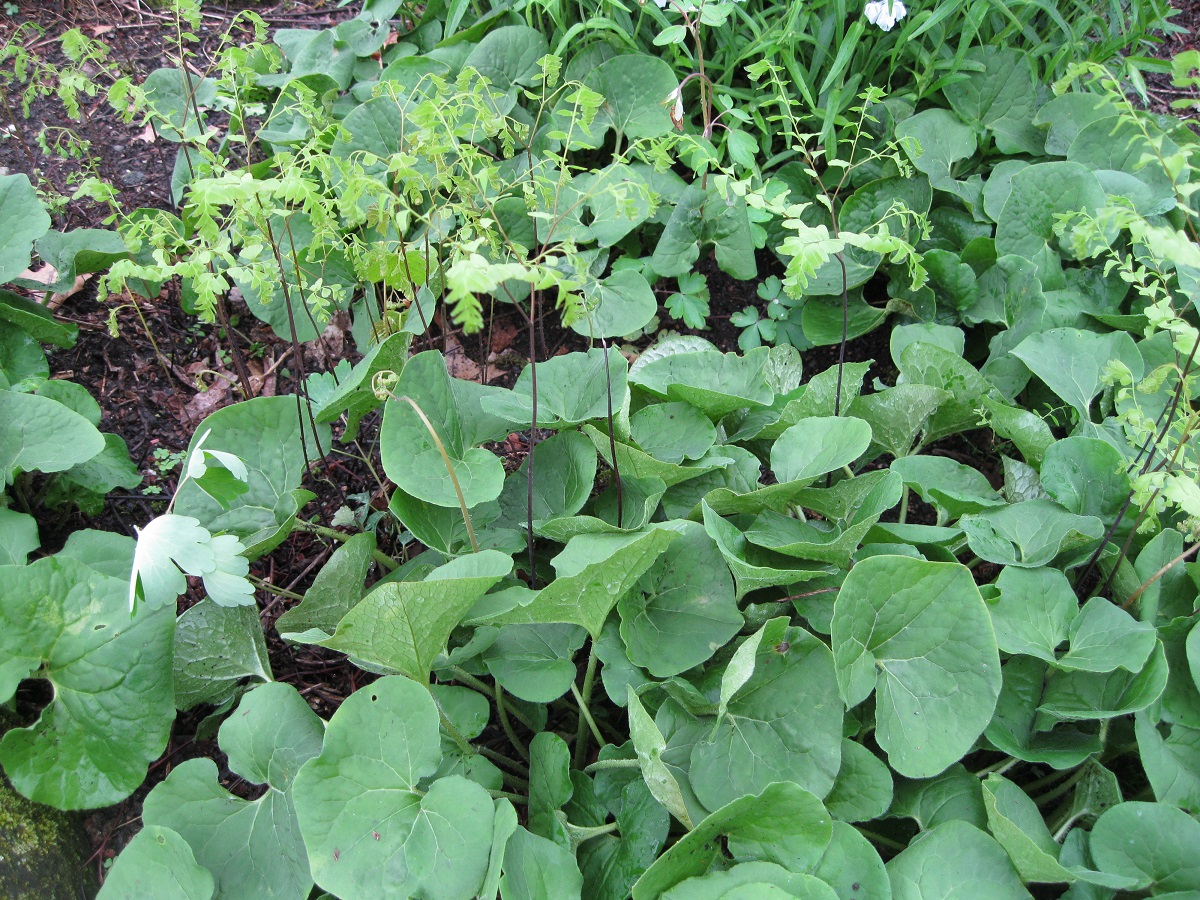
William Cullina suggested planting Wild Ginger and Maidenhair ferns together.  As always, the Ginger has an early start but the ferns will soon catch up.  We find this combination attractive while the underground plant parts occupy different depths.  Soon this display will be stunning.
 

These Shooting Stars were moved here from the shade garden near the house.  The more attractive blue flowered plants are less hardy  and have basically disappeared but these are firmly claiming ground.  Perhaps they prefer more sunlight.


The recent frosts severely hammered these Bleeding Hearts.  The damaged foliage was quickly hidden by new growth with today's rain drawing out the flowers.


Two years ago, Daisies were moved from the gravel bank lot here.  Flowers were seen but this year there was no sign of these plants here.  These were moved from nearby ground and several days saw water carried here as transplanting them looked like a failure.  Today's heavy rain made all of these plants look alive.  Perhaps Daisies are a biennial and we will have to adjust to them claiming new ground leaving weed filled ground behind.


Cardinal Flower has truly struggled to hold onto life this year.  Repeated warm days were followed by hard frosts.  Yesterday these plants appeared to be dead and we found comfort from the fact that this ground held seed from last year's flowers.  Water was also carried to these plants but it made little obvious difference.  Today's rain seems to have brought them back to life.
 

Saturday, May 30, 2020

Walk In The Garden With Me


I'm taking a walk in the native plant garden.  I would love to take you with me.  Please stay on the path and don't be afraid to ask any questions you may have.  I may or may not have the answers.  This is a Greater Yellow Lady'slipper.  Back again this year, this plant should not be missed!  It actually had four buds, but one day a flower drooped and the next day it was gone.  Three flowers are still terrific!


 If I remember correctly, the wild ginger was planted here first.  Ed planted the stump last year.  This year the black cohosh that Jane gave me so long ago was transplanted right behind the stump.  The rock polypody is new.  The little flowers are a  baby woodland phlox that grew from a piece that I stuck in Ed's carefully prepared soil early this spring.


The gorgeous original  clump woodland phlox  is back again this spring.  The pale blue flowers make a lovely companion for the smooth Solomon's seal.  In the evening the flowers seem to glow and the clump can be seen from the road if you slow down  to look at gardens like I do.


The early meadow rue plants are here for their second year and I am delighted to have proof that  just like I thought I do have a male and a female plant.  A few leaves of the mother plant show in the lower right of the picture.  The tiny pale green seedlings are baby meadow rue plants.  We could never have too many of these delicate looking plants!  I will watch these grow and transplant them to fill in empty spots.


Red columbine  and white shooting stars were transplanted this spring from the shade garden up by the house.  Clearly they are happy in their new home.  Virtual garden walks are not as much fun as real ones.  On the other hand I can taake this walk again in December if I want to do that. So can you!

Friday, April 10, 2020

Winter's Return


A dusting of light snow covered the ground early this morning.  Once again NOAA's forecast was accurate.  Sharply bitter winds coming at us from the Northwest meant that no outdoor work would happen here today.  This quick look at emerging plants was all that we did.

The slightly out of focus green blob is a newly emerging Trillium.   I had to perch on a curved rock to get this photo and my balance is far from what it was in the past causing the camera to shake.  So far four have pushed above the soil.  Trilliums take me back to my childhood home located in Newfield.  A section of woods contained a large patch of these flowers.  My habit was to snap off an armload for my Mother.  Unaware that I was killing plants by also removing their leaves, I now plant more here every year.  One simply must have a huge swath of these pure white flowers.


This may not look like much but three tips from a Yellow Lady's Slipper have made an appearance.  More will follow.  It is planted just across the path from the bench.  We will make many trips to sit and enjoy these unusual flowers.  The tiny red spheres are sumac seeds.  It seems that every seed germinates requiring a great deal of time to pull the newly emerging trees.  For now we leave this ground alone to prevent damage to the soon to appear Lady's Slippers.


Squirrel corn's pale yellow flowers are easy to miss.  This early native has a growth habit that seems to doom it to failure.  At the end of its growing season, a mass corms each of which resembles field corn kernels mark the location of the crown of the plant.  They appear to be an open invitation to small animals to dine there.  Somehow enough remain to present new growth the following year.  Having seen the remains of this plant, no imagination is required to see the origin of its name.


Last Fall Wild Ginger was transplanted near the Maidenhair Ferns. This Ginger is the first plant to appear here.  There is still no sign of growth from the ferns.   We have read that this combination of different plants will create a stunning picture.  A future picture is sure to follow.


Robin's Plantain was discovered growing in one of our meadows.  Also called Blue Spring Daisy, it has an  lavender and yellow composite flower similar to an aster. It has since disappeared from that spot but transplants continue to thrive in our gardens.  This one was moved adjacent to the developing shade garden where its location will receive generous amounts of morning sunshine.  It appears ready to grow.


Saturday, July 13, 2019

Moss Island


We spent a great deal of time yesterday working on the garden down by the road.  Few of the stones in the distant planting area were in place when we first arrived here.  Our goal is to have walking paths so that one can safely walk among the plants with no risk of stepping on any treasures.  Aside from the fallen sumac leaves, this ground looks interesting.  The pit manure truck in the background was never intended to be part of the picture but our reality is that a truck like this one or a beat pickup truck is likely to be captured.  From this vantage point we do not have a totally natural woodland garden.

A rather large stone lies in the newly defined planting area.  I was able to move it by flipping it end over end.  Now I cannot raise it.  A hammer and chisel have opened the beginnings of a crack but I can no longer swing that sledge hammer endlessly.  A return visit is planned to attempt to deepen the crack and split the stone in half.  Then the stone will be flipped to its final resting place with the option of placing the two pieces one on top of the other.


Our method for removing highly invasive pasture grass is shown here.  Thick layers of grass clippings are spread over the weeds.  They easily penetrate the cover but the roots develop on the surface between the soil and the clippings.  After a year or two passes it is not an impossible job to roll up the mat and the weeds leaving mostly clean soil behind.  The area covered with chopped tree leaves was covered with weeds when we arrived.  Becky did a masterful job of clearing this area.  An occasional weed will appear but the plan is to place plants here next spring.  With any luck the cleared area will expand this summer.


The poet Robert Frost wrote about the mystery created by a bend in the road.  His words helped place these path stones.  Despite my efforts to define smooth curves, it appears that creating straight lines is my default method.


The last glacier dumped a huge load of broken stones here.  Some are pieces of nearby ridge sedimentary rock while others made a journey of some distance from the deeper sea to our north.  This rock is unusually heavy for its size indicating the likely presence of limestone.  Its moss grew here so it presents an image of both far away and nearby.


Our Wild Ginger is growing strongly in its new location.  New growth is pushing outward. Here the plant will have the option of placing growth in the cracks between the stones making visible the usually hidden from view flowers.  That will not happen quickly but we can be patient.


Most of the rocks visible in this photo started the day on the jumble of stones at the edge of the nearby field.  Fallen down barbed wire fence and ground littered with stones and holes had to be crossed to gather these moss covered stones.  Twenty-four round trips were safely made and these stones are now part of our garden.  Great care was taken handling these stones since the bond holding moss to stone is easily broken.  With any luck the new home will prove satisfactory and the moss will remain in place.

Friday, April 19, 2019

New Plants Every Day


To most this would appear to be a picture of nothing.  It seems that five wooden Popsicle sticks are scattered on the surface of ground dead leaves.  Sharp eyes might see the letters PT on the markers.  It may be hard to believe that we were wildly excited by what we saw here this morning.

In the Fall of 2017, we placed an order for dormant plant parts from Tennessee Wholesale Nursery.  The following Spring nothing grew where we had placed the root-stocks.  A call of complaint was made and we were assured that  we would see live plants in another year.  We were understandably skeptical but were assured that the guarantee would be honored if nothing grew.  So we waited.


This morning we were thrilled to see Painted Trilliums growing near four of the plant markers.  One of the plants had sent up two stems and we will likely see the remaining plant soon.  We fully expect that flowers may be a year or two away as these plants adjust to their new home.  We are more than willing to wait since we have never seen this plant in the wild despite its being reported as common in the Catskills.  We now have live plants that spent a year and one half totally hidden from view.  One has to wonder just what the plant pieces were doing for that length of time.


Here we have two old friends.  The three heavily veined closed leaves mark the appearance of Wild Ginger.  Our new shade garden is the third location that this plant has occupied.  It is just possible that this carefully chosen spot will support growth appropriate for a ground cover.  The bright cluster of leaves belong to Sweet Woodruff.  This nonnative was not part of the planned transplanting but came along uninvited.  It is not by choice that we will allow this alien to remain here.


The Unadilla River Valley has been home to dairy cows ever since European immigrants first arrived on this land.  In the last few years, the size of the dairies has exploded with hundreds of cows never leaving the huge shed on a factory farm.  Manure is drained into huge circular cement ponds where it waits its time to be spread on the fields.  Yesterday the manure tanker made many trips to coat the entire field with this slippery brown gold.  Needless to say the smell of pit manure is nothing like the wholesome scent of old fashioned manure mixed with straw bedding.  Putrid is a descriptive word that is nearly vile enough to describe the stench.


The owners of Cobar Farms are both former students of mine.  We find them to be remarkably considerate since the manure on this field is always turned under the day following its application.  For the size of their dairy operation, this is a really small field but they are excellent neighbors.

Rain is in the forecast for the next several days.  That should send more perennial plants into visible above ground growth.  This year's gardens are truly underway.

Friday, April 27, 2018

Purple Pollen


Native Trout Lily first captured our imagination nearly one quarter of a century ago.  In our stony glacial soil, it grows wildly but flowers rarely.  It seemed like a worthy idea to try commercially available plants.  We purchased plants from two different sources on different years.  We now need to try and sort out just what we have.  The plants are vigorous and flower freely.  They may be European immigrants or have originated on the West Coast of North America.  Either way they have made themselves at home in our developing shade garden down near the road.
 

It is difficult to decide which appears more stunning, the split white pollen gathering style or the purple pollen producing anthers.  Combined with the speckled leaves, the visual statement is powerful.  Unfortunately the plant is low growing and the open flowers point downward.  We will need to return with proper equipment to get more photos.  A foam pad to get me flat on the ground and the small tripod to support the camera while it finds its intended focus could produce great pictures.  This is the first day that these flowers were open so we visited them unprepared for what we found.


This purchased Sharp-Lobed Hepatica has been with us for less than one year.  It certainly appears to have found its new home to its liking.  There is a good chance that two more plants will be purchased to plant nearby this one.  A naturally expanding group of this native plant is our goal.  A chance for cross pollination cannot hurt.


Native Wild Ginger has been with us for several years.  Its location along the inside wall of the stone square was less than perfect.  The adjacent Ladies Mantle grew large placing the Wild Ginger in dense shade.  It continued to grow but we believe that its new location between several Sumac trees will result in its more vigorous growth.  We brought our custom mix of woodland soil to this spot.  The impenetrable tree root mass was covered over to provide growing space for the Ginger.  Ground hardwood leaf mulch will add to the topsoil in time while keeping out weeds now.  We have high hopes for the vigorous desirable growth that may happen here.

Saturday, June 27, 2015

Lingering Frost Impact


Some have not forgotten our late May freeze with frost.  The lasting impact on various plants raises many questions.  Contradictions are all that is clear when looking at what happened to various green growing things.  For the first time in our collective memories, peas were hammered by the freeze.  We have two plantings of snow peas spaced about two weeks apart in time.  The earlier taller plants were hit harder than the younger shorter peas.  As shown by the harvest, these plants made a comeback.  The older plants are shorter than usual and both plantings are ready to pick now despite the difference in when they were planted.


Our wild ginger is planted inside the stone square at the base of one of the walls.  Despite the protection from the rolling frost river, the ginger took a real hit.  Blackened leaves were the only ones open when the frost hit.  Lower bright green leaves opened after the storm.  We probably should trim away the damaged leaves but this is a native wild plant that has survived many generations without human interference.


Our locust tree would prefer to grow 100 miles south of here in central Pennsylvania.  It is late to open its leaves here and has proved to be frost sensitive in the past.  We expected it to drop the newly opened leaves that endured the freeze.  We had absolutely no hope of seeing blossoms because of the cold.  Not only did the tree keep the leaves, it opened flowers. A nearby state road runs along the Butternut Creek valley.  Locust trees line both sides of the highway for several miles.  We were fortunate to travel there when the trees were in flower.  Rich farm fields, a meandering creek and white locust flowers painted a beautiful picture.


We have two varieties of Lily Regale.  Both were covered with a giant plastic garbage can when the frost hit.  Bud-less brown plants mark the location of the plants that show off pure white flowers occasionally.  The variety that has white flowers with red on the outside of the blossoms is apparently more hardy.  We sometimes see many more buds here but at least we will have some open flowers soon.


One of Becky's new purchases was planted out before the cold.  This single remaining flower, smaller than a dime, and a few stubs are all that remain of what was a large beautiful plant.  These pieces may survive but it will take a couple of years before we see a mature Spider Web Hens and Chicks plant.


This astilbe lies directly in the path of the frost river that pours down on us from the nearby ridge.  Despite the protection given be an inverted five gallon pail, impact of the freeze can be seen.  In a normal year this plant would be taller than the stone wall.  Now both the leaves and the flowers look great but short.  Perhaps this plant was forced to put out a second flush of leaves and they did not grow to their normal height.  "Bloom where you are planted!"  It's not always easy!