Showing posts with label Robin's Plantain. Show all posts

Friday, April 10, 2020

Winter's Return


A dusting of light snow covered the ground early this morning.  Once again NOAA's forecast was accurate.  Sharply bitter winds coming at us from the Northwest meant that no outdoor work would happen here today.  This quick look at emerging plants was all that we did.

The slightly out of focus green blob is a newly emerging Trillium.   I had to perch on a curved rock to get this photo and my balance is far from what it was in the past causing the camera to shake.  So far four have pushed above the soil.  Trilliums take me back to my childhood home located in Newfield.  A section of woods contained a large patch of these flowers.  My habit was to snap off an armload for my Mother.  Unaware that I was killing plants by also removing their leaves, I now plant more here every year.  One simply must have a huge swath of these pure white flowers.


This may not look like much but three tips from a Yellow Lady's Slipper have made an appearance.  More will follow.  It is planted just across the path from the bench.  We will make many trips to sit and enjoy these unusual flowers.  The tiny red spheres are sumac seeds.  It seems that every seed germinates requiring a great deal of time to pull the newly emerging trees.  For now we leave this ground alone to prevent damage to the soon to appear Lady's Slippers.


Squirrel corn's pale yellow flowers are easy to miss.  This early native has a growth habit that seems to doom it to failure.  At the end of its growing season, a mass corms each of which resembles field corn kernels mark the location of the crown of the plant.  They appear to be an open invitation to small animals to dine there.  Somehow enough remain to present new growth the following year.  Having seen the remains of this plant, no imagination is required to see the origin of its name.


Last Fall Wild Ginger was transplanted near the Maidenhair Ferns. This Ginger is the first plant to appear here.  There is still no sign of growth from the ferns.   We have read that this combination of different plants will create a stunning picture.  A future picture is sure to follow.


Robin's Plantain was discovered growing in one of our meadows.  Also called Blue Spring Daisy, it has an  lavender and yellow composite flower similar to an aster. It has since disappeared from that spot but transplants continue to thrive in our gardens.  This one was moved adjacent to the developing shade garden where its location will receive generous amounts of morning sunshine.  It appears ready to grow.


Saturday, January 4, 2020

More Green Native Plants


Wild Columbine was found in blossom on the fill that was used to bury the remains of the barn that burned here in the mid 1960's.  When we visited John Burrough's cabin columbine was growing in front of his cabin and around the dry stone wall that enclosed his grave site.  We also found it growing from narrow slits in the shale cliff that bordered the trail at Buttermilk Falls State Park near Ithaca.  It seems like the perfect plant to grow next to our neighbor's mowed field.  Here in January some of the plants are still green.


The plastic tag identifies this as a purchased plant.  Its size may place it among bushes but we plan to use it to separate sections of planting beds.  We were surprised to find it still green.


Robin's Plantain looks like an aster when it is in flower but the season then is all wrong.  Another name for this plant is Blue Spring-Daisy.  We found it growing wild in one of the pastures.  It took to being transplanted and has claimed large sections of ground.  We are using it as another border plant between our flowers and the neighbor's field.  Here again we were surprised to find it still green.


Round Lobed Hepatica is in danger of being overrun by Forget-Me-Nots.  Aside from their exuberance they are a desirable plant.  These will be weeded out when the ground thaws but many will be planted in open ground.


Saving the best for last, here are some new Cardinal Flower plants for next summer.  At least three dead stalks can be seen so the new plants are overcrowded.  Since this is a wild plant we will wait and watch to see just what will grow here come spring.  Some of these plants were known by us to remain green under snow cover but others gave us a pleasant surprise.  They are not the only living things here that are eager for the arrival of the next season.

Friday, June 1, 2018

It's June? Seriously?


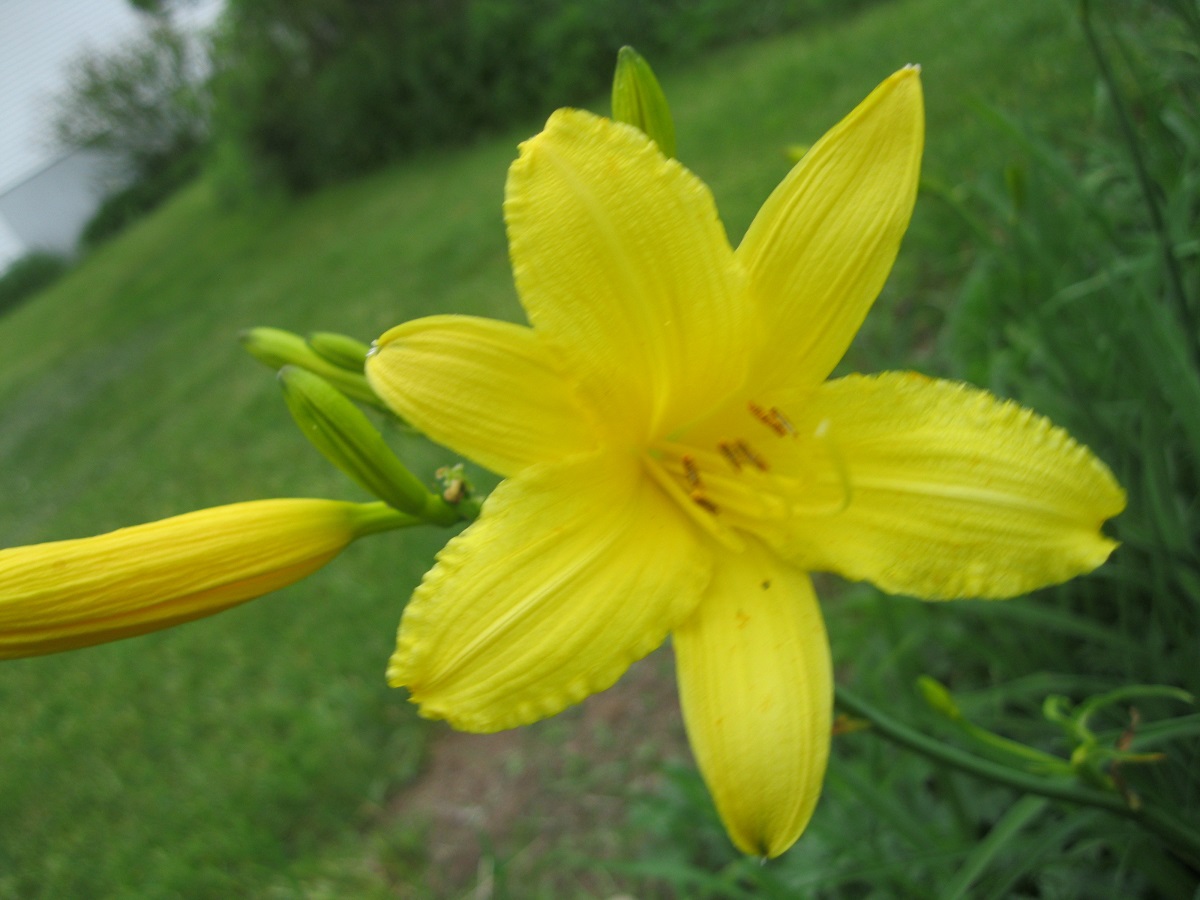
I looked at the calendar and May had thirty-one days this year just like always.  How did it go by so darn fast?  We have not had Lemon Lily flowers for several years.  They  have usually been frosted in May but not this year!  Early this morning I saw the cheery yellow flowers from the house.  I wanted to get out there while it was still cool.  Since there are weeds popping up everywhere,  I chose to work right next to these lovely flowers.  The first thing I did was stick my nose into this flower coming face to face with a Flower spider.  I backed off and so did she but she only went to the other side of the flower where I could no longer see her.  The whole area around the lilies was filled with fragrance.  It was a pleasure to remove unwanted plants and give these beauties their place in the sun.  While I was out there, two  blue Indigo Buntings stopped by close enough for me to enjoy their iridescent color and twittering.  I stopped to watch them and  the  House Wrens that seem to have babies  to feed in the pink birdhouse.  


The Robin's Plantain, also known as Blue Spring Daisy, is blooming now too.  It is a native from a patch that  used to grow in the back meadow.   It is a plant I have rarely seen elsewhere.  It could use some help holding its spot.  Perhaps it will get moved to the top of the list for my next time spent in the garden.


Gorgeous flowers are blooming everywhere.  This is the Blue Flag that grows in front of the house..


All of the Iris are opening now.  This family heirloom goes back to my Mom and my Grandmother.  The fragrance of this flower is a memory from my childhood.  Not big and showy, but hardy, fragrant and lovely, this is one of the plants that garden visitors ask me to share.  I do that often and gladly!  It is cooling off now.  Perhaps I can do a little more before it rains!

Sunday, November 4, 2012

Loose Ends


Native wild flowers often present contradictions to anyone that tries to bring them into the garden.  Cardinal Flower continues to puzzle us.  It reproduces by both seed and daughter plants at the crown.  Six young plants and uncountable numbers of seeds are produced every year by a single plant.  One would expect weed like numbers from this treasure.  That is not the case here.  Late spring freeze and thaw cycles are terribly hard on the daughter plants.  New plants from seed have eluded our identification.  This fall we planned to resolve the latter matter.


One of those black plastic nursery trays was placed over freshly weeded garden soil.  Commercial potting soil filled the tray and spilled over the edges.  Seed that had been gathered on one of those rare dry fall days was sprinkled on top of the sterile potting soil.  In nature the wind shakes the plant stems scattering the ripe seeds.  They fall on the surface of the ground.  Light may be necessary for germination so the seed was left on the surface.  If cardinal flower seedlings appear here in the spring, we will be able to see just what they look like.  Knowing their form will help us save some during early spring weeding.  Our ignorance may have placed countless seedlings in the compost bucket.


Robin's Plantain usually blooms here in  late spring.  These late fall flowers are a fluke.  Usually the stems on this plant are much taller.  For some reason this plant was compelled to produce these short flowers in November.  I suppose a real optimist would take this as a sign of an early spring or a mild winter.  The snow and chill in the air today does not support that idea.

Sunday, May 20, 2012

A Garden Book Review


This book is one of my treasures.  I don't think you can pick this one up at your local bookstore.  If however, you like to collect vintage garden books, this one is a gem!  How to Know the Wild  Flowers was written by Mrs. Wm. Starr Dana in 1897.   It is illustrated by Marion Satterlee.  Mrs. Dana was a friend of John Burroughs.  It's likely that it was this friendship that made it possible for her to get this book published.  As it was, she had it published using her husband's name.  It was Burroughs' idea to write a wildflower book dividing the flowers by color and  then listing them in the order of their bloom time.  The illustrations are black and white drawings that are exact enough to make good identifications of unknown wild flowers.  It is especially useful and interesting to me because the book covers wildflowers  known in 1897.


It was some years back when I discovered this unknown wildflower at the Stone Wall Garden.  I searched for some time to identify it.   I have a number of wildflower books, but it was in Mrs. Dana's book that I found this description.

 Robin's Plantain. Blue Spring Daisy,  Erigeron bellidifolius. Composite family.

"This is one of the earliest members of the Composite family to make its appearance, that great tribe being usually associated with the late summer months.  The flower might easily be taken for a purple aster which had mistaken the season..."

A link to this post and to other reviews of gardening books can be found at Roses and Other Gardening Joys.  There is little time to read  now, but it's nice to have a wish list of  books to be ready for those long winter nights when reading about gardening is great entertainment.

Monday, May 26, 2008

Robin's Plantain


Do you know this wild flower? It is also known as Blue-spring daisy. I was stumped when I found this flower in the meadow. I didn't recognize the plant, so I took one flower for identification purposes. It had a tiny piece of root. I stuck it in Ed's latest bed to see if it would survive. That was several years ago, and since then it has become a dense patch.

I never found the flower in any of my recent books. I did find a line drawing and description in Mrs. William Starr Danas', How to Know the Wild Flowers, 1897, and I think the plant is mentioned by John Burroughs.

Although I've never seen the plant anywhere else, I'm told it is common. The patch certainly is growing at an exponential rate. I think we will make a place in the meadow and put it back where the competition from other plants will keep it in check. Well, maybe I'll replant just a little piece where it is. I still think of it as a rare and beautiful wild flower.