Showing posts with label Round-lobed hepatica. Show all posts

Wednesday, March 10, 2021

56 Degrees In The Shade


Today was a day well worth waiting for featuring clear skies and warm temperatures.  A cautious walk across ice and snowpack led us to plants that are just today free of snow cover.  This is a picture of Bluets that have a long history of disappointment here resulting from their frequent disappearance.  Here we see a plausible explanation for that problem.  Fresh deer tracks in the snow and an uprooted plant likely illustrate the problem.  Today, Becky firmly replanted the chewed then spit out plant piece deep in a narrow crevice in the wall stones.


Columbine is a persistent native plant.  Breeders have developed wild colors for this plant but we prefer the red natural color.  John Burroughs had a blue flowered version of Columbine growing in front of his cabin located on land where he grew up.  During our visit there seeds were ripe.  We do not usually snatch plants but some of these seeds found their way into my pocket.  As a possible lesson in maintaining proper behavior, none of these seeds grew here.


This may well be the star of today's show.  Round Lobed Hepatica is a native woodland plant with the uncommon habit of carrying over functional leaves from the previous summer.  These tattered leaves will provide nourishment  for the first wildflower blossoms of the year.  They will be followed by a compact cluster of new leaves.


This fern was a new purchase last year.  Rock Polypody is its name and two fernlike leaves are visible.  Above and to the left may well be the freshly chewed stems that correspond to the nearby new deer tracks.  Wire cages are both unsightly and common in our planned wildflower woodland garden.  If the ground thaws tomorrow, another cage will be placed here if we can find one free of frozen soil's grip.


Chickweed suffers from the same ailment that keeps dandelions from being seen as a treasure.  Both are wildly hardy and excessively common.  Chickweed is constantly weeded out but we cannot eliminate it.  That may be a good thing since in the past persistent leg sores on an old man were cleared with the application of Chickweed tea when the doctor had no treatment to suggest.  As the photo shows, this plant grows under a thick layer of snow although new blossoms may be days away.


This plant is new to us and its name remains elusive.  A stone still hidden under the snow carries the name but we could not see it today.  This plant is obviously hardy and we remember its yellow flowers.  Safe from the deer, we look forward to another year with this plant.  When we learn more about its growth habits, a better location may be necessary.


Woodland Phlox may solve a huge problem for us.  It grows with reckless abandon and will soon fill a respectable area with yearlong growth.  Many of our shade garden plants are more reserved and leave much ground free of desirable growth.  After a winter of covid lockdown, it was simply wonderful to find living plants growing where just yesterday only snow could be seen.


Saturday, January 4, 2020

More Green Native Plants


Wild Columbine was found in blossom on the fill that was used to bury the remains of the barn that burned here in the mid 1960's.  When we visited John Burrough's cabin columbine was growing in front of his cabin and around the dry stone wall that enclosed his grave site.  We also found it growing from narrow slits in the shale cliff that bordered the trail at Buttermilk Falls State Park near Ithaca.  It seems like the perfect plant to grow next to our neighbor's mowed field.  Here in January some of the plants are still green.


The plastic tag identifies this as a purchased plant.  Its size may place it among bushes but we plan to use it to separate sections of planting beds.  We were surprised to find it still green.


Robin's Plantain looks like an aster when it is in flower but the season then is all wrong.  Another name for this plant is Blue Spring-Daisy.  We found it growing wild in one of the pastures.  It took to being transplanted and has claimed large sections of ground.  We are using it as another border plant between our flowers and the neighbor's field.  Here again we were surprised to find it still green.


Round Lobed Hepatica is in danger of being overrun by Forget-Me-Nots.  Aside from their exuberance they are a desirable plant.  These will be weeded out when the ground thaws but many will be planted in open ground.


Saving the best for last, here are some new Cardinal Flower plants for next summer.  At least three dead stalks can be seen so the new plants are overcrowded.  Since this is a wild plant we will wait and watch to see just what will grow here come spring.  Some of these plants were known by us to remain green under snow cover but others gave us a pleasant surprise.  They are not the only living things here that are eager for the arrival of the next season.

Sunday, September 1, 2019

Hepatica In September


For the most part, we came to native wildflowers rather late in life.  Becky has an incomplete memory of Arbutus that is limited to instantaneous recognition of its scent.  Trillium and Jack In The Pulpit are the extent of my childhood flower memories.  In our retirement years those three plants were our focus in establishing a wildflower garden.

The pictured Hepatica has been with us for a number of years.  Surrounded by weeds, it seems to have escaped any recent notice.  That speaks of possible ignorance on our part since many of our native plants are at rest showing no above ground growth now.


This Hepatica may be in its second year with us.  Planted in the new garden, most of the surrounding ground is bare with the exception of shredded leaves.  Finally the fact that these leaves will survive winter made an impression on me.  This plant is among the first to flower here.  That is just the beginning of its display.


The first two photos were taken today.  The next two show flowers open in April.  The Popsicle stick label identifies this plant as a resident of our new shade garden.  A three lobed leaf shows both the remains of a blossom and the source of the name Liverwort.  As this leaf matures it will more closely resemble a human liver as legend has it.  Perhaps the resemblance will be to three closely spaced livers.


This picture was taken in a wooded area just across the Unadilla River.  There a dirt road climbs uphill where a bank lies close to the road.  Looking up at flowers growing there creates stunning images of flower parts usually hidden from view.  This picture is special for two reasons.  First, a purple flower always catches my eye.  Secondly, the three lobed leaf was formed in the previous year.  Hepatica blossoms appear before the new leaves push themselves past the fallen leaf litter.  Old winter worn leaves provide the nourishment for these early flowers.  Leaves visible in the first two pictures will appear next spring darkened and worn by their winter under the snow.

One location near the top of the slope above the roadway features a huge display of Hepatica plants.  Growing between stones and ferns, their early blossoms, create a stunning image.  My plan for spring is to place a large number of newly purchased plants near the moss covered stones that now line a new planting area in our shade garden.

Wednesday, April 10, 2019

Finally Flowers


Yesterday, when these pictures were taken, began as the second consecutive warm pleasant day.  Thunder and rain gave way to unpleasant cold.  Overnight frost was missed by just two degrees.  These Round Lobed Hepatica flowers are the first of our native plants to bloom.  Three were purchased last year at Catskill Native Nursery and all are still with us.  This plant's flowers before leaves habit give us a local story of interest.

A neighbor that built his house on the western edge of the Batterson Farm firmly tells the story of his discovery of a purple flowered Arbutus.  Arbutus carries its dark green leaves beneath snow cover and its white or pink blossoms are still a few weeks from opening.  Out in his woods early in the year, he saw purple flowers nestled among the evergreen Arbutus leaves.  It certainly looked like that Arbutus did indeed have purple flowers.  Since that plant was reported as quickly stolen, no one else had a chance to see that unusual sight.  One of our Hepatica plants appears mature enough to divide.  This Fall we will attempt division and place one under light Arbutus growth.  We will not be able to share the resulting purple flowered Arbutus with our neighbor since unfortunately he has lost his eyesight.  He will however be able to hear that his discovery made years ago remains alive and well near where he first found it.


Last year two Bleeding Heart plants were purchased in Norwich and placed at either end of the bench in our newly developing shade garden.  Both flowered and one has made an appearance this year.  It appears that we will have a large native plant flowering close to the bench.  Later this year we will likely see a photo of Becky sitting on her bench surrounded by native flowers.


This Virginia Bluebells plant is also in its second year with us.  It too was purchased at Catskill Native Nursery last year.  Our memory says that it did not flower during its first season with us.  It looks like this strong new growth just might produce flowers this year.  Either way we will not be disappointed since the plant remains alive.


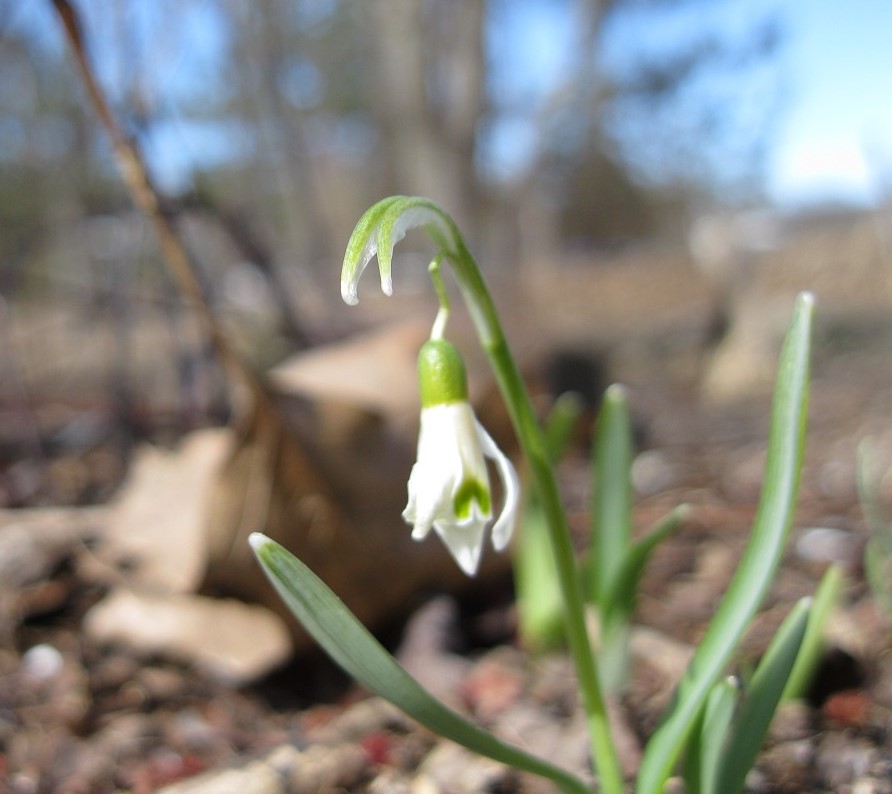
It is easy to see why these nonnative plants are widely popular.  Snowdrops frequently open their white flowers while snow remains on the ground.  They reseed freely with large clumps proudly holding garden ground.  Winter aconites also frequently flower surrounded by new snow.  Their yellow flowers certainly catch the eye even when they are surrounded by brown dead leaves.  These plants are in the shade garden near the house although some of the Snowdrops have been transplanted in the developing garden down near the road.

Aged hands do not respond well to working in cold soil when the air temperature remains in the 30's so this post represents today's gardening activity.

Saturday, April 6, 2019

Budding Hopes


Ed and I have been faithfully touring the shade garden peering at all those places where we hope to see signs of Spring buds.  It is April after all and we don't want to miss anything.  The red shoots of these pink Trout lilies have been tantalizing us for awhile, but today we were treated to an actual flower bud and the lovely speckled leaves to go with it. Yes!!!


Ed had to climb up on a rock and lean over to get this closeup of a Round-lobed Hepaticia bud.  It is just getting started and you have to really look to see it.  Ed centered the picture perfectly.  If you click on the picture and make it as big as possible, you can see the flower bud making its debut.  We are especially excited to see life from our native spring ephemerals.  Waiting has been hard, but it does make us appreciate sweet success!


Green buds on Ed's treasured Trailing Arbutus plants had him kneeling on his gloves to carefully remove many leaves and debris that were beginning to smother those soon to be open, favorite, fragrant flowers.


Beautiful little  Katherine Hodgkin Dutch iris came back again.  Their numbers seem to have decreased in this spot, but three perfect little flowers still make my heart sing.  To some it may seem silly to be so thrilled by the coming of Spring in the garden, but I know some who read this will totally understand. 

Monday, March 25, 2019

First Day Truly Outside


This winter has not been thought of kindly in very many circles.  It just will not quit and make room for some warmer days.  Last night the temperature fell below freezing again and this ground remains hard despite clear skies and warm sunshine now.  Careful persistence did allow for some progress in creating a path for the water that is certain to come that does not include removing some of the driveway.

The pictured combination of a supporting pole and bent knees would make it appear that I read and understood points made in the stretching book that daughter Amy presented to me this weekend.  Actually this is the only way that I can reach the ground.  The ditch always fills with plowed snow and ice since no plow can clear the depression.  Recently, a maddock was used to pry away thick ice where some melt water had opened a channel under it.  Today's goal was to deepen the channel in an attempt to contain the runoff that is certain to come.  Two wheelbarrow loads of sod were removed and wheeled downhill.  An old guy must work smart.


These Snowdrops have been watched daily longing to see an open flower.  Transplanted just last Fall, the spectacular display will be seen next year.  That they are alive and trying is all that was hoped for.
Nonnative, they were knowingly placed in our wild plant garden since we need an early flower.


What is it ? is the obvious question here.  The red fuzzy spheres are sumac seed berries that the robins eat.  Near the top of the photo are two globs that feature fuzzy tops and three stem pieces form last year's leaves.  Round Lobed Hepatica is the name of this native wildflower that was transplanted here one year ago.  It has survived and has begun to grow with early Spring flowers promised.  It appears that we actually have two plants here and if that is the case they will be separated this Fall.  Soon we will see pale purple colored flowers appearing ahead of the new leaves.  Yes, these fuzzy lumps have us excited.


Royal Catchfly has proven difficult for us to grow.  A small fortune has been spent buying new plants year after year but it appears that one of last year's plants intends to grow here for another year.  The bright red flowers still seen on the plant tag should make the appeal of this plant obvious.  Cleaning up spent Siberian Iris leaves will happen when both the ground and the plants are no longer frozen.  At that time the desired plant will be gently pushed just a little deeper into the soil.


Daffodils are well under way here.  For some reason our attempts to give these plants growing room usually sets them back for two or three years but these really need to be divided.  That task will properly wait until Fall while the huge Siberian Iris in the foreground is scheduled for removal and division soon.  We have no idea just where all of these reasonably sized plants will go but space must be found.  We have not got what it takes to trash plants that will grow beautiful flowers.  That iris is huge and we are not certain that we can remove it in one piece.  Breaking off pieces is the more likely method.  Soon we will have more to do than we can possibly get done.  We have dealt with that reality many times in the recent past.