Showing posts with label transplanted arbutus. Show all posts
Sunday, April 17, 2016
Worth The Wait
One of the advantages of these no film cameras is that large numbers of images are essentially free. Arbutus flowers present several challenges to any camera. Tiny blossoms with a deep central cavity make finding a clear focus nearly impossible. Some part of the image is always blurry. White coloration is not handled well by these cameras. These pictures do not come close to showing the colors that I saw this morning. Light pink splashes of color were seen on nearly every flower but cannot be seen in the photos. This morning the sun had not yet cleared the ridge when these pictures were taken. The first image shows the promise of splendid displays yet to come.
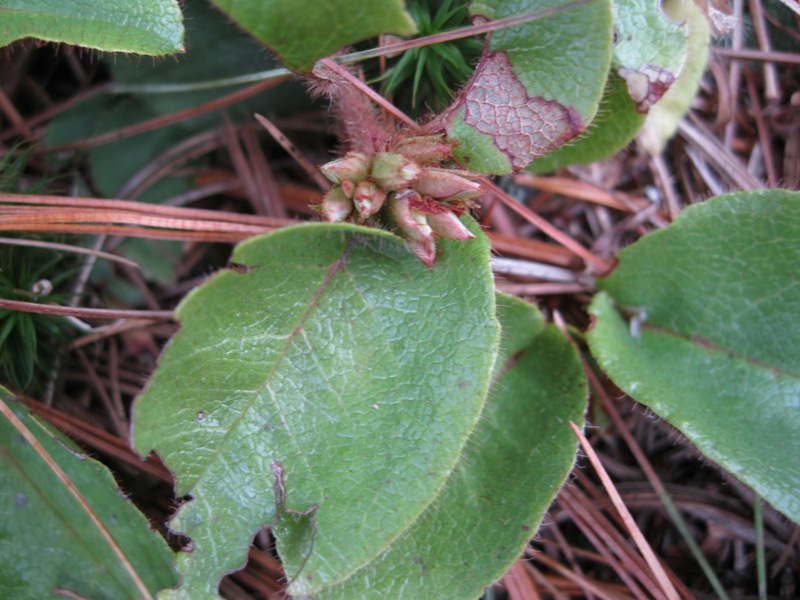
These flowers present much more pink color to the eye. One blossom has already been knocked from the plant. Many of the bud clusters are under the fallen pine needles. One must do a little staging to bring the flowers into view. Despite working reverently and carefully, I may have dislodged the fallen flower.
Here the base of a male flower is in focus. The tan grains will soon produce pollen. Clear or white moist appearing hairs line the walls of the tunnel that leads to the base. Soon the tan structures will be covered with yellow pollen. This has only been seen in the photo of another as we have to date always missed it. Arbutus is a plant that is built on five parts to many features. Five petals make each flower. There should be five of the tan pollen producing grains but that is not what the photo shows today.
This is the state of the transplants that were moved here two years ago. I was unable to carry water to these plants last fall and feared for the condition of the bud clusters. Many remained brown and shriveled but some managed to open flowers. Fallen white pine needles covered the lower parts of each plant. Light penetrates the needle cover and some insulation helped these plants survive our snow-less winter.
Here is the entire patch. Six transplants were placed entirely too close together but each can almost be seen. One the left edge of the picture, two plants lie between the stones. On the right edge, three plants are in a line between the stones. The center plant is still small as pine sap killed several leaves during its first summer here. The single huge plant centered at the top completes the group.
This may be our best photo yet of arbutus flowers but more will follow.
Monday, February 22, 2016
Setting Goals
This area is among my favorite places to walk on this glacially twisted land that is ours for the moment. The massive white pine tree has grown up through the stone wall that was built when the field, visible through the trees at the left of the picture, was first cleared nearly two centuries ago. That river bottom land becomes covered with a cone shaped pile of mixed outwash that poured over the edge of the receding glacier. Filled with an assortment of stones of various sizes, mud, clay and sand, that ground was quickly deemed not suitable for farming. It is a pleasant place to walk if one stays on the lower edges of the steep slope.
A deep natural soil developed at the base of the old tree. Several generations of fallen pine needles have rotted into an acidic mix that should support the growth of arbutus plants. Two of our transplants were moved here last summer. A small old cage protected the plants from hungry rabbits this past winter but more permanent arrangements need to be made. A 6 X 6 foot square of wire fence was bent to a 5 X 5 square with 6 inch high edges. After the ground thaws, a low field stone well will be built around the outside edge of the cage. That will prevent hungry woodchucks from pushing the cage aside or rabbits from wiggling under it to feast on evergreen arbutus leaves.
The growing white pine tree simply pushed the old stone wall aside. That piece of wall is still largely intact but now sports a curved outer edge. Restoring the near edge of the wall to a straight surface is an option. If that happens, the curved outer edge will be left as it is. The new straight wall will only approach the tree. Room for some additional tree growth without moving the new wall will be left.
My desire to help the native treasure arbutus find a natural home here is filled with contradictions. Without the cover of the ugly wire cage, numerous hungry animals will eat the plant flush to the ground. Looking ahead, arbutus will likely prosper here and soon reach the limits of the cage. New growth will then appear beyond the cage and be at risk of becoming rabbit. In time the cage will rot and the entire patch of arbutus will then be at risk. We cannot change the fact that former farm land supports animal growth in numbers that far exceed what was present before man came and made this his home. Our efforts may allow wild arbutus to grow here again if only for a short period of time. We find that limited success well worth the effort. Time spent working outside at this time of year is an additional bonus.
Sunday, November 22, 2015
Yet Another Arbutus Post
Our unusually warm November days have drawn us outside focusing on cleanup to get a jump on next year's garden. Daily walks always include a visit to the arbutus plantings. Transplanted last year, these plants are closely watched. Their new flower buds seemed smaller and less healthy than the buds on our older plants. These pictures were expected to reveal dead flower buds since I was unable to carry water to them during the dry months of August and September. Once again the camera sees more detail than our old eyes. These buds may be smaller than the others but they are alive and healthy. The possibility of a generous flower display here has us looking forward to the end of winter.
Another situation sets these plants apart from our other three plantings. Numerous chewed leaves here show that many creatures are feeding on these plants. The leaf that still displays its skeletal structure and lower leaf surface is particularly interesting. What is the identity of the delicate feeder that left this behind? These meals were taken earlier in the year when we were not making daily visits. We did not see the feeders and have no clue as to their identity. No action will be taken to limit the foraging since this is a wild plant that is supposed to survive on its own. We do screen out the rabbits and the woodchucks but their numbers are excessive here as this former farm reverts to woodland.
These six plants have had two summers here. Their close spacing will soon make it impossible to tell where one plant ends and another begins. As the plants grow across each other, male flowers and female flowers will appear in close proximity to each other. This was not the plan but it might just work in producing viable seeds.
The mostly mossy patch to the right is the location of a transplant that endured a continuous drip of pine pitch last year. Leaves coated with the sticky white stuff could not function to support new growth. This plant remains alive and should in time catch up with the others. Now the pine drippings are falling on the plant at the top of the photo. With numerous larger leaves it continues to prosper despite the hardship.
One of our goals is to understand the habits of this plant. A recent revelation is that flower buds appear at the ends of stems newly grown this year. We cannot say for certain that buds only form on new growth but that seems likely. Roots form at junctions in older stems so we do not disturb the plants by poking around looking for answers to questions that are of no real consequence. We do enjoy this plant and are eager for the sweet scent that will fill spring air.
Tuesday, October 27, 2015
Fallen Leaves
As October draws to a close, the sights and sounds of man fighting fallen leaves are common here. If left to winter over where they fell, a slimy sodden mess will be revealed when the snow cover finally disappears. Clearing leaves on a bright fall day has pleasant components. Lawns are light bright green when the leaf cover is quickly pulled away. A pleasant scent unlike any other fills the air at this time of year. Cold has ended most of the annoying flying insects by now and pleasant days outside are definitely limited at this time of year. We do not have lawns to rake but in some places the leaves require attention.
Arbutus is an evergreen plant that cannot simply sleep until spring. Sunlight to some degree is needed to maintain its life function. Our first discovered wild patch of arbutus grew on a steep slope that was becoming home to birch trees. Despite the steep north tending slope, fallen leaves did not clear and the arbutus were smothered under their deep dark cover. Wild plants finding death is a natural process. Human intervention is short term but is all that we can do.
These plants found their location without human meddling. They grow in the lumpy overburden that was pushed aside more than a half century ago to open a gravel pit. We have known about the location of these plants for years but sometimes we could find no trace of them. Two winters ago I discovered tell tale signs that a rabbit was eating these plants. That is yet another peril of being evergreen. When the weather warmed, a protective wire cage and a field stone wall were placed to protect the remains of these plants. Recover they did but now fallen leaves threatened to end them once again. Human hands had to intervene.
With the cage set aside, fallen leaves were gingerly removed from the recovering arbutus. All of this regrowth is one year's work since the foraging rabbit left no sign of a leaf anywhere. Flower buds were found on larger pieces of new growth. This surprised me since I expected two year's of regrowth would be required before flowers would be seen here. The wire cage is back in place and low sunlight is once again nourishing the desired plants.
What will happen to these native treasures when we are forced to leave this land is uncertain. Without someone to clear them, the increasing load of dead leaves will likely smother these arbutus. When this happens it will be a natural process that our actions were only able to delay. As it is, these plants are back and their flowers will be enjoyed when the snow finally disappears.
This is the present state of the arbutus that were transplanted here four years ago. Their wild home was on a ridge that had recently seen its forest cover cut. Exposed to unrelenting daylong sunlight, these plants managed to modify and adjust. Only tiny sunburned leaves grew close to the ground and flowering was profuse. The four transplants have undergone a complete transformation in their new location under a white pine tree. Longer taller leaves extend far above the litter of fallen pine needles. An occasional oak leaf will cover and smother an individual arbutus leaf but the plant will survive. The wire cage must remain to protect from foraging rabbits and woodchucks. The plants have reached the limits of the cage and we will watch to see how the stems deal with the barrier. If the growing stems push past the wire cage, the new growth will be exposed to danger. Natural pruning will likely occur but the bulk of the plants will be protected until the wire rusts away.
These six new flower buds hold the promise of memorable scents next spring. Their seed will provide an opportunity for a natural increase in the number of plants here but the laws of nature will rule. Some may survive and some will be eaten.
These four transplants have brought to me pleasure that is beyond description. Having them survive transplanting and watching them prosper here has been great. They do set seed so there is always hope that they will increase in number .
Sunday, May 17, 2015
3 For 3
A number of basic errors were made in the placement of these six transplanted arbutus last year. The distance separating the individual plants is small. They do now have a year's additional growth but that might have been anticipated. Two plants in the foreground are both female and that was known at the time of planting. Alternating male and female plants would have made pollination more likely. The old cage was small last season and needed replacement before new growth appeared. Now there is twenty-five square feet of protected ground available for new growth. The three stones inside the cage are intended to keep the cage wire above the plants should some critter walk across here. The row of stones at the base of the wall will keep the cage firmly pressed against the tree trunk and defines a suitable walkway for people. Low stone walls will be placed along the remaining two sides of the wire cage to hold it in place laterally. When they are finished these plants will be safe from foraging rabbits and woodchucks.
The time for arbutus flowers has quickly passed. With this year's early excessively warm daytime temperatures and a complete lack of rain, these sweetly scented blossoms lasted just over one week. That seems unusually quick and we did not spend nearly enough time inhaling their aroma. Last year this process moved more slowly. Now we will have to wait for nearly a full year for another opportunity to adequately enjoy their fragrance.
Three of these plants are female and all are sporting tiny seed capsules. Two of the plants had pink flowers and their seed berries are also pink. The white flowered plant has white seed clusters. This color connection is simply an observation. We make no claim about an actual cause. Two hairy stems mark the beginnings of new plant growth. Forming seeds while growing new plant parts must make this the busiest time of the yearly cycle for these female plants. There are at least three blossoms shown that did not set seed. None of them now display the style that would have collected pollen.
These two seed clusters prominently show their styles. A five pointed star can be seen at the end of the right most style that is still firmly held in the center of the seed berry. The long profile of the other style shows just how deeply in the base of the flower the seed berries are located. The tip of the style was well inside the opened flower. The developing seed berry may have pushed the spent blossom clear. Cast off flowers litter the nearby ground.
We still have seen no sign of new plants from the seed formed last year. Perhaps other options will give us new plants from seed this season. A huge white pine has been found growing on the end slope of the kame terrace. That location would give us a chance to plant arbutus on a slope. There is still much to do and learn about this plant.
Friday, May 1, 2015
Pink Arbutus Flowers
Pink buds opened to reveal pink flowers. This arbutus was transplanted here in 2011. It has only displayed white flowers in the past. Why pink and why now are questions without answers. We believe this plant to be male but after our earlier gender confusion we will watch and hopefully learn.
These white blossoms do show a trace of pink coloration on the newly opening flower and nearby bud. We will watch to see if pink fades to white tomorrow. The green disc centered at the base of the flower may grow into the pollen gathering organ. If that happens, then the green disc is an early marker for female flowers. We believe that we can tell the difference correctly now but we need to check and verify our accuracy.
The tan fuzzies at the base of this flower may produce the pollen. We will watch to see if yellow pollen does form here. May is an extremely busy time for us and we have never taken the time to look at arbutus flowers as they reach sexual maturity. One of our goals is to take pictures of male flowers loaded with pollen. If successful, we will be seeing arbutus pollen for the very first time.
On May 18, 2011, we transplanted four wild arbutus plants in this location. This is how they look four years later. It is now impossible to determine exactly where one plant ends and the next begins. A fifth plant that grew from seed is also part of this wild appearing patch of healthy plants. When the wind is right, the scent from these flowers can be enjoyed from a distance. All is right with this part of our world.
Wednesday, March 25, 2015
End Of March Arbutus
We have trailing arbutus growing in three separate locations here. A small wild patch grows near the gravel bank and is still covered with more than one foot of snow. Our first cluster of transplants is at the base of the cone shaped hill near the driveway. Safe from predators under a bright silver wire cage, these plants are beginning to emerge from the snow cover. I did shovel away the snow down to the top of the cage several days ago. New transplants are located at a considerable distance from the house and were seen for the first time just yesterday.
These old transplants are still covered in part with beady snow. Two clusters of blossom buds provide hope that the time for flowers grows near. The cycle of these evergreen leaves is still poorly understood here. Four brown leaves can be seen in the photo but their identity is unknown. We have yet to see dead arbutus leaves in any number. We have been watching these plants for nearly five years. That would suggest that most of these green leaves are really old. When this plants thaws, the identity of the brown leaves will be determined. For now the only safe course is limited to visual inspection.
This is a new transplant moved nearly one year ago. The circle of large leaves is the new growth produced last summer. The interior clump is the original plant. Its previous location exposed the plant to full sun and its leaves were small and sun scorched at moving day. New growth makes a circle around the old growth. A sharp contrast in leaf size might allow us to determine just how long individual leaves remain alive. It continues to appear that transplantation of small arbutus plants is possible if their need for a wild location is satisfied.
This cluster of three small leaves has been under observation since last fall. It gives every appearance of being a new daughter arbutus plant from seed. Located on the edge of the soil clump that was moved along with a larger arbutus, we have no way of knowing just how long this seed was waiting to begin life. We did plant seed last summer and are anxiously awaiting any sign that germination is underway. Someday soon all of this snow should be gone and we will have a chance for a proper look about.
Tuesday, July 2, 2013
Arbutus, July 2013
In early May of 2011, four small Arbutus plants were carefully dug from the wild and moved to this location beneath a white pine tree. Most of the pictures that follow were taken from this same position. The flat stones edging the planting were later moved to accommodate a protective wire cage that was installed following the attack on these plants by a marauding woodchuck fresh from its winter's sleep. A patch of moss surrounding arbutus leaves at the right will serve as a landmark.
Those four original plants have exploded into this impressive display. The bright light green leaves are all new this year. Low afternoon sunlight casts a light edge on some of these leaves but only the camera sees it. To the human eye all of these leaves are green to the edge. Our heavy regular rain for the entire preceding month may have encouraged more new growth than is customary.
One has to look closely to find the dark green leaves that were newly formed just one year ago. By comparison to this year's new growth, they are relatively few in number but their appearance a year ago truly excited us then. We cannot begin to imagine what these plants will look like one year from now.
There has not been any discernible change in these remains of female flowers over the past month. Three or four black beads are visible in the picture but we are expecting the seeds to form on raspberry like structures. Perhaps now is the time to commit to renewed daily inspections as these things may happen rapidly. Last year we missed the seeds completely.
Nearly every leaf shown is attached to our from seed baby plant. Only three small dark leaves marked the location of our baby earlier this year. I find it hard to believe that all of this new growth sprang from such humble beginnings. This plant is poorly placed relative to the edge of the protective cage but any changes will be made to the cage. There is absolutely no way that this plant will be moved.
Our tour ends at the single patch of wild arbutus that grows here. It is growing in the overburden that was pushed off of our gravel deposit more than half a century ago. This is a poor location at best and this spring very little of this plant could be seen. Its expected demise was premature as is evident by all of the new growth. Perhaps the woodchuck found its first meal here, inflicting only a setback. Maybe one of these days the gardener will find a few minutes to eliminate some of the plant's competition.
Labels:
arbutus,
Epigea repens,
trailing arbutus,
transplanted arbutus
Subscribe to:
Posts (Atom)