Showing posts with label male arbutus flowers. Show all posts

Thursday, April 20, 2017

Best Trailing Arbutus Display Ever


As regular readers know for certain, Epigaea repens holds a prominent place in our gardening life.  Successful transplantation of this native treasure is rare but all of the plants in these photos were transplanted here.  We still have huge holes in our knowledge of arbutus but we continue to try and learn more about this plant from careful observation.


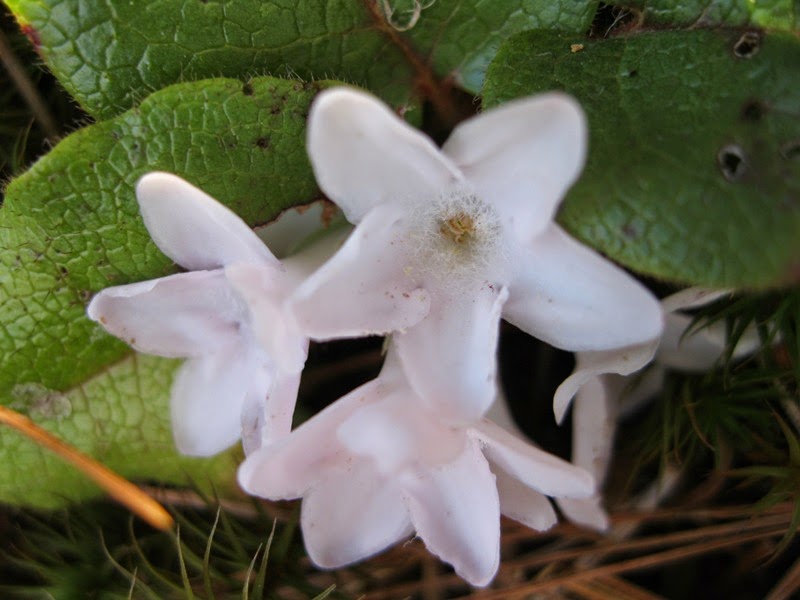
This is just one corner of our first attempt to transplant arbutus.  This display of open flowers is the most impressive that we have ever seen here.  Our point and shoot camera has problems with the color white.  Today the cloud cover was thick and rainfall was imminent.  Some combination of dim light and yesterday's rain made for great pictures today.

Despite the pretty pink coloration, this plant is male.  Five tan objects that resemble grains of wheat are positioned around the bottom of the hairy tube that connects the open petals with the base of the flower.  The depth of the tube also causes focus problems for the camera.  Some work is required to position a hand lens so that the desired part of the flower is in focus.  The hair like filaments that densely line the tube are somewhat clear resembling fishing line.  They add to the camera focusing difficulties.


In this picture the prime focus is on the filaments.  Beneath them is a green object that is opening like a five pointed star.  Yesterday it was tightly closed.  This organ captures pollen making this the female flower.  If new plants from seed grew here, we would consider our attempt to reintroduce this native jewel a success.  To date many seeds have been seen but no new plants followed.  The number of years between seed production and new plants from seed is not known to us.  We do know that this plant stringently follows its own schedule so we wait.


The petals of these older male blossoms are stained with blotches of brown.  They may be pollen stains.  Today for the first time, we saw a bumble bee working the open flowers.  It was quite comical to watch it force its large head deep to the bottom of the open flowers.  It is commonly suggested that ants pollinate arbutus flowers but we will add bumble bees to the list.  We did have a remote lone female plant develop seed last year and wondered about the source of its pollen.  Due to the distance between that plant and the others, bumble bees are more likely pollinators than ants.


Fallen pine needles, open white flowers and dark green leaves combine to create a beautiful image.  Tan skeletal remains of parts of the leaves eaten by insects only serve to establish that this otherwise perfect picture is in fact real.

Sunday, April 16, 2017

Coming Out On The Other Side


We were in our early fifties when we moved to this wild land surrounded by several square miles of forest.  Winter walks into the woods were common then.  Treks on snowshoes were enjoyable adventures.  Sledding down steep slopes occasionally included piercing screams.  A hand powered snow pusher cleared the one quarter of a mile long driveway for most storms.  Winter was just another season to be enjoyed.  Now joints ache in response to short periods of time outdoors.  Fingers and toes turn scary white in response to cold air.  Much of the fun has gone out of winter so early flowers are a welcome treat and bring with them the promise of more to come.


This patch of transplanted from the wild arbutus plants is my pride and joy.  Four tiny plants have been joined by a fifth from seed plant to form this sizable display.  We knew nothing about these plants being either male or female with gender identification easily made if you know where to look in the open flowers.  Three male plants and one female are what we have here.  The plant from seed has disappeared blending in with the others.  Its gender remains unknown.  Our lone female has been reluctant to flower and seeds were seen here for the first time just last year.


Two days ago we found a single open flower here.  Recent hot dry days have pushed more buds to open.  These plants could be seen as little more than a rather insignificant ground cover with tiny white or pink flowers.  When the nose is brought close to an open flower, the plant's appeal is quickly understood.  We have two other patches of arbutus nearby.  When I left these plants to check on the others, Becky was pressed flat to the ground with her nose close to these open flowers.  When I returned several minutes later she was still drawing in their unbelievably sweet aroma.


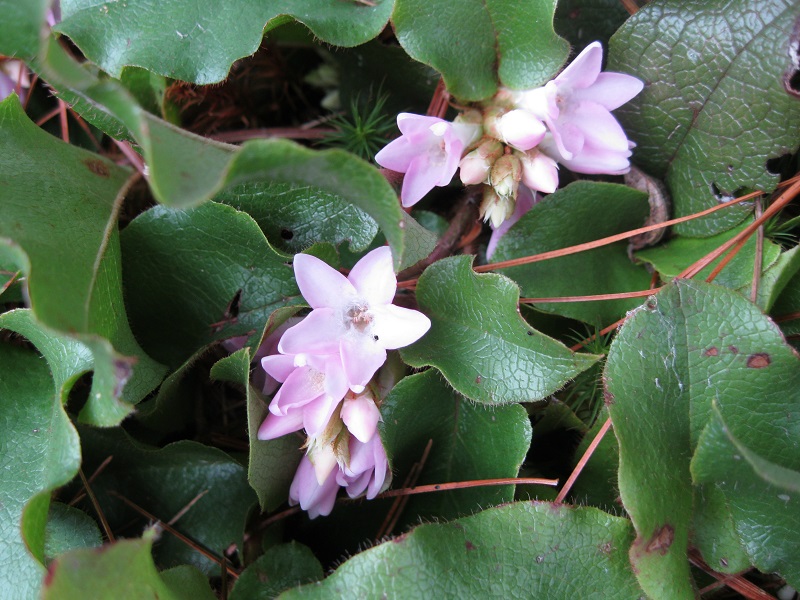
These plants were also taken from the wild and planted behind the stone arbutus wall.  Three plants of each gender were placed here so that fertilization is easily accomplished.  This site is more favorable for arbutus growth as can be seen by the number of flower buds in each cluster.  Many of these flowers tend to be pink.  The eye sees the pink coloration but the camera fails to accurately record it.


The scent of the arbutus now exists in competition with the overpowering smell of the lagoon cow manure that is presently being sprayed on nearby fields.  Tractor trailer loads of this black gold are taken to the fields all day long at this time of year.  Its sharp smell is simply overpowering.  We are fortunate in that the location of the fields and the direction of the winds tend to soften our exposure to this unpleasantness.  We have elderly neighbors whose house is located just past the end of a huge stinky field.  Cut arbutus flowers brought inside might help them but  I simply cannot bring myself cut these precious flowers.

Friday, May 8, 2015

Sex Amongst Arbutus


Our weather's sudden and dramatic shift from cold with deep snow cover to hot and dry has had an impact on all of the early flowers.  Every day finds a different appearance displayed by the arbutus.  The first picture shows the female's pollen collecting apparatus open, extended, and ready to receive pollen.  What first appeared as a light green dome at the base of the blossom has pushed out and opened displaying a five pointed star.  Five is a frequently repeated number for this plant.  Five petals, a five pointed star, and a five sectioned seed berry if all goes well.


This is how the male flowers look on the same day as the first picture.  Here the base of the blossom shows five paired pollen producing structures.  When the flowers first open, the difference in color at the base of the flower is the most reliable identifying clue.  Green is for girl while brown points to boy.


Interior flower parts soon show the impacts of heavy foot traffic.  An ant is in the picture but we have also seen small bumble bees and other unidentified crawling insects in the open flowers.  Some individual flowers have presented a confusing appearance since both male parts and female parts were present in a single blossom or on a single plant.  Speculation suggests hungry ants biting off pieces and  carrying  parts about dropping them here and there.


This mature female flower shows a heavy coating of golden tan pollen that was trapped and held by the numerous hairs the line its tube.  We know the exact location of this flower and expect to find a seed berry here shortly.


At first glance, I was troubled by all of the flowers that were no longer attached to this plant.  A hand lens revealed the exposed pollen collecting structure stained a golden tan.  We hope that timely applied pollen caused the discoloration.  So now we watch and wait.  Seed berries may form here.   Since nothing has yet to appear where we scattered seed last year, perhaps we will try William Cullina's method for treating arbutus seed as a greenhouse object.  That decision need not be made today.  Still wildly working male flowers, not knowing that the female flowers have moved on to their next petal-less reproductive step, are now our only source of the intoxicating arbutus scent.  It is amazing the speed with which these plants have  completed their reproductive activity.  Despite my daily visits to these plants, I have yet to see the yellow pollen shown in a William Cullina photo.  Perhaps next year's possibly more normal weather will allow the plants to complete a leisurely reproductive path and I will finally see yellow arbutus pollen.

Friday, May 1, 2015

Pink Arbutus Flowers


Pink buds opened to reveal pink flowers.  This arbutus was transplanted here in 2011.  It has only displayed white flowers in the past.  Why pink and why now are questions without answers.  We believe this plant to be male but after our earlier gender confusion we will watch and hopefully learn.


These white blossoms do show a trace of pink coloration on the newly opening flower and nearby bud.  We will watch to see if pink fades to white tomorrow.  The green disc centered at the base of the flower may grow into the pollen gathering organ.  If that happens, then the green disc is an early marker for female flowers.  We believe that we can tell the difference correctly now but we need to check and verify our accuracy.


The tan fuzzies at the base of this flower may produce the pollen.  We will watch to see if yellow pollen does form here.  May is an extremely busy time for us and we have never taken the time to look at arbutus flowers as they reach sexual maturity.  One of our goals is to take pictures of male flowers loaded with pollen.  If successful, we will be seeing arbutus pollen for the very first time.


On May 18, 2011, we transplanted four wild arbutus plants in this location.  This is how they look four years later.  It is now impossible to determine exactly where one plant ends and the next begins.  A fifth plant that grew from seed is also part of this wild appearing patch of healthy plants.  When the wind is right, the scent from these flowers can be enjoyed from a distance.  All is right with this part of our world.