Showing posts with label arbutus flowers. Show all posts
Thursday, April 18, 2019
Early Arbutus Flowers
Returning home from a therapy session today, I decided to drive to the back and check on the garden by the woods. In two places string fastening the wire fence to the posts had rotted. Temporary repairs were made and naturally a stop was made to look at the Arbutus plants. Six plants, three of each gender, were transplanted here in 2013
Arbutus plants form their flower buds in the fall. I was expecting to see only white tipped buds. These were more swollen than expected.
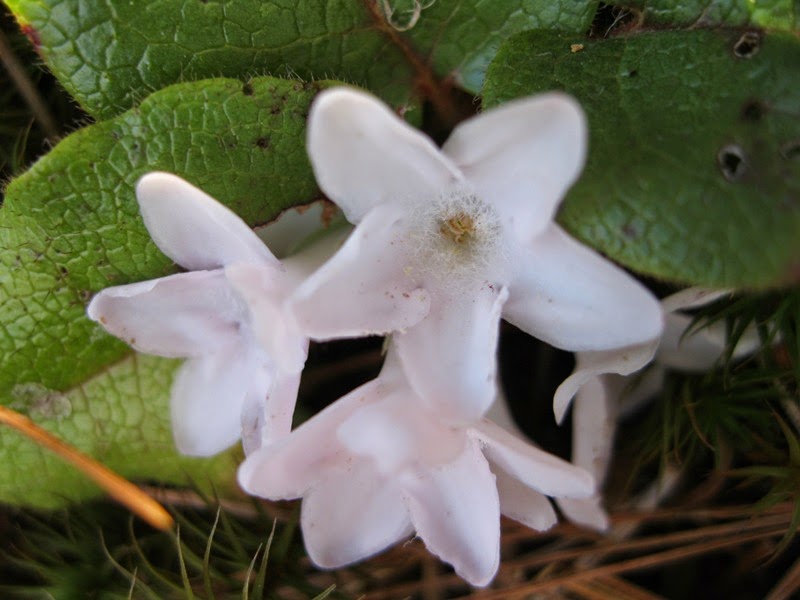
Open flowers came as a complete surprise. Most of the buds remain tightly closed now but here are open flowers. Looking at the base of the blossom, one can see five objects resembling grains of wheat. Those structures will in time produce pollen identifying this as a male plant. The appearance of the pollen is quickly over and I have yet to see a pollen laden anther.
These two plants were placed in a deep deposit of white pine needles.where nothing resembling soil as I know it exists. Arbutus plants require extremely acid but poor ground in which to grow. The growth of these plants is visually different from the others. Long stems bearing sparse leaves is the rule here. Each gender is present here and seed production happens each year. Despite the occurrence of mature seeds, we have yet to see the appearance of a new plant from seed.
This is our only patch of wild plants. We have no idea just how many plants grow here or what genders are present. We became aware of their existence when we first purchased this land twenty-five years ago. Flower buds are rather numerous now so the gender question should be answered this year.
It is surprising how small this group of plants is considering their age. They were eaten to the ground by a starved rabbit and that is the reason for the cage. Apparently that is a common experience for wild Arbutus plants. These have totally disappeared several times in the past before we learned what was happening to them. Now all of these native treasures grow under wire cages. We would prefer that they grow without a wire cover but we need to keep them alive and expanding.
These flowers are on a plant far removed from the other pictured plant in bloom. A close look down into the base of the blossom will reveal a green thing growing above the bottom of the open flower. It is the pollen grabbing stigma marking this as a female plant.
This is a picture of our first group of transplants. When these four plants were moved in May of 2011, we did not know that some would be girls and others would be boys. As luck would have it, one female plant is surrounded by three males. One new plant from seed did appear here but the seed that grew was in the soil clump surrounding a transplant.
We cannot leave without mentioning the outstanding feature of this plant. It is obviously a low ground cover with dark shinny leaves but it is the fragrance that has made this plant famous. One must place his nose close to the soil to sample the scent. The flower is sweet beyond description and accompanied by the smell of rotting pine needles, it is an experience will be enjoyed and remembered possibly forever. Each year as the blooming period comes to an end, I make a promise to myself that I will live long enough to experience the scent of Arbutus at least one more time. That is a promise that I have kept once again.
Sunday, May 15, 2016
Arbutus Seed Clusters
The season for trailing arbutus flowers is drawing to a close. In a few different locations, some older blossoms have been found hidden under covering leaves. Their location out of direct sunlight may be responsible for the longer season. These flowers are not the only things here showing marks of age and we are still taking moments to savor their mature scent.
We were delighted to find immature seed clusters moving toward the formation of viable seeds. Soon after the pink tinged flowers first appeared here, the blossoms littered the ground having been separated from the plant. Pollen needed to be deposited on the now blacken tips of the rod like structure protruding from the center of the seed berry. With the flower petals lying on the ground, the pollen receiver was fully exposed for easy access. The timing must have been exactly right as every blossom in this cluster was fertilized. That claim may be an exaggeration since the leftmost flower remains are hidden from view.
These seed berries are on a different plant at the other end of this group of transplants. The brown tipped spent flower in the center was not fertilized and will now wither away. The hairy stem at the right edge of the seed cluster may be the beginning of new growth. We did see new growth just beginning to appear on other plants. It is impressive that these female plants develop seeds while sending out new stems and leaves. That seems like a formidable task for any plant.
Once again we missed seeing pollen laden male flowers. This is a busy time of year for both the plants and the gardener so new pollen remains on the list of things for us to see in the future. These plants still show the impact of the very dry fall last year. Many of the blossom clusters formed then displayed a dead brown appearance. Some can still be found in that exact same state. We did enjoy many open flowers but the overall display was smaller than usual. We hope that the hard freeze forecast for tonight has no impact on these developing seeds.
Friday, May 8, 2015
Sex Amongst Arbutus
Our weather's sudden and dramatic shift from cold with deep snow cover to hot and dry has had an impact on all of the early flowers. Every day finds a different appearance displayed by the arbutus. The first picture shows the female's pollen collecting apparatus open, extended, and ready to receive pollen. What first appeared as a light green dome at the base of the blossom has pushed out and opened displaying a five pointed star. Five is a frequently repeated number for this plant. Five petals, a five pointed star, and a five sectioned seed berry if all goes well.
This is how the male flowers look on the same day as the first picture. Here the base of the blossom shows five paired pollen producing structures. When the flowers first open, the difference in color at the base of the flower is the most reliable identifying clue. Green is for girl while brown points to boy.
Interior flower parts soon show the impacts of heavy foot traffic. An ant is in the picture but we have also seen small bumble bees and other unidentified crawling insects in the open flowers. Some individual flowers have presented a confusing appearance since both male parts and female parts were present in a single blossom or on a single plant. Speculation suggests hungry ants biting off pieces and carrying parts about dropping them here and there.
This mature female flower shows a heavy coating of golden tan pollen that was trapped and held by the numerous hairs the line its tube. We know the exact location of this flower and expect to find a seed berry here shortly.
At first glance, I was troubled by all of the flowers that were no longer attached to this plant. A hand lens revealed the exposed pollen collecting structure stained a golden tan. We hope that timely applied pollen caused the discoloration. So now we watch and wait. Seed berries may form here. Since nothing has yet to appear where we scattered seed last year, perhaps we will try William Cullina's method for treating arbutus seed as a greenhouse object. That decision need not be made today. Still wildly working male flowers, not knowing that the female flowers have moved on to their next petal-less reproductive step, are now our only source of the intoxicating arbutus scent. It is amazing the speed with which these plants have completed their reproductive activity. Despite my daily visits to these plants, I have yet to see the yellow pollen shown in a William Cullina photo. Perhaps next year's possibly more normal weather will allow the plants to complete a leisurely reproductive path and I will finally see yellow arbutus pollen.
Subscribe to:
Posts (Atom)