Showing posts with label ants. Show all posts
Sunday, June 21, 2015
Seeds and Ants Everywhere
We need a written record of when events happen here especially with the arbutus. Last year's newly moved plants are beginning to open their seed berries now. Ants were working all over the patch when we visited today. One was caught in the act of chewing off a tasty piece of the white supporting part of the seed berry. Both black and tan seeds are scattered about as it is the white flesh that the ants are after. This plant opened pink colored flowers this year and the seeds are tan rather than black. This is nothing more than an observation since we do not know with any degree of certainty the accuracy of what we think that we see.
Two styles have been separated from the remains of the flowers. A close look will reveal an ant working the center spot where the style was. The structure of this newly opened seed berry strongly suggests a second flower very different from the original but beautiful in its own right.
This picture was cropped in an attempt to make visible the white spots that cover the surface of each seed. Total success is elusive. Here we also have black seeds and red seeds growing on the same plant. The black seed are just coming into daylight as the wrappers are just starting to open. We find more puzzles than answers.
This arbutus leaf was withered and cemented closed. Investigation revealed the caterpillar responsible for the damaged leaf. It resembles a lesser maple spanworm that becomes a small white moth. They are the most common night flyers that gather around porch lights. These pests need to find another food source as they will be dispatched on sight. Arbutus is protected here.
Labels:
ants,
arbutus seeds,
Epigaea repens,
lesser maple spanworm,
white moth
Friday, May 8, 2015
Sex Amongst Arbutus
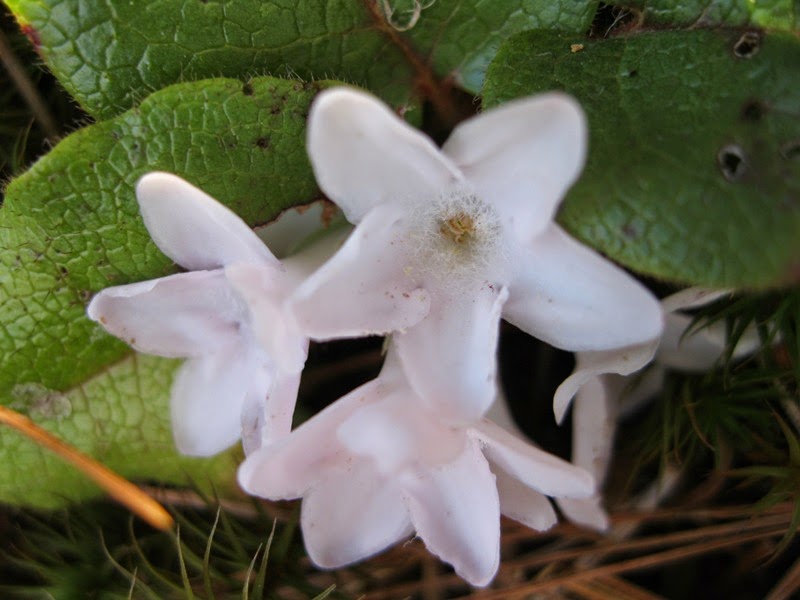
Our weather's sudden and dramatic shift from cold with deep snow cover to hot and dry has had an impact on all of the early flowers. Every day finds a different appearance displayed by the arbutus. The first picture shows the female's pollen collecting apparatus open, extended, and ready to receive pollen. What first appeared as a light green dome at the base of the blossom has pushed out and opened displaying a five pointed star. Five is a frequently repeated number for this plant. Five petals, a five pointed star, and a five sectioned seed berry if all goes well.
This is how the male flowers look on the same day as the first picture. Here the base of the blossom shows five paired pollen producing structures. When the flowers first open, the difference in color at the base of the flower is the most reliable identifying clue. Green is for girl while brown points to boy.
Interior flower parts soon show the impacts of heavy foot traffic. An ant is in the picture but we have also seen small bumble bees and other unidentified crawling insects in the open flowers. Some individual flowers have presented a confusing appearance since both male parts and female parts were present in a single blossom or on a single plant. Speculation suggests hungry ants biting off pieces and carrying parts about dropping them here and there.
This mature female flower shows a heavy coating of golden tan pollen that was trapped and held by the numerous hairs the line its tube. We know the exact location of this flower and expect to find a seed berry here shortly.
At first glance, I was troubled by all of the flowers that were no longer attached to this plant. A hand lens revealed the exposed pollen collecting structure stained a golden tan. We hope that timely applied pollen caused the discoloration. So now we watch and wait. Seed berries may form here. Since nothing has yet to appear where we scattered seed last year, perhaps we will try William Cullina's method for treating arbutus seed as a greenhouse object. That decision need not be made today. Still wildly working male flowers, not knowing that the female flowers have moved on to their next petal-less reproductive step, are now our only source of the intoxicating arbutus scent. It is amazing the speed with which these plants have completed their reproductive activity. Despite my daily visits to these plants, I have yet to see the yellow pollen shown in a William Cullina photo. Perhaps next year's possibly more normal weather will allow the plants to complete a leisurely reproductive path and I will finally see yellow arbutus pollen.
Friday, September 2, 2011
Don't Know My Eggs From my Aphids
Almost without notice, our activities have shifted toward getting ready for next year's garden. While clearing out the residue from the second planting of peas, a young milkweed plant was pulled and placed in the weed bucket. A large number of golden eggs caught my eye but I placed the entire plant in the bucket. The chance that I may have inadvertently trashed monarch butterfly eggs haunted me. Monarchs are described as laying their eggs thinly on many different plants. What I saw on the milkweed stem was a large number of eggs. Finally the milkweed stem was removed from the weed bucket and tied to a standing milkweed plant. I had to give the eggs a chance to hatch.
A picture seemed appropriate to record my actions. While taking the picture I had noticed ants working the eggs. I figured that some of the eggs would be eaten by the ants. Examination of the picture revealed that the eggs were actually aphids. The camera sees much more than my old eyes. It plainly shows the length I went to in order to save aphids and ants from the indignity of the compost bucket. We have never claimed to actually know what we are doing.
Friday, August 1, 2008
Borer Wars: News From the Front
It was quite a bonfire. A pall of smoke hung heavy over the garden. The funny thing was, it smelled like thousands of birthday candles.
Subscribe to:
Posts (Atom)