Showing posts with label fossils. Show all posts

Sunday, December 4, 2016

Stone Stories and Hidden Treasures


We found this land because of our passion for stones and my passion for building stone walls.  The farmer's wife that had worked this farm for decades saw an opportunity to unload the last twisted piece of the original farm.  She offered us free field stone to use in our village garden.  Many truckloads of wall stones later we purchased the last piece of the farm.  Native stone has fascinated us.  At one time this area was covered by a vast sea.  Mountains to the east surrendered to the ravages of weather and their sediments washed into the sea.  Geologists gave the resulting land form the name Allegheny Plateau.  Several periods of glaciers carved the flat plateau into its present configuration of bedrock hills and river valleys.  We own a small piece of a bedrock ridge that is the visible remains of the plateau.  The rest of our land surface consists of glacial deposits.  Our tiny metamorphic stones were carried here from the Adirondack Mountains to our north.  Larger sedimentary rocks were formed closer to home.  We find these rocks both fascinating and useful.


This rock was long ago placed in the patio next to the section of garden enclosed by four stone walls.  It was selected because of its size and shape.  Years of foot traffic have worn away a thin deposit of sediment revealing a stone surface featuring ripple marks.  This stone was formed in a shallow section of the sea where gentle currents formed the ripple marks.  It is also possible that the marks are worm tunnels made by life forms on the bottom of the sea. In either case the rock is interesting and attractive.


This piece of a formerly huge rock is headed down near the garden by the road.


This is the same rock close to where it was found with a newly exposed interior surface taking in the sunlight.  When this rock was first discovered, its shape was nearly a cube.  At that size machinery would have been necessary to move it.  A series of parallel cracks were discovered crossing the exposed top surface.  A hammer and wedges allowed me to split that monster stone into several pieces small enough to be carefully moved by hand.  This piece remained unused because of its other side. Special stones with interesting fossils are hidden treasures!


Here is a closeup of the fossil covered surface.  This face deserves to be seen and that required placement as a top of a wall stone.  Its mass made such a location both difficult and unwise for me to attempt so up until now this treasure remained leaning against a tree in the woods.


This stone slice is from another monster that was located close to the above pictured stone.  A weathered crack invited investigation with my hammer and chisel.  For the first time a stone of this type actually split for me.  The core of the rock is heavily mineralized and unbelievably hard.  Contact with a hammer usually produces only a sharp ringing sound in my ears and pain in the joints of the arm swinging the hammer.  This rock has also remained on the forest floor where it was found.  The moss covered outer edge is soft and moist supporting growth.  That layer will soon fall away from the hard central core.  This stone is far to interesting to bury in a stone wall.


Here is the site of the project that will make good use of these interesting stones.  The current owner of the original farmhouse in the background takes excellent care of his home.  The previous owner allowed the field to grow weeds unchecked and I took similar care of my narrow strip of road frontage.  Now we are working to establish a tended flower garden on our side of the property line.  This new growth of sumac is creating a shaded area that can be used as a pleasant place to sit and rest and it might support native woodland plants.  We intend to use our large flat rocks to build a low ledge that will direct water to the base of the plants.  With our  well drained gardens, extreme drought ended our Bloodroot plants that had reproduced from seed.  Here at the bottom of the lane we have different soil and drainage.  We will see if the large stones will capture enough moisture to keep new plants alive.


Today's weather forecast predicts that we will awaken to find two inches of snow on the ground tomorrow morning.  The rest of the week may feature more snow each day.  Those facts made moving stones out of the woods seem like a great use of this blue sky day.


This stone's final destination is to the left at the base of the hill.  The red of the sumac berries can be seen from a distance.


Here the rocks supporting moss growth are placed flat on the ground to try and keep the moss alive.  When the ledge is completed these rocks will be placed on a slant in full contact with the ground.  So placed these rocks will capture moisture from the night air and hopefully keep both the moss and the native woodland plants alive.

Friday, February 5, 2016

Just Wait Lichens Will Grow On You


I wanted to learn about lichens this winter.  So far I have learned that these tiny plants are legion in numbers and complicated.  Identification is a problem, but they still fascinate me.   Now when look at a stone or a dead branch,  I move in closer using my camera.  The scalloped edges on this grey lichen  captured my attention.           


We more commonly find moss growing on the ground itself or on rocks nearly totally buried in the soil.  Past attempts to move moss covered rocks in stone walls frequently results in the death of the moss.  During dry periods the lichens become brittle and dormant but regenerate when moisture returns.  When the moss becomes dry it usually disappears.  The small patches of moss and the lichens chose this spot to grow.  The process is a very slow one.


This fallen dead branch was found lying across the lane.  The brown shaggy growth covered the upper surface only and likely grew after the dead branch fell.  The light and dark green lichens were actively growing when the branch was alive and still attached to its tree.  Our tree surgeon told us that when these growths appear the tree is doomed to die and that nothing can be done to stop that final process.  It now appears that much more action follows the death of the branch.  This brown growth appeared quickly since we walk where it was found frequently and did not see it earlier.  We placed the fallen branch across the barbed wire fence for the photo.  It was returned to the ground so that the natural process already in motion could continue.


This bright yellow lichen was hard to miss.  We have to walk past this spot every time we leave the house via the basement ramp.  A closer inspection reveals bright yellow bubbly round growth when I scroll in on this picture.  Nature  has so much to for you see if you bother to notice!


Textbooks describe a large sea that once covered the area where we live.  The presence of the shell fossil points to sediments washing into that  sea covering the living mollusk.  The sediments became layers of stone and we are in awe whenever we find a well formed fossil.  The white blob remains an unsolved puzzle.  It resembles the silk that formed inside of a milkweed seed pod following exposure to rodents and birds that feed on the mature seeds.  Perhaps it is just that and it became stuck on the moss growing on this interesting stone.  Most years all this is covered with snow.  This February is different and I am enjoying  the view!

Monday, April 13, 2015

Special Stones: Photos By Amy


Ed's special stone collection on top of the curved stone wall has finally emerged from its blanket of snow.


Stones may get second billing in the title of the blog, but they hold fascination for all of us.


Any stone that seems special and interesting finds its way into our pockets and then gets a place on top of the wall where we can inspect our treasures anytime.


When Amy was here she took these amazing photographs.  While not quite the same as being able to pick them up and feel the texture, her pictures are so detailed it is very close.


It would be hard to choose which stone to fondle here. The gray and white one looks so smooth!  I have a thing for purple, but those holes in the brown one are irresistible


There are so many. They are all so different, so captivating if you have a fondness for stones.
 

I think if you could resist this beautiful fossil then you must  be immune to the attraction of interesting stones.


Next winter when the snow covers Ed's stones again. We can look at them here and remember how they feel in our hand or our pocket.

For Ed, the allure of these stones is how they came to be here.  Our valley is so ordinary that it does not attract scientific study.  Erosion of an ancient mountain range to our east poured massive  fine muddy deposits into the inland sea that covered this region.  Thick layers of shale formed to cover this part of the state.  These native rocks are dull gray with occasional marine fossils.  Glaciers and their melt water cut valleys in the shale plain and left behind exotic stones from exciting geological regions to our north.  Limestone formed in deeper parts of the sea is sometimes found in our gravel bank.  Coral fossils are rare here but have been found.  Near volcanic stones formed in the Adirondack Mountains are also among the stones on our wall.  Tumbling in glacial melt water for those distances made these stones smooth and small.   Not impressive in size, they are still items of interest here.    

Friday, March 7, 2014

Drawn Outside


Clear blue skies and bright warming sunshine drew us outside this morning.  Snow cover continues to be widespread and deep, filled with ice crystals that fail to support a human foot.  The pictured sumac seed clusters did attract our first robin today.  Natural winter bird food is a feature of this trash tree.  We find its bright color spirit lifting during our barren Winter and the birds drawn to it are a bonus.


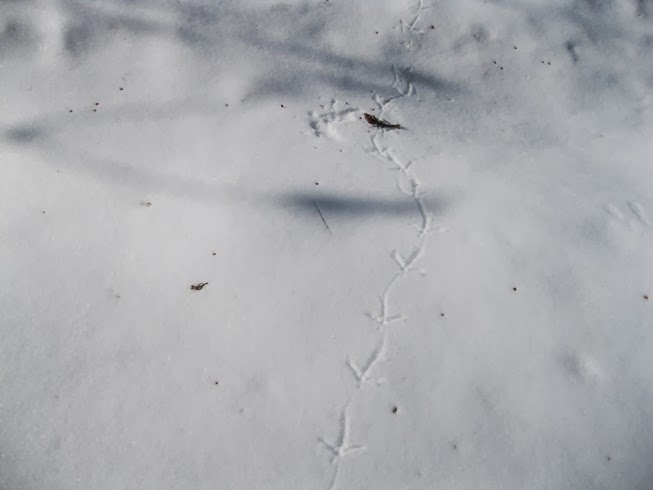
We cannot identify with certainty that the robin made these fresh tracks in the snow.  A body impression in the snow near the fallen sumac seed cluster shows a table setting used for breakfast this morning.  The red dots scattered about are from a meal taken at the top of the tree.  If this day continues to be clear and warm, the lawn area behind the house that is kept plowed of snow will soften and we should see robins feeding there this afternoon.  Any sign that this Winter is drawing to a close is welcome.  Our current electric bill shows that February was seven degrees colder than last year and our electric consumption had increased by one third.  We really need to see some Spring.


The return trip from the mailbox included a visit to the arbutus.  Expecting to find only the protective cage and snow,  seeing dark green hairy leaves was an unexpected surprise.  Current plans are to try hand pollination this year as no seeds were produced last year.  We will also try to get better pictures of the differences displayed by male and female flowers.  Amy's camera and tripod will be borrowed for this attempt.  Still, the problem of photographing the deeply placed white flower parts presents challenges.  


My interesting stone collection located atop the stone wall leading to the basement has been cleared of snow.  Dark colored objects absorb heat from the sunlight and this spot is the first to clear.  These signs of sea life point to a far different landscape here in times long past.


This rather common looking piece of black limestone contains a real puzzle.  Near the center is a thin structure filled with holes.  The thinness  is what puzzles me.  It looks more like bird skin than coral or sponge.  We plan to place this piece before the college professor and learn what he thinks has been turned to stone here.

Friday, November 16, 2012

How Did They Get Here?


The land that we occupy is quite a mystery to even a casual observer.  Five meadows ranging in size from two to five acres are each on a different level.  Each is relatively flat but all are separated by changes in elevation.  All are the product of the receding glacier.  Different soil types are found in the various meadows.  Some are rich with clay while others are sandy gravel.  We cannot begin to understand exactly how our land came to be.  It must represent more than a single event in the melting of the glacier.


Water sorted deposits fill our valley.  Operating gravel banks abound.  Last fall we had our road improved with several truck loads of gravel from an operation a few miles upstream from us.  On my daily trips up and down the lane with the mail, different appearing stones would catch my eye.  Some found my pocket and wound up on the wall near the basement entrance.  Geology books suggest that our soil may have come from as far away as the Adirondack Mountains.  I would really like to know the identity of these stones to aid in understanding just how they came to be here.  


Fossils clearly identify a sandstone of some type.  Chunks cemented together in a single stone are conglomerate similar to the deposits that form the Catskill escarpment.  More dense stones show pits that could have been formed by gas bubbles under tremendous heat and pressure.  Perhaps I should rent a geologist to walk this land and describe just how it came to be.  He might even be able to identify the names of the pebbles atop my wall.  All those different  colors and textures are so intriguing to look at especially if you have a thing for stones and I do.

Sunday, February 5, 2012

Match The Task To The Day


Usually snow madness has set in here by the first week in February.  Weeks of unrelenting snow fall limits outside activity.  That is not the case this year.  Once again we awoke to find frost covering the bare ground but the sun quickly melted that.  On the sunny side of this stone wall the ground is soft while the shady side remains firmly frozen.  A quick tap with a hammer releases the frozen stones so some wall building is possible today.  Most of the stones in this area have been thrown in a heap.  The farmer's children were likely given the task of picking these rather small stones from the field and they had no interest in wall building.  Putting this right made for an incredibly pleasant day.
  

One advantage to working stone in the cold is the lack of critter activity.  Snakes, wasps and spiders are dormant now.  Not so for this stone roach.  This creature may have a proper name but it is unknown to us.  We assigned the name stone roach to these numerous occupants of our stone piles.  Despite the removal of the roof from its frozen quarters, this guy moved quickly.  It was gone in a flash returning to the stone wall.  Another second and he would have been missing from this picture leaving just a cool and frosty fossilized stone.


The purpose of this wall is to consolidate the stone pile freeing up the ground for planting.  An attractive wall is unlikely given the poor quality of the stone.  All this wall has to do is remain standing for a few years.  Stone placement in the interior of the wall is the most important factor in building a stable wall with this rubble.  A great number of stones were handled today to build a rather short section of low wall.


Day's end found about six feet of new wall.  The dumped stone pile is shrinking.  If this wall is to continue to grow, additional stone will have to be brought to the site.  We have the stone but time for this kind of play is limited.  One thing about a stone wall it waits quietly and patiently  for the builder's return no matter how long that takes.

Wednesday, November 9, 2011

Focus on Stones


The last couple of days here the focus has been on stones more than plants. Ed is working  on the driveway and his new wall project. Stones hold a certain fascination for both of us. Today the weather has been glorious, sunny and warm. It drew us outside like a magnet. I did some garden work and took the opportunity to walk around with the camera.  I headed down to the gravel bank to check on Ed's progress. These stone closeups were taken there. The tiny lichens that grow on stones are amazing to me.


This one molds to the shape of the rock like a lacy shawl.


These tiny lichens and mosses are growing on the vertical side of a stone in a wall. The sedimentary rocks develop  cracks once exposed to the elements and this one also has fossils. Growth gets a foothold in these  places.


Here  tiny green  mosses grow on the small horizontal surface in the gap between two wall stones and in the ridges of the fossils.


This large rock is destined to be a top stone on Ed's new wall. The fossils, lichens, and intriguing texture of this stone will be lost on those who quickly pass by. All they will see is Ed's nice stone wall. But those who take the time to linger and look more closely will get to see so much more.

Monday, September 5, 2011

Interesting When Wet , Photos by Amy


This Mammoth Pink Chrysanthemum looks fresh as a daisy!


Asparagus Berries hold on to those water droplets.


The end of the pink poppies and the beginning flowering 'Autumn Joy' sedum are a sure sign of fall.

Our new great  lobelia flowers are a beautiful shade of blue except for the plant that turned out to be white.

The red hibiscus may be blown over, but it still blooms on.


'Stardust' chrysanthemum's fluted petals hold many water droplets.


 A fossil on top of the wall shines neatly when wet.


Could be lichens or perhaps some fungus, but this stone is almost completely covered with growth.


No wet garden post is complete without a picture of lady's mantle.


A bumblebee takes advantage of the lull in the rain to visit mullein flowers.  It's good Amy went out to visit the garden when she did. We are back to rain again.