Showing posts with label red Sumac. Show all posts
Friday, March 7, 2014
Drawn Outside
Clear blue skies and bright warming sunshine drew us outside this morning. Snow cover continues to be widespread and deep, filled with ice crystals that fail to support a human foot. The pictured sumac seed clusters did attract our first robin today. Natural winter bird food is a feature of this trash tree. We find its bright color spirit lifting during our barren Winter and the birds drawn to it are a bonus.
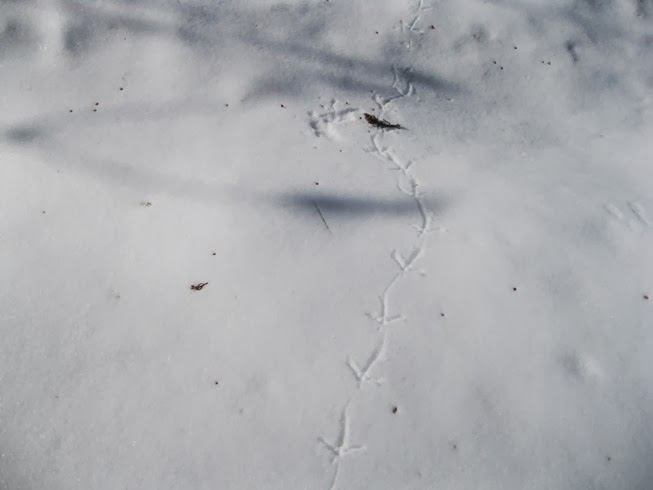
We cannot identify with certainty that the robin made these fresh tracks in the snow. A body impression in the snow near the fallen sumac seed cluster shows a table setting used for breakfast this morning. The red dots scattered about are from a meal taken at the top of the tree. If this day continues to be clear and warm, the lawn area behind the house that is kept plowed of snow will soften and we should see robins feeding there this afternoon. Any sign that this Winter is drawing to a close is welcome. Our current electric bill shows that February was seven degrees colder than last year and our electric consumption had increased by one third. We really need to see some Spring.
The return trip from the mailbox included a visit to the arbutus. Expecting to find only the protective cage and snow, seeing dark green hairy leaves was an unexpected surprise. Current plans are to try hand pollination this year as no seeds were produced last year. We will also try to get better pictures of the differences displayed by male and female flowers. Amy's camera and tripod will be borrowed for this attempt. Still, the problem of photographing the deeply placed white flower parts presents challenges.
My interesting stone collection located atop the stone wall leading to the basement has been cleared of snow. Dark colored objects absorb heat from the sunlight and this spot is the first to clear. These signs of sea life point to a far different landscape here in times long past.
This rather common looking piece of black limestone contains a real puzzle. Near the center is a thin structure filled with holes. The thinness is what puzzles me. It looks more like bird skin than coral or sponge. We plan to place this piece before the college professor and learn what he thinks has been turned to stone here.
Labels:
bird tracks,
Epigaea repens,
fossils,
red Sumac,
trailing arbutus
Sunday, December 1, 2013
A Cold Walk In The Snow, Photos by Amy
A visit from Amy usually includes a walk about with the camera in her hands. It is interesting to see what catches her eye. Here I saw a large number of patio stones that had absorbed sufficient heat from sun light to melt their snow cover. Amy saw lichen and thyme growing on a snow framed stone. Living color under the snow always amazes us.
A wide area of untouched snow was dotted brown. The close view of the camera revealed seed pods adjacent to scattered seed. A black birch tree is up wind of these seeds and may be the source. We will leave them where they fell but will return to see if either the chipmunks or the red squirrel take advantage of this possibly sweet tasting food source.
Heat from sunlight falling on dark leaves or heat from life process itself has opened a hole in the snow cover over the arbutus. Any walk outside includes a detour to check on these treasures. Some tiny nibbler has been feeding on several of these leaves. So far the damage is slight but we would like to know who feeds here. A nearby edging flat rock is littered with hulled acorns but something smaller than a squirrel or chipmunk ate these leaves.
Sumac is considered by many to be a trash tree. It does grow like a weed but its leaves are a source of beautiful fall color. Its red seed clusters supply food for many birds. Tracks in the snow seem to indicate a feast on a fallen cluster but only the small red bits could be found. All of the tracks were made by birds leaving no clue about how all of this ended up on the ground.
Two walking trips up the driveway are made most days. Unusual stones catch the eye and they are carried to the wall near the basement entrance. None of these exotics are native here. They were all carried a great distance from their points of origin by the last glacier. We would like to be able to identify each stone by name and understand how it was formed but we are far from that knowledge. Holes in the surface of a specimen may point toward limestone created by the coral growths in a ancient inland sea. The yellow one's rough texture says sandstone but the water worn smooth surface of the others keeps their identities secret.
If one looks, their is always some natural wonder to be seen.
Labels:
Epigaea repens,
exotic stones,
lichen,
red Sumac,
thime,
trailing arbutus
Subscribe to:
Posts (Atom)


