Showing posts with label planting garlic. Show all posts

Wednesday, October 7, 2020

Sixty More Planted


There has been serious disease on garlic bulbs recently.  Fellow blogger Daphne posted a process intended to clear the cloves of the disease.  An overnight soak in one quart of water containing one teaspoon of baking soda was followed by a rinse and peeling of the cloves.  Then a three minute soak in vodka was followed by a rinse and immediate planting.  We spent just over one hour carefully peeling sixty cloves.  Great tenderness is required to prevent injury to the cloves.  Scissors are used to cut a small nick at the top of each clove  staying clear of the clove flesh.  Using that as a starting point, the clove wrappers are removed.  On occasion blue smoke and street talk fills the air.


 The forty cloves are from a variety named for its source Helen.  Sadly, she has joined the great majority but she was a powerful positive influence on both of us.  Attitude is everything and her constant expression of positivity still has its effect on us.  The twenty cloves are Purple Stripe that we use as a spacer between our major varieties.

Just a short time ago we planted three beds with eight hundred ten cloves.  Now we plant one bed with two hundred twenty cloves.  We now have only five varieties compared with the more than thirty formerly planted.  That still sounds like way too much garlic for an elderly couple but we need next year's seed in addition to what we eat or give away.  At this point we have one hundred twenty planted with one hundred still to go.

Garlic exists in two distinct forms soft neck and hard neck.  Soft neck is preferred for braiding but it does not do well in our rather cold climate.  We have planted only hard neck for decades.  Our main crop consists of four different varieties all carrying local names.  These are all of the Porcelain type and display larger cloves but fewer cloves per bulb.  Helen's seed this year all came from bulbs having exactly four cloves.  Our marker variety is a Purple Stripe type featuring smaller cloves but beautiful purple bulbs.

So far this year we have encountered no brown spots indicating the presence of disease.  This is a first for us in many many years.  We did have eight plants that displayed ground level rot at harvest so our concern about illness persists.  The peel and soak is time consuming  and tedious but we will likely continue it for the remaining seed stock this year.  Planting next year's garden at this time of falling leaves and cold nights lifts our spirits.  We are well aware of what is coming our way but the first crop of 2021 is in the ground.

Monday, October 5, 2020

Sixty Planted


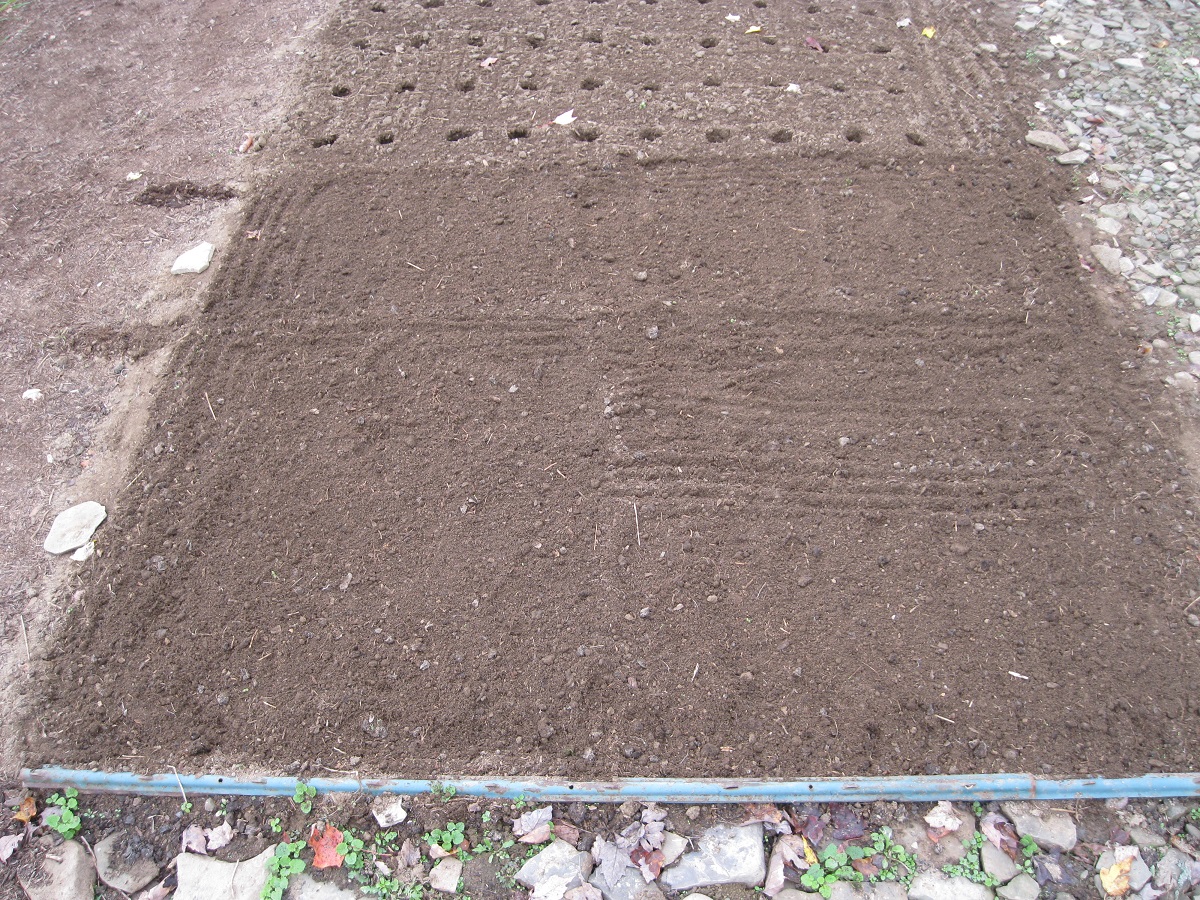
Today the first sixty garlic cloves were planted.  Usually their planting date corresponds with my Father's mid October birthday but with the early heavy frosts it just seemed right to get the cloves into the ground.  Susquehanna White and Guilford Purple Stripe were the chosen varieties.  These varieties will not be found in any catalog as they are locally grown and named.  We discovered Susquehanna White at a hidden from the road organic garden stand.  A more perfect spot could not be found.  A south facing slope gently rolled down toward the D&H Railroad main line and the mighty Susquehanna River.  I have never before been envious of a garden location.  Guilford Purple Stripe was grown by a retired pharmacist that lived in Guilford.  It has a different growth habit than the rest of our varieties and is used to visually separate the other varieties.  Four by ten and two by ten is the general planting scheme.


This shows the remainder of the bed that will be planted over the next several days.  Another section of fence that is rotated 90 degrees was placed over the two pieces shown.  Since it was needed to close in the garden it is now tied to the fence posts.  All of our beds are five feet wide and our method of push a hole then skip two before pushing the next hole gives us ten plants per row.  The spacing for the rows is push a hole then skip four before pushing the next hole yielding twenty-two rows. 


This unknown to us Aster was just discovered growing near the Arbutus plants.  We plan to carefully dig it from the ground and move it into a garden spot.  Transplanting at this time of year is not usually done since Fall planting frequently results in frost heaved plants.  We must remember to cover it with a cage since the deer eat garden grown Asters to the ground.  The unusual color of the flowers is what drew me to this plant.  Asters are a huge family of native plants and we will try to find the name of this one.  Ed's Delight may have to suffice.


This is our second group of transplanted Arbutus.  We have found that the soil under White Pine trees suits Arbutus.  This is the time of year when the evergreen tree sheds its needles.  New growth pushes the old needles away so the tree always looks green.  Many of these fallen needles will be hand picked so that the Arbutus leaves receive enough sunlight all the winter.  I never realized that native plant gardening required so much work.


 This native New England Aster consists of but a single stalk.  The recent frosts ended many of the Goldenrod flowers leaving asters as the food source for late Monarch butterflies.  Deer left this wild plant alone but heavily feed on the same variety placed in my gardens.

Thursday, August 27, 2020

Progress


We opened our Wilderness garden one decade ago so that garlic could be planted in soil free of pathogens from the deadly disease that nearly destroyed our entire crop.  Written references  to that situation indicated that our garden near home would always carry the seeds of that illness.  New garlic was purchased and we have been able to grow healthy garlic here ever since.

Eight planting beds were planned but two of them remain undeveloped.  It seems that more than can be completed is always part of the plan.  The soil near the house contains many broken stones that can be used to build decent safe paths but here the soil was more finely ground by the glaciers with the desired small flat stones mostly missing.  With planting beds needing attention this central path was more of a stone dump than a safe place to walk.

Earlier this year Becky attempted to enter the garden crossing the weed filled jumble of stones that filled this area them.  A stone of some size caught the end of her foot throwing her toward the ground.  A steel pipe had been driven into the ground to mark the edge of the planting bed.  Becky fell  heading directly toward that pipe.  Some combination of luck and skill resulted in the pipe end barely grazing the side of her head.  No blood was drawn and we will not mention the contents of my pants as I stood behind her helplessly.  The pipe was pulled that day and this proper end of the path was built yesterday.  A load of junk stone has been removed but small flat stones are still needed to finish this job.  For now the end stones have been solidly placed with absolutely no wiggle.  Small flat stones will be placed on top of the path as they become available.  No steel rods now reach for the sky and they will always be removed before I leave the job.  The white plastic pipe near the fence serves as the hinge for the gate.  It is totally encased by the bent fence and is a hazard to no one.


Here we see the boundary between a bed that has been fallow but weed filled.  Believe it or not these weeds are rather small since this bed has been already cleared this year.  The adjacent bed has been repeatedly covered with grass clippings and the weeds are removable using only hand tools.  As of today the planting bed is totally free of weeds from end to end.  Screened manure would have been spread here today had the early morning lightening and rain not altered our plans.  This ground will be frequently enriched and hand tilled between now and mid-October when the garlic is returned to the ground.


Here are our tools of choice.  All of the weeds on the pile in the background were carried there using the purple trug.  The American made Cobra Head hand cultivator follows the spade that only loosens the weeds.  Gloves protect Becky's hands with an ample supply of water close by.


This wild location at the base of a wooded slope is developing as planned.  In response to reading two sentences written by John Burroughs describing his search for the seldom seen in this area Cardinal Flower, I have spent many years trying to find a location that will support this plant without further help from me.  The raised road to the gravel bank traps the water that moves down the hill in the background.  Cardinal Flower needs generous amounts of water in order to survive.  This hill slopes toward he north delaying the early plant growth that so often freezes out both here and in Burrough's Catskills.  Lingering snow cover protects the tender green growth that has been under the snow for the entire winter.  Our garden plants have been severely hammered by this year's drought.  Short stems bearing few flowers are all that we find in our there.  Many early spring visits will be made here to check the progress of these plants next year.

Wednesday, October 17, 2018

Garlic To Ground


Mid October is the time to remember my Father's birthday and plant garlic.  The actual placement of the cloves into the ground is done on bent knees.  From this prayerful position, one can remember past pleasant moments and hope to be able to harvest yet another garlic crop come July. We are of an age where we no longer take future events for granted.

The planting holes have previously been punched using the wire fence pieces to establish a precise grid.  Since our ability to eat garlic has diminished, the distance between the rows has been increased by two inches.  Now we will have twenty-two rows rather than twenty seven.  Two hundred twenty garlic plants is still way more than we will use but garlic has been with us for decades.  At this point in my life the experience of planting next year's crop is more important than eating it.  This morning featured crisp cool air, bright sunshine and the promise of a tomorrow.


The smaller cloves on the left are a locally grown purple stripe variety.  Their growth habit is tall with widely spaced leaves.  They are used to mark the limits of the main crop.  Each bulb consists of eight cloves and doubles are common.  The larger cloves are a locally grown porcelain variety.  Here the number of cloves range from four to six.  Helen's is the name we assigned to this variety to remember Becky's dear friend Helen who is no longer with us.  This is our best variety since it remains free of rot spots that still linger in our other varieties.  Every clove peeled this morning was healthy.


These peeled skins resemble the remains of a shrimp meal.  Despite their overnight soak in baking soda and water, removing them is a hard job.  We carefully snip the top making sure to stay above the clove.  Loosening the outer skin requires carefully applied force since the clove must remain unmarked.  Sometimes a single layer of transparent skin remains on the clove.  It is both sticky and amazingly strong.  Once it is removed from the clove, it wants to remain attached to a finger.

Today is the second time we planted this year.  Two more days will finish the job.  The peeled cloves are given a brief vodka bath.  This method of preparing the cloves for planting has almost completely eliminated the nasty rot.  We also plant in new ground each year trying to avoid soil borne disease.  Space for two more new beds remain but then we will be forced to plant in ground that has previously grown garlic.

Friday, October 14, 2016

Garlic And Arbutus


Mid October is when we plant our garlic.  Most of the seasonal activity in the gardens now deals with plant cycles coming to an end.  A beginning at this time of year just seems special.  My late father's birthday is nearly here and the quiet of planting is a perfect time for reflection and remembering.

The far end of this planting bed received seventy garlic cloves this morning.  The soil surface there is visually different from the rows of marked planting holes.  Five rows of our best variety, given to us by Helen, were planted first.  Then two rows of our marker garlic Guilford purple stripe were planted next.  Most of our varieties are in the porcelain group.  These plants are tall with widely spaced leaves.  Purple stripe plants are shorter with closely spaced numerous leaves.  These differences help me keep the different varieties separate at harvest.


Our arbutus plants were transplanted under white pine trees because we felt that such a location would favor them.  This is the time of year when the white pines cast off their old needles in the process of growing new ones.  We find the appearance of the needle covered wall and ground attractive and natural but a dense cover on the arbutus is not acceptable.  Our friend Jane has spent decades in close contact with woods and the plants that grow there.  She has told us of brushing away the fallen leaf cover to reveal arbutus plants in healthy bloom.  I find this difficult to understand since the life function of these plants requires some sunlight.  So I must carefully remove the dense cover of fallen pine needles.  That is not natural but neither is the galvanized wire cage that prevents wildlife from eating my plants.


This picture shows only half of the arbutus plants clear of pine needles.  The other half are so densely covered that it is difficult to see them.  One other planting was cleared yesterday but two additional ones still need attention.  This up close attention revealed numerous healthy looking bud clusters.  We hope that the snow cover this winter is continuous so that the plants emerge healthy.

Wind will clear most of the pine needles from the top of the stone wall.  Cracks between the cap stones will hold some needles all year.  That too is an attractive sight.

Tuesday, October 14, 2014

Leaf Littered Lane


Each season of the year is special in its own way if one takes the time to take a long look.  The center of the lane marks the boundary of our land.  We hold a right-of-way to use the other half of the lane but it matters not since our neighbors are  easy to get along with.  Leaf litter will be harvested here when the coming frost leaves the ground and we begin gardening once again.  For now this is a truly beautiful place to walk on many levels.  The scents and sounds created from moving across the fallen leaves and needles are tranquil and sooth the soul.


The white pine nurturing our transplanted arbutus is dropping its old needles at the same time that the hardwoods are shedding their leaves.  If one looks at the upper part of the tree, occasional clumps of brown needles can be seen still attached to the branches.  It may be that the new green needles push away the old growth after cutting of their nutrient supply and taking it for their own use.  Unlike the maples and oaks, a white pine is always fully clothed in green.  The brown mass of discarded needles is deep and slippery.  To be honest, I must admit to pulling the dropped needles away from the arbutus leaves.  Evergreen, they must have uninterrupted access to sunlight.  Covering needles are not moved very far.  Their decomposition will build acidic soil necessary if the arbutus is to flourish.
    

It does not get much better than this long view.  The ridge belongs to another friendly neighbor but we look upon it as our own.  Our view is free and we do have permission to walk the ridge.  Coyotes, bears and perhaps wildcats call this area home so we tend to enjoy it from a distance.  In my younger days, a hike to the top of the ridge was safely completed.


Garlic went to ground today in the manicured planting bed to the right.  Twenty-seven rows were spaced eight inches apart.  Placing two sections of fence, one rotated 90 degrees from the other, on the surface of the ground creates graph paper with two inch spacing.  The end of the handle of the stone fork quickly punches planting holes.  Place a hole, skip three, place a hole defines the rows.  From a row hole moving along the other axis, skip two and place a hole results in six inch spacing within the row.  If all two hundred seventy plants emerge, the order of the planting will be either too fussy or impressive.  More work remains to be done here now.  Molasses mixed with water will be sprinkled on the surface of the ground.  That mix is reported to encourage beneficial soil organisms.  Screened hardwood leaves will cover the surface.  We would rather mulch than weed.

Monday, October 14, 2013

Naked Garlic Planting


Naked refers to the state of the planted not the planter.  Disease continues to plague our attempts to grow garlic.  The matter is widespread in New York State.  Last year we passed on a nearby three day conference focused on this issue.  Instead we turned to the October 1, 2010 post on Daphne's Dandelions for a possible solution.

The above photo shows the status of our garlic bed yesterday evening.  The far section is planted and mulched.  The near section will be planted today.  Potatoes grew here this year.  Following their harvest, weeds were pulled and soil amendments added.  Garden compost, old manure, woods soil, lime and molasses were added in turn.  Then dried grass clippings were applied in a thick layer.

This week the clippings were pulled clear and the bed was worked with a stone fork.  The fence was placed on the ground to define the spacing.  Twenty-seven rows were marked eight inches apart. Spacing in each row is six inches.  Spacing in the rows is a little sloppy but the distance between the rows is precise.

Grass clippings cover half of the bed.  This is intended as a controlled test to measure the effects of the mulch.


This bulb is part of a purchase from a local grower.  In the past her garlic has been excellent but this year's heavy continuous rainfall overwhelmed her ability to dry her crop.  The outward appearance of an intact bulb identifies the problem.  The wrappers are shrunken and soft.  Fully half of her garlic bulbs proved to be in this condition.  This represents a serious problem for her.  Garlic is a major crop for her and she would never have sold bulbs in this condition had she known.  Disappointed customers and insufficient planting stock will prove major problems for her.


Daphne's system involves an overnight soak in water with baking soda added.  The cloves are then peeled and rinsed.  Garlic with large cloves peeled rather easily but our small tight cloves were a genuine challenge.  The brown circle of root growth at the base of each clove is a result of the overnight bath.  A double clove would have gone unnoticed had that clove not been peeled.


These discards show rot that would have likely killed the plant.  Regular clove popping would not have revealed the condition of these cloves.  Of the four varieties treated, nearly one clove in five was found to be unsuited for planting.  Since we have no experience with planting skinned cloves, half of each type was planted intact.  If the carefully drawn planting map can be found in July, we can compare the yields of  peeled cloves with intact cloves.

One of the attractions for us of growing garlic is the early start on the next season's garden.  Fall is a time of growth ending but today we planted for next year.  These buried cloves will send out root growth now in preparation for green growth that will appear soon after the snow departs.  Somehow that just makes me feel good.

Wednesday, October 19, 2011

New Garlic Bed


It is unclear  if Ed could garden at all without his 2 X 4 inch welded wire fence.  Here two pieces are placed at a right angle to each other forming a 2inch by 2 inch grid.  Rows of evenly spaced parallel planting holes are rather quickly made.  The 5 ft. by 13 ft. beds are also defined.


Garlic may grow better in evenly spaced parallel rows or the gardener here may just be excessively fussy.  The cloves are spaced six inches apart in both directions.  This close spacing makes weeding difficult.  I have developed a concern that dirt that falls on a garlic plant lodges where the leaf grows from the stem.  Nasty soil micro organisms then have a route to the interior of the plant causing mold and rot.  Not weeding solves this problem so the close spacing is a plus.


The fence that marked the bed now serves a more traditional role.  The third section of this planting area will be developed in the spring.  Grass clippings were used to kill the pasture grass but some still grew. Rotted grass clippings in contact with the somewhat clear topsoil underneath make a great start for a new planting area.  The top slimy mess of grass clippings waits in heaps while we look for a way to use it.

Garlic has a special appeal because it is fall planted.  While the bulk of our plants are becoming dormant or just plain dying, garlic is beginning its growth cycle.  The actual act of planting a food crop now is uplifting.  All of the hopes and dreams of next year's garden came alive as each clove of garlic went into the ground.  Not bad for a dreary fall day.

Sunday, September 18, 2011

Critter Clues


Ed has been using grass clippings to make new garden space back in the wilderness garden. It works really well although there is a slight aroma while the grass clippings dry out. The other day Ed drove his tractor back to the wilderness garden and discovered interesting holes in the  somewhat firm surface.


Divots were scattered in the grass. It made Ed think back to the day last fall when  he came eye to eye with a coyote. He thought perhaps  coyote or even fox  pups  were having fun tossing the clumps of grass in the air in harmless play. Several days went by and both of us forgot about these clues left by  our wild visitors.


Once again it's time to ready the wilderness garden to plant next year's garlic. Ed arrived at the wilderness garden to find it had been disturbed again.  This time the clues of wild visitors were a little more grizzly. Pieces of meat were found hidden in the grass mulch. Clearly we have a dispute about just who the owner of this space is. Ed moved the  meat cache out of the way. As far as he is concerned that garden space is reserved for his garlic. As Ed spends more time preparing the soil to plant his garlic in the garden, I expect the critters will back away. It's not because of the garlic, although it is supposed to keep werewolves at bay. I think Ed's presence will be enough to send our visitors to another part of their range.


These fresh footprints in the recently turned soil look large enough to have been made by a coyote.  Clumps of sod were strewn about as the animal retrieved its stored meat.   Ed usually leaves a kill site as the coyotes may be near by and ownership of the kill is clear.  But this is his garden.  A meeting of the minds will be reached and the fence will keep the coyotes out.  Coyotes may be clever but Ed is stubborn.  He will stay out of the woods near their den in case coyotes are vindictive.