Showing posts with label Guilford Purple Stripe. Show all posts

Friday, October 9, 2020

Crud Alert


One hundred eighty garlic cloves were peeled in preparation for planting before we discovered a problem.  In the past, the diseased growth usually appeared on surfaces at the other end of the clove as a brown spot.  This hole at the root end of the clove was easily seen resulting in removal from the to be planted group.  This picture made clear disease issues not detected by the naked eye.  The decision not to plant this one is not to avoid an empty place in the planted group but to keep this poison out of our soil.  Overall, our garlic appeared to be in excellent condition especially when compared to the more common infestation of years past.  We considered discontinuing soaking and peeling but in the end it continued.  It turns out that was a lucky but excellent decision.  This clove is a White Bishop variety.


This White Bishop clove escaped elimination at peeling.  The cataract removed sharp Becky eyes raised concern and removal from the to be planted pile.  Since all root and later leaf growth springs from this area at the base, we cannot be certain that there are disease issues with this clove.  It seems that focusing on unhealthy issues can make one a little crazy.  My aged eyes would have placed this clove in the to plant group and that might have been a sound decision.

Our original planting stock for this variety was purchased from local legend Charlie Bishop.  He planted a large section of river bottom land with garlic and traveled about the area selling his product.  One year we saw him at the Saugerties Garlic Festival.  Many pickup trucks there were parked in a circle with the tailgates facing the center of the group.  Most of the growers were standing around waiting for a prospective customer to examine their garlic.  Charlie was standing on a box loudly speaking like a carnival barker about how he grew his prized garlic in river bottom land directly adjacent to the mighty Susquehanna River.  Needless to say he sold far more product than the others.


This Purple Stripe clove was judged to be free of disease and therefore it could have been planted.  It was not planted.  This illustrates the unexpected issues following a sharp focus on disease.  Last year's harvest found empty spaces where Purple Stripe cloves had been planted.  We had no idea the cause of the failed plants.  At this point sixty cloves of this variety are in the ground.  This blog post is intended to provide a record of events available for future inspection.  At this point all have been planted.  Perhaps next year we will need to take a closer look at this variety when selecting planting stock as a result of its condition at harvest.

Monday, October 5, 2020

Sixty Planted


Today the first sixty garlic cloves were planted.  Usually their planting date corresponds with my Father's mid October birthday but with the early heavy frosts it just seemed right to get the cloves into the ground.  Susquehanna White and Guilford Purple Stripe were the chosen varieties.  These varieties will not be found in any catalog as they are locally grown and named.  We discovered Susquehanna White at a hidden from the road organic garden stand.  A more perfect spot could not be found.  A south facing slope gently rolled down toward the D&H Railroad main line and the mighty Susquehanna River.  I have never before been envious of a garden location.  Guilford Purple Stripe was grown by a retired pharmacist that lived in Guilford.  It has a different growth habit than the rest of our varieties and is used to visually separate the other varieties.  Four by ten and two by ten is the general planting scheme.


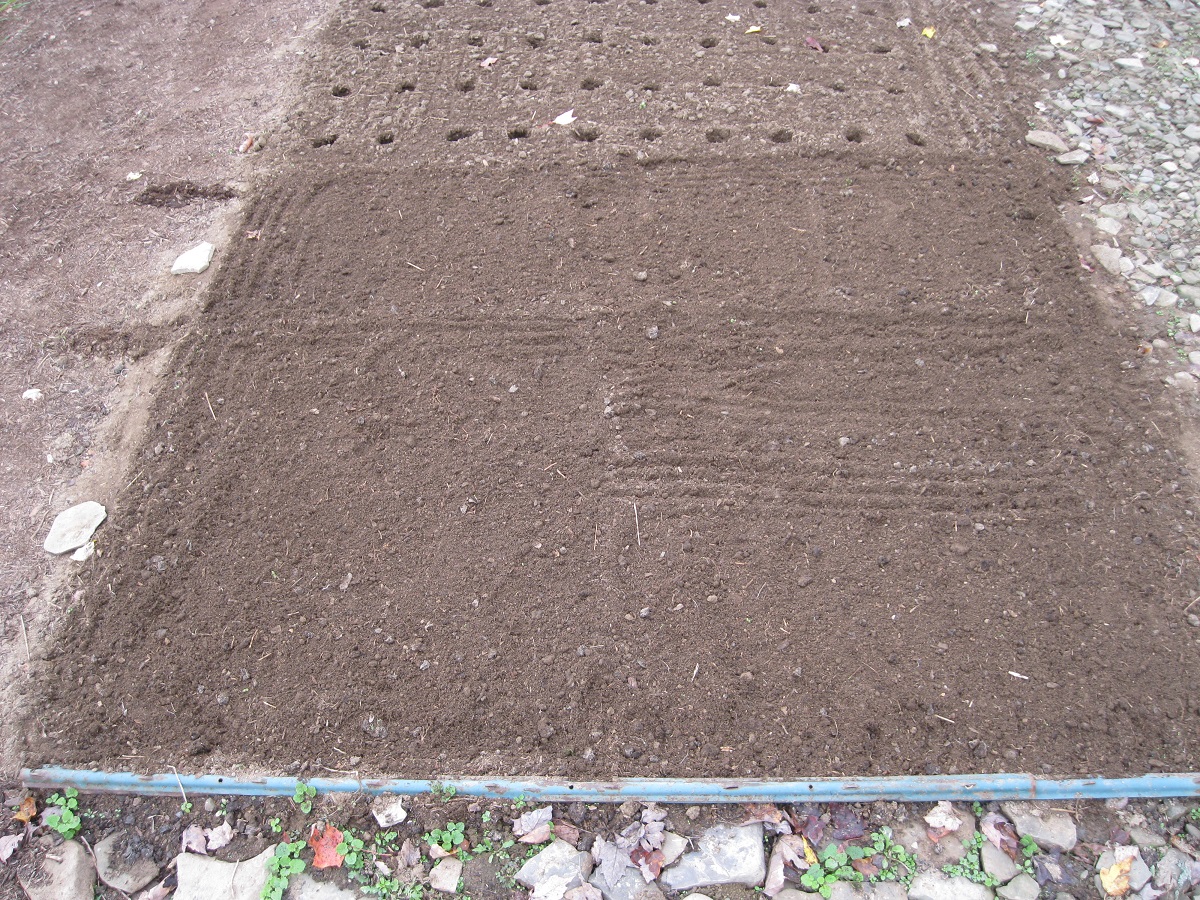
This shows the remainder of the bed that will be planted over the next several days.  Another section of fence that is rotated 90 degrees was placed over the two pieces shown.  Since it was needed to close in the garden it is now tied to the fence posts.  All of our beds are five feet wide and our method of push a hole then skip two before pushing the next hole gives us ten plants per row.  The spacing for the rows is push a hole then skip four before pushing the next hole yielding twenty-two rows. 


This unknown to us Aster was just discovered growing near the Arbutus plants.  We plan to carefully dig it from the ground and move it into a garden spot.  Transplanting at this time of year is not usually done since Fall planting frequently results in frost heaved plants.  We must remember to cover it with a cage since the deer eat garden grown Asters to the ground.  The unusual color of the flowers is what drew me to this plant.  Asters are a huge family of native plants and we will try to find the name of this one.  Ed's Delight may have to suffice.


This is our second group of transplanted Arbutus.  We have found that the soil under White Pine trees suits Arbutus.  This is the time of year when the evergreen tree sheds its needles.  New growth pushes the old needles away so the tree always looks green.  Many of these fallen needles will be hand picked so that the Arbutus leaves receive enough sunlight all the winter.  I never realized that native plant gardening required so much work.


 This native New England Aster consists of but a single stalk.  The recent frosts ended many of the Goldenrod flowers leaving asters as the food source for late Monarch butterflies.  Deer left this wild plant alone but heavily feed on the same variety placed in my gardens.