Showing posts with label lemon grass. Show all posts

Thursday, September 20, 2018

Lemon Grass Ready To Move Indoors


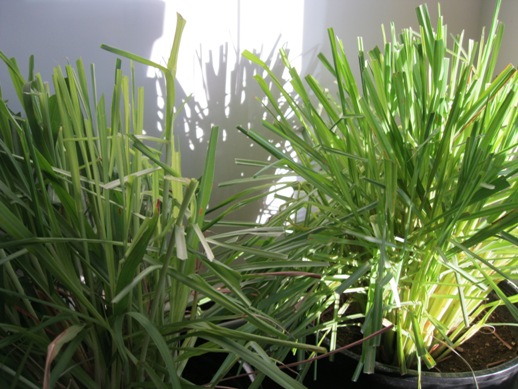
Lemon Grass is a native plant in India.  Growing there in climate zone 9 or 10, it will reach four feet in height.  We have kept this plant alive in rather cold conditions for a number of years.  Winters are passed indoors where we heat heat the house to 68 degrees.  Two plants are placed on the landing midway up the stairs from the basement.  A mostly glass entry door provides the plants near it to enjoy generous amounts of sunshine.  The extra distance to the ceiling creates strong air currents which seem to benefit the plants.  The other two plants are placed on a work table directly in front of the three bedroom windows.  These plants have a rather tidy growing habit so they create little liter.  Each pot is placed in a plastic dishpan so that generous amounts of water can be given to the plants.

These plants grow to a size that makes placing them in three gallon pots difficult.  Our habit is to divide the monsters so that we always have reasonably sized plants to lug around.  We were late in getting to breaking apart the overwintered plants and their condition was poor.  Seven plants were set out in a garden bed in late June and we expected several of them to simply die.  All seven grew into impressively healthy specimens.  We only have room to bring four indoors so we must make an effort to harvest the remaining plants.  Fresh leaves are used to make tea but we do not dry any.  We have fresh leaves all winter long so why bother drying leaves?


Here the chosen four will make the transition to life in a pot.  The shade garden protects the new transplants from full sun.  Now we need to stay aware of coming weather so that these plants can be moved indoors ahead of the first frost.  We really do garden to some degree all year.  We need to be more aware of this wonderful experience and enjoy it to the fullest.


This plant came through last winter in excellent condition.  When the risk of frost had passed, this plant was removed from its pot and planted in the shade garden.  It has given us fresh leaves for tea all summer but its end is near.  Anyone with greenhouse space is welcome to provide this plant with a winter home. You will need a five gallon bucket and a strong back.  We do not deliver!

Friday, September 23, 2016

September Frost Forecast


In this part of New York State, September frosts have become all too common.  Today was a hot humid scorcher but frost warnings have been posted for tomorrow night.  We insist on growing and carrying over plants native to the tropics.  One light kiss of frost will end them.  They need to be moved into the house now.

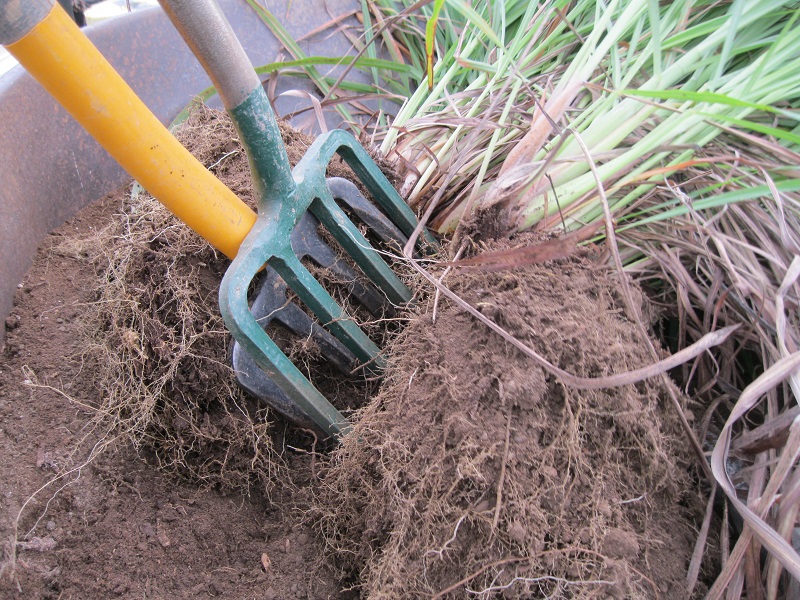
The first step in separating this plant into smaller pieces is to insert two spades into the root mass.  Lemon grass will divide easily once the tangle of roots have been pried apart.  Pushing the spade forks into the root mass is the most difficult part of this job.  One can almost hear the plant scream out.


This clump of lemon grass spent the summer planted out as a garden plant.  Native to India it is accustomed to heat, floods and drought.  Here it experienced all of that and more.  We have found that it survives division and placement in a pot if it is watered heavily.  In this photo the two spades back to back are rocked against each other to pry the root mass apart.


As violent as it appears, little damage is done to the plant.  With the root mass separated, gentle tugs disengage the crown.  The near spade is an English product made by Smith and Hawkins.  When Amy lived and worked in New York City she purchased this tool for us in Manhattan.  It rode with her as a subway took them to Brooklyn.  Then a ride on a commuter train headed north was part of a weekend trip home.  My spade is well traveled and is only used to divide plants.  We will not risk breaking it on heavier work.


Two intact pieces of the original plant have been placed into three gallon pots.  Plants roots will quickly be pressing against the pot sides but the root mass is of sufficient size to allow its return to the garden in the late spring.  Now the pans full of water will give the transplant a generous soaking not unlike monsoon rains.  Tomorrow they will look as stately as they appear now.

These two plants will spend the winter on either side of the mostly glass front entry door.  Ample sunshine and active air currents there have always brought these plants through their season indoors in fine condition.  June seems so far away now but it will find us and these plants will return to the great outdoors.

Sunday, September 14, 2014

The Heat Is On


An overnight low temperature of 39 degrees F remains in our weather forecast.  Frost warnings are absent from forecasts but our experience requires some caution.  Older hardiness zone maps show a finger of cold stretching from the high peaks of the Adirondacks to very near the southern border of New York.  Mountain cold spreads across the state bringing us temperatures that are frequently seven degrees colder that those forecast.  A little simple arithmetic tells us that frost here is possible tonight.

These two Lemon Verbena plants grew from cuttings taken earlier this year from plants overwintered in our basement.  Our experience with this plant has shown some frost hardiness but we are super cautious.  Four other plants will remain outside tonight.  Two plants are three years old now and are simply too large to pot up and bring inside.  The other two plants are in their second year and will spend the winter indoors.  A light frost tonight will do them no harm so their move into a pot is days away.

We have watched countless Lemon Verbenas die inside during winter.  Our success with them has improved greatly since we started cutting them back several days before the move to the pot.  The older plants will also require root pruning.  Notorious wilters, they pout for days after transplanting.  A close look at the above photo will reveal drooping stems already despite my flooding the pot and sprinkling water on the leaves.  Confined to a shady daytime location, it may take a week or more for them to recover.

We have found it impossible to buy these plants locally.  Richters is a reliable mail order source for Lemon Verbena but if we are successful starting new cuttings they may not get an order again next year.


Lemon grass is another plant that naturally grows in a much warmer climate.  Two of these plants will spend the next several months on a table where I build models.  They will be positioned between me and the large windows but all are content with that arrangement.  The other two will flank the mostly glass front door that we never use as a door.  Air currents swirling up the stairwell, heat from radiators on either side and a generous southern exposure combine to make this the best location that we have to overwinter plants inside.

We have discovered that a key to success with these plants in pots is generous amounts of water.  Each pot will be placed in a plastic dishpan intended to contain excess water.  The plants will draw from their individual reservoirs between waterings.

It is much too early for these plants to start their time indoors.  For the next several weeks they will spend warm days basking on the stone wall and cold nights indoors.  It seems that much of my time at either end of the gardening season is devoted to moving potted plants between the wall and the basement.  Hefting three gallon pots filled with soil keeps me fit.  I really look forward to the day next spring when this process starts again.  Then it will represent another beginning rather than the present ending.

Our wake up temperature was 49 degrees F the following morning.  The four butternut squash picked yesterday were almost completely ripe.  Cool nights set the sugars in butternut squash so those remaining in the field will be of better quality than the ones harvested yesterday.  The four pumpkins picked yesterday gave every appearance of being fully ripe.  As it turns out, we were overly cautious but when dealing with frost one error is fatal.  The plants in pots will be returned to the wall and another day in the garden will soon be underway.

Thursday, January 24, 2013

It's So Cold That...


We headed out this morning at 9:00AM and it was cold, too cold!   As I sat bundled up but shivering in the car, the temperature on the dash registered 2 degrees.  As it turned out that was the balmy temperature where the sun was shining directly on the car.  When we headed down the lane the numbers dropped steadily finally reaching - 3.  I shudder to think how low it actually got last night.  Any gardening to be done when it is like this will be inside.  I watered the rosemary and ran my hand over the leaves of the plant to get that lovely fragrance.


I used my kitchen shears to give the lemon grass a haircut.  Running your hands over this plant would be a bad idea.  The leaves have very sharp edges, but they make a nice cup of tea and add  wonderful flavor when cooking.

While we were out we stopped and picked up some insecticidal soap.  Last week it was warm enough that Ed took the lemon verbena plants outside to rid them of white flies.  With this kind of cold any battles with the bugs will have to be fought indoors.  A treatment that kills the patient isn't very helpful!

Monday, September 10, 2012

Early September North Wind


Pictures of the people here are rarely published.  We would prefer not to frighten people.  The unusual garb deserves an explanation.  Sun sensitivity is an undesirable side effect of some necessary medications.  A Solumbra helmet drape and a long sleeved shirt allow day long work outside.  With little skin exposed biting insects can find no meal here.  Passers by give me strange looks and tend to keep their distance.  I'm not sure that this is new behavior.

Today we noticed a shift in the wind.  It was coming at us from the north.  Frost is predicted in the cold shaded valleys.  Frost will likely not call here tonight but many of our plants detest cold nights.  Three pathetic lemon grass plants survived last winter indoors.  They were among the last of the plants to be planted out.  Their high water need was met during the drought and we have three beautiful plants to bring indoors.  For now they will spend only cold nights in the basement.  The rest of the time they will be outside on the stone wall.


We usually order three Lemon Verbena plants from Richters.  This year we took cuttings from our overwintering basement plants.  The cuttings rooted so for the first time ever we were able to plant out our own young plants.  Leaves on the freshly potted plants are droopy as expected.  Lemon Verbena really resents disturbance of its roots.  By morning their perk will have returned.


In 1993 Becky purchased a scented geranium at Caprilands from Adelma Grenier Simmons.  We have kept the monster alive and in bounds with severe pruning.  This year we discovered a section of stem that had layered.  This piece of plant has leaves, roots and a stem.  It should remain alive.  We could use a fresh start with this treasure.


Days in the summer sun brought the curry leaf plant back to health.  Becky vowed to herself that this plant would not see another winter indoors.  Time will tell the fate of this plant.  Tonight it is safely tucked in a spot on the basement floor.

Saturday, February 11, 2012

Lemon Grass, Lemon Verbena, and a Mummy


I dry herbs for tea so we can enjoy them in the winter, but I really miss herb tea made from fresh green plants. One of my favorite herbal blends is a triple lemon tea.  It consists of lemon balm, lemon grass, and lemon verbena.  I don't have lemon balm growing in the house, but today I picked some lemon verbena leaves and lemon grass leaves to make a nice pot of fresh herb tea.


When I picked the lemon verbena leaves, I also picked this leaf that clearly has a resident. My first thought was to toss it into the compost for immediate disposal. But I was curious to know just who lurked in this mummy like cocoon.


I can breathe through a tissue, so I chose that for the top of my jar. I wanted something fine in case whatever hatches out is tiny.


Now the mummy lurks on my kitchen windowsill. If something hatches I will be sure to see it there. Ed thinks it might be a spider. I don't know what it is, but I hope this mummy doesn't come with a curse.

 February 17: Whatever was in the jar escaped into my kitchen. A hole in the tissue was my first clue. Examination of the remains on the leaf showed that something hatched out of a thin shell. Darn I guess it came with a small curse.

Tuesday, October 4, 2011

House Arrest


It is time to accept reality and move our tender plants indoors.  This location inside of the entry door that we never use has proven to be our best location for over wintering plants.  We have other locations with better light but the moving air currents are stronger here.  A high ceiling combined with heaters on both sides of the landing really move the air.  Since this is the best location, only the most favored plants get to spend the cold seasons here.


Three rosemarys line the left wall.  For some reason I thought obtaining a golden rosemary was a good idea.  Golden leaves look like dying  leaves so this plant always looks like it is on its way out. It's walking a thin line, because any plant that begins to look unwell loses this prime location. Two sweet bays, a tuberose, the patchouli and two lemon grass plants complete the group. Here in zone 4, tender plants get a six month sentence indoors. There is a slight chance for early parole if we get good weather in the spring. At some point these tender plants will again become the "In and Out Gang."