Showing posts with label September frost. Show all posts

Thursday, September 17, 2020

The Heat Is On

We have frost in the forecast for the next three nights starting tomorrow.  Our preference has been to avoid cleaning up frost blackened leaves by clearing out the sensitive plants ahead of the frost.  Powdery mildew has hit the pumpkins and squash rather hard making them a mess to clean up either way.  We planted a single hill that contained two pumpkin plants and two squash plants.  Soil preparations ahead of planting included adding aged manure to the planting site.  As the desired plants grew we cleared out weeds and covered the bare ground with chopped leaves.  During the drought we hauled in enough water to keep the plants alive.  When rainfall finally resumed, these plants exploded with extensive new growth.  This first picture was taken this morning before Becky started clearing the ground of squash and pumpkin vines.  

This long view shows the entire pumpkin patch now cleared.  Some weeds were found on the center path and also on the crossing path that is only half stone.  Clearly our early weeding and addition of leaf mulch kept new weeds at bay.  The four planting beds at the far end of this garden are in great shape for next year's garden.  The remains of the sunflower plants will be left in place to both feed the birds and drop seeds for next year's plants.  We intend to be here early come spring to pot up newly emerging sunflower plants for placement in an area of our choosing.

The garlic bed in the left foreground is almost ready to plant.  Two additions of aged manure have been spread and turned under.  The dark spots are pieces of this screened manure that remained at the surface.  Next, sifted compost will be spread on the surface then turned under.  One last pass with the potato hook will be made just before planting time which is quickly approaching.

Freshly applied reground bark mulch is reestablishing a weed free path between two planting beds.  The first time we did this, plastic was rolled out before the bark mulch was added.  Quack grass roots quickly wove their way under and through this barrier making their removal impossible.  Now we will have total access to this pesky weed that is sure to return and perhaps this battle will finally be won.

This is the extent of our ripe harvest.  We have read that pumpkins showing some orange color will continue to ripen after they are harvested.  We shall see.  A spot on the front deck is where these were placed.  Placement next to the south facing house wall might moderate the coming cold frosty nights.  A blanket will be added as cover to try to avoid freezing the fruit.  If that works, many warmer days in the sun may fully ripen each of these.


 Here is the delivery system used to bring in bark mulch.  Needless to say the tractor driver was rather proud of being able to back the wagon past the gate posts.  The drop into a hole for one wheel did not simplify that move.  I wonder how Sidney's FFA teacher would have rated this park job?

Friday, September 1, 2017

September First Frost


Just to be clear, this post title refers both to the first frost of the season and the fact that it occurred on the first day of September.  Located in the Southern Tier of New York, we are accustomed to seeing the aftermath of a late September frost some years but never this early in the month.  The weather service did not speak of possible frost last night but mentions it for tonight.  Last night's forecasted low was in the mid forties.  We have been here long enough to know the likelihood of frost in our location when the weather station expects numbers in the forties.  It came as no surprise when we looked out this morning and saw wilted leaves on the squash.


The pattern of the damage raises more questions than answers about the actual movement of the cold air that caused the damage.  Long after we placed our garden we observed the pattern of frost on the grass.  Cold pours down from the high ridge behind the ridge that we can see from here and its path is defined by our low notch.  That river of cold follows the contour of the lower ground and finds an exit toward the west.  Unfortunately for us, a wide bend in that river washes over much of our garden.  The basil is planted on slightly higher ground and escaped any damage last night.  We hope that it remains undamaged come morning.

When I first came to this area little more than one half of a century ago, the old timers spoke of the year without summer.  They had heard stories from men much older than themselves of a year when frost formed every month of the year.  Only July and August are usually free of freezes but there are old tales of frost then. If the frost formed before midnight last night, then we just experienced frost in August.  So in this youngster's memory, frost eleven months out of the year is possible but rare.  A July frost seems highly unlikely but who is going to argue with tales from the collective memory of old timers.


This is just a little good news.  Ingaborg gave us these plants many years ago and we refer to them as Inga's mallow.  They self seed and reappear in many places in the garden.  They can be transplanted if the move is completed early since they grow from a taproot.  These beautiful flowers never fail to spark fond memories of a true master gardener.


This is the season of mums in front of many stores.  We prefer to grow our own but the plants prefer a warmer location.  This Mammoth Pink has held its location near the south facing house wall for the past two years.  It is self shaped since we never get around to that task.  These flowers should be fine tomorrow since our frost river flows far away from this spot.

Friday, September 23, 2016

September Frost Forecast


In this part of New York State, September frosts have become all too common.  Today was a hot humid scorcher but frost warnings have been posted for tomorrow night.  We insist on growing and carrying over plants native to the tropics.  One light kiss of frost will end them.  They need to be moved into the house now.

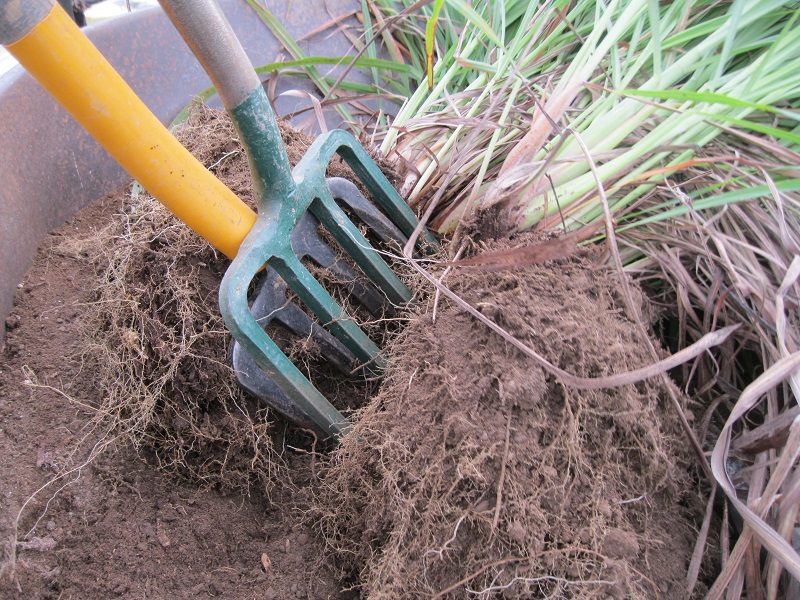
The first step in separating this plant into smaller pieces is to insert two spades into the root mass.  Lemon grass will divide easily once the tangle of roots have been pried apart.  Pushing the spade forks into the root mass is the most difficult part of this job.  One can almost hear the plant scream out.


This clump of lemon grass spent the summer planted out as a garden plant.  Native to India it is accustomed to heat, floods and drought.  Here it experienced all of that and more.  We have found that it survives division and placement in a pot if it is watered heavily.  In this photo the two spades back to back are rocked against each other to pry the root mass apart.


As violent as it appears, little damage is done to the plant.  With the root mass separated, gentle tugs disengage the crown.  The near spade is an English product made by Smith and Hawkins.  When Amy lived and worked in New York City she purchased this tool for us in Manhattan.  It rode with her as a subway took them to Brooklyn.  Then a ride on a commuter train headed north was part of a weekend trip home.  My spade is well traveled and is only used to divide plants.  We will not risk breaking it on heavier work.


Two intact pieces of the original plant have been placed into three gallon pots.  Plants roots will quickly be pressing against the pot sides but the root mass is of sufficient size to allow its return to the garden in the late spring.  Now the pans full of water will give the transplant a generous soaking not unlike monsoon rains.  Tomorrow they will look as stately as they appear now.

These two plants will spend the winter on either side of the mostly glass front entry door.  Ample sunshine and active air currents there have always brought these plants through their season indoors in fine condition.  June seems so far away now but it will find us and these plants will return to the great outdoors.