Rumor has it that at one time in the somewhat distant past, the NYS DEC recommended that Multiflora roses be planted to control erosion. Unfortunately these plants turned out to be wildly invasive. They certainly fill a waste space creating an impenetrable barrier. Their huge numbers point to the fact that they are now here to stay.
Focusing on the flowers, we captured at least two bees. The upper one has such a generous pollen load that she cannot assume a stinging position. Several of the flowers have been stripped of pollen revealing black ripening seeds. As we walked up the driveway, the sweet sweet scent of these roses hit us while we were still some distance from this plant. These plants are hardy, beautiful and smell great. It is easy to see why early European settlers carried this seed with them.

What remains of our young Jack-in-pulpits fills the left edge of the photo. Several bare stems mark the former location of several plants. Last year our resident deer did not hit here until much later in the summer. We were unsure if any of the plants would return. This area would be difficult to cage so no protection was provided. In the past I have collected urine to use as a deer repellant. Somehow carrying a sprinkler can down to the road enabling me to spread what is renewable protection seemed in contradiction since the area is filled with a sizeable rock and many other plants. So our deer made his way between other wire cages and nipped off both leaves and flowers.
This young buck is stabbing the ground clearly stating his ownership of this turf. We raise our objections to his presence with loud firm teacher control talk or sounds similar to the bark of a big dog. For the most part he remains unimpressed eventually moving into the cover of the nearby wooded slope.
Two invaders can be seen in this picture. The two plants growing in cracks in the stones defining the path are sunflowers. Needless to say we did not plant them. Some bird did that and these will likely need to be soon moved into more sunlight if they are to grow tall and flower. Back in the planting bed is a now rather rare ragweed plant. Becky has been unrelenting in her intense efforts to remove them from our land. This lacy leafed nasty will very soon disappear.

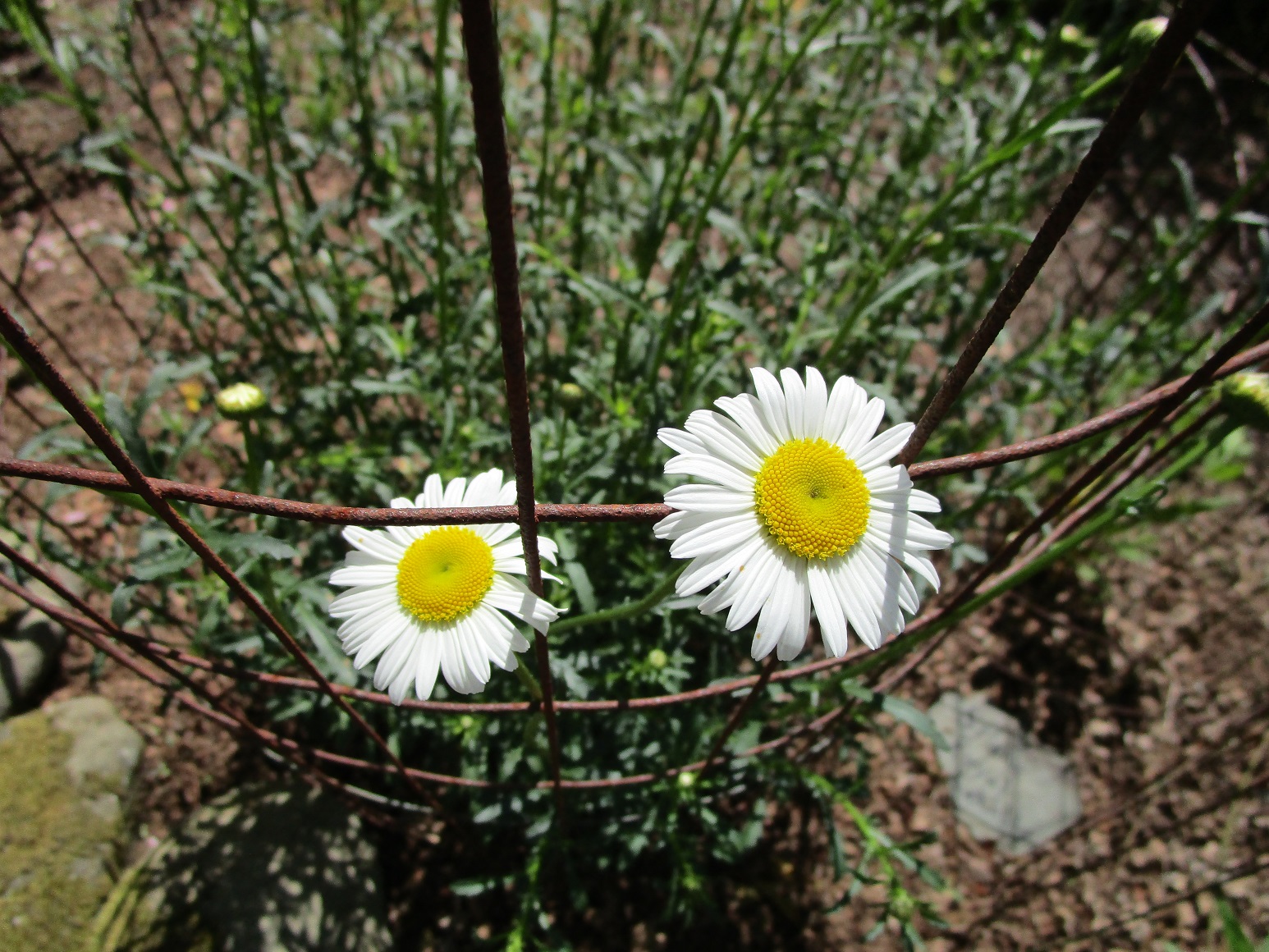
This is another European immigrant. It is easy to understand why daisy seeds were intentionally brought from their European homeland to bring a touch of home to this new land. We have tried, mostly unsuccessfully, to grow large swaths of commercially offered larger plants. This cluster was pulled from the level ground at the base of our gravel bank to see how it liked the open area near our woodland garden just last year. It seems to have settled in. We know that this plant will take and hold considerable ground so we intend to move it nearer to the south edge of this area when a now wild area is cleared.

Becky knows full well the origin of this Wild geranium. Our first plant came as an uninvited guest hiding under the leaves of a plant purchased at Catskill Native Nursery. It appeared to be a small attractive plant that could cover the bare ground between our desirable woodland plants. These tiny flowers have tiny fecund seeds that carpet the area. Besides that, over time the original plant revealed its monstrously large root mass and its need to take and hold all of the ground near it. We weeded out buckets of these plants earlier this year. Somehow this one still grows here and the flowers will soon be seeding another generation of these attractive but invasive plants.