This is perhaps the busiest time of year in the gardens. We race to pull the grassy weeds before they drop their seed load. Vegetable beds must be cleared of weeds and dead plants in preparation for fall enrichment of the soil. While we try to find a time of the day relatively free of stifling heat and humidity for our efforts, the plants are also at work preparing for next year.
Cardinal Flower reproduces by both seeds and daughter plants. Up to six new plants appear at this time of year around the base of the soon to be dead stem. These plants remain green all winter with or without snow cover. The thin flowering stem is something that we have never seen before. Plants similar to this one can be seen in several places throughout the garden. They may be new plants from seed. If so, they do not usually flower in their first year. They more commonly grow only a rosette of low leaves in preparation for the coming winter. This miniature plant is also displaying the sexual activity that precedes the formation of seeds.

One of the remaining mysteries about Cardinal Flower is how the large number of daughter plants that form under a cluster of enduring flowering plants survive. Each browning stem in this photo identifies a single mature plant. Each mature stem will try to produce up to six daughter plants for next year. Overcrowding seems highly likely and we will leave this plant in place to see how it grows next year. A plastic bucket will be used to protect these young plants from frost so that we can watch and perhaps learn more about this native treasure.
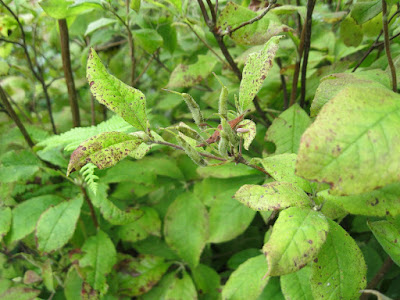
Pinxter is another native plant that seems to hide its business from our prying eyes. This cluster of maturing seed pods will be closely watched every day now. The brown object among the seed pods has already split open releasing its seeds. We have read that each seed has fluff similar to milkweed at both ends of the seed. We would like to see that and a controlled planting of these seeds should prove interesting. It is likely that we have weeded out Pinxter seedlings every year simply because we did not know what they looked like. I wonder just how many years are required for a Pinxter plant from seed to form flowers?
Pinxter is a plant that forms its flower buds ahead of the coming winter. Several early flowering plants share this trait. These buds are at great risk of becoming wildlife food during the harsh days of winter. We will surround our plants with wire cages to deny the deer access to our plants. It seems that many native plants cannot survive without human intervention now.
We have appeared to be gone from the face of the earth lately. Our internet connection disappeared and the phone company had great difficulty both finding and repairing the problem. We hope that their recent efforts prove durable.


