Showing posts with label Pinxter buds. Show all posts

Wednesday, March 17, 2021

Fall Formed Flower Buds


We still have snow covered ground anyplace where the slope of the ground dilutes the strength of the sunlight but we can walk about and find plants mostly free of snow.  Trailing Arbutus is widely described as impossible to transplant but we have found success.  This native plant is among the early flowers that form their buds in the fall.  It seems reasonable that a flower bud would be fragile and tender but since flowers will be open as soon as four weeks from now an early start is essential.  Oak leaves are covering areas of these plants but any work among possibly frozen or brittle plants will wait for reliable warmth.  The promise of incredibly sweet scented flowers after a winter of isolation is a major mood booster.


Pinxter is another native plant that forms its flower buds in the fall.  Our deer herd are fond of eating these buds so wire cages surround the plants at some distance to keep these future flowers beyond their reach.  Sweet scented pink flowers will soon fill this area.  We have found this plant resistant to reproduction.  Root runners are expected but have yet to be seen here.  Many open seed pods indicate that an abundance of seeds were present at the end of last year.  Try as I might, I have yet to see a seed.  They are described as having milkweed like fluff at both ends of the seed.  Seeing that and having seeds to plant are totally unrealized goals.  We will try again this year.


Snow drops are the first to flower, frequently while surrounded by snow making them popular without limit.  Early widespread transplantation makes its native occurrences impossible to describe.  We follow the centuries of moving this plant about totally disregarding the purity of our native plant shade garden.  The Sumac berries cover this ground with bright red seeds.  It seems that every seed germinates so we will spend a great deal of time weeding out baby Sumac trees. 


Becky took a first walk in our main garden near the house.  A deer herd of some size summer feeds on our plants but have been largely absent when deep snow covered this ground.  Retreating snow revealed the heavily chewed on bony remains of one of our deer.  When snow melt is complete, it is unlikely that any fleshy remains will be found.  Coyotes usually pull of pieces and drag them into the cover of Japanese Honeysuckle to eat their meal.  A small pile of bones and fur will be moved to a distant compost pile.  
 

Friday, September 14, 2018

Looking To Next Year


This is perhaps the busiest time of year in the gardens.  We race to pull the grassy weeds before they drop their seed load.  Vegetable beds must be cleared of weeds and dead plants in preparation for fall enrichment of the soil.  While we try to find a time of the day relatively free of stifling heat and humidity for our efforts, the plants are also at work preparing for next year.

Cardinal Flower reproduces by both seeds and daughter plants.  Up to six new plants appear at this time of year around the base of the soon to be dead stem.  These plants remain green all winter with or without snow cover.  The thin flowering stem is something that we have never seen before.  Plants similar to this one can be seen in several places throughout the garden.  They may be new plants from seed.  If so, they do not usually flower in their first year.  They more commonly grow only a rosette of low leaves in preparation for the coming winter.  This miniature plant is also displaying the sexual activity that precedes the formation of seeds.


One of the remaining mysteries about Cardinal Flower is how the large number of daughter plants that form under a cluster of enduring flowering plants survive.  Each browning stem in this photo identifies a single mature plant.  Each mature stem will try to produce up to six daughter plants for next year.  Overcrowding seems highly likely and we will leave this plant in place to see how it grows next year.  A plastic bucket will be used to protect these young plants from frost so that we can watch and perhaps learn more about this native treasure.
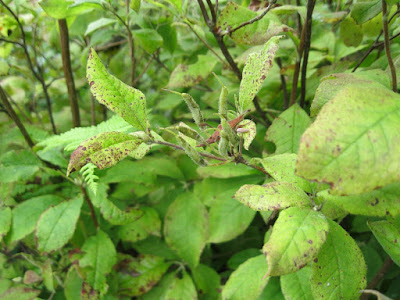

Pinxter is another native plant that seems to hide its business from our prying eyes.  This cluster of maturing seed pods will be closely watched every day now.  The brown object among the seed pods has already split open releasing its seeds.  We have read that each seed has fluff similar to milkweed at both ends of the seed.  We would like to see that and a controlled planting of these seeds should prove interesting.  It is likely that we have weeded out Pinxter seedlings every year simply because we did not know what they looked like.  I wonder just how many years are required for a Pinxter plant from seed to form flowers?


Pinxter is a plant that forms its flower buds ahead of the coming winter.  Several early flowering plants share this trait.  These buds are at great risk of becoming wildlife food during the harsh days of winter.  We will surround our plants with wire cages to deny the deer access to our plants.  It seems that many native plants cannot survive without human intervention now.

We have appeared to be gone from the face of the earth lately.  Our internet connection disappeared and the phone company had great difficulty both finding and repairing the problem.  We hope that their recent efforts prove durable.

Friday, January 12, 2018

Previews Of Coming Attractions


Gosh I miss my plants!  Today's weirdly warm weather allowed for a quick preview of coming attractions in the garden. This perfect little round clump of bluets in the garden down by the road means there will be beautiful little blue flowers arriving in the spring.  They are not to be missed!


This coral bells will be a coming attraction for the hummingbirds in the neighborhood.  True it has been nibbled on a little, but the mound of foliage with slender stems and tiny reddish pink bells will come back strong and have me all a buzz along with the hummingbirds!


This perennial flax is clearly planning to  put on a show of beautiful blue flowers.  Each delicate pale green feathery stem will have blue flowers on the top.  Individual flowers fade quickly, but keep coming and the plant looks great from spring to fall.  For me it is a must see!


Ed's pinxter is a budded and ready for it's dazzling pink display coming in May.  If you have never seen this native plant in person, you have missed something very special!


Cardinal flower is having a special grand opening here in 2018.  These magnificent stunning red native plants loved by hummingbirds and gardeners alike are still in the production phase.  We will tell more when spring arrives.  The rain has begun and our sneak preview is over for now.

Monday, October 30, 2017

Late Walkabout


When it comes to hardy, these Emperor of China chrysanthemums can't be beat.  They don't even get started until it gets cooler in October.  When it gets cold the leaves change to dark red, but the flowers  continue to bloom.  So far the latest flower we have had has been in December! 


At this time of year our focus is on cleaning up another mess in preparation for the next gardening season.  We have found no time for a simple walk in the garden.  Daylight outlasted the chore tasks so we had time for a look around.  This is likely a Cardinal Flower from seed.  There is but a single plant here so new growth near a dying flowering stem is unlikely.  There is also no sign of the remains of a stem.  In the company of violets and clover this might have been seen as just another weed.  Its location in the south west corner inside of the stone square is marked here so that it can be found in the spring.  It is much larger than the plants growing at the base of flowering stems and we would like to try potting it up.


These are newly discovered buds on the Pinxter bush.  We knew that the buds formed in the fall and as luck would have it we found them today.  Last year the deer ate here so timely preventative action was taken today.  Wire cages were placed so that the Pinxters were surrounded by either wire or stone wall.  During this time we found an additional bush growing very near the larger plant.  We have known about this small plant for several years but have resisted trying to move it.  This coming spring perhaps we will try our luck at moving this plant for the third time.


As fall color photos go, this one is somewhat unusual.  The setting sun is lighting up these Goldenrod seed heads in an attractive manner.  Traditional fall colors meet the sky on the edge of the gravel bank hill.  Goldenrod presents a conflict to us.  It is a highly invasive weed that takes and holds ground at the expense of whatever plant grew there in the past.  For that reason it needs to be exterminated.  It is the last plant to flower in our meadows providing nearly the only food source for late appearing Monarch butterflies.  For that reason we must have this plant.  It takes a pry bar and a block of wood to lever out the root mass and some plants are removed in that manner.  Others are left in place to feed the next season's crop of butterflies.


Repeated frosts have caused the trumpet vine to drop its leaves.  Today it was bald enough to reveal the wren nest that we knew must be there.  When the vine was covered with its red trumpets this summer, wren vs. hummingbird activity was wonderful fun to watch.  It seemed like the birds enjoyed their competition.  I fully expect all of them to return next year!