Showing posts with label trailing arbutus cuttings. Show all posts

Tuesday, June 16, 2015

Here We Go Again


This first arbutus seed berry to open was caught in the act.  Three of the five covering flaps have peeled back exposing tiny ripe black seeds.  Imprints made by the developing seeds are clearly seen on the open flaps.  White spots mark the black seed surface in an amazing display of miniature complexity.  We have seen no young plants yet from the seed scattered last season.  More than one freeze thaw cycle may mark the natural process of germination.  Since ever advancing age places time limits on how long we can wait, harvesting some seed, carrying it over in the refrigerator and starting it inside in late winter is the present plan.  Three additional unopened seed clusters lie hidden under the open one.


Creating arbutus plants from cuttings has totally eluded us.  The number of plant pieces killed must now approach one hundred.  Given the success we have had using Richters natural rooting powder with lemon verbena, more arbutus stems have been nipped.  Heel cuttings will be taken just ahead of the stem cut.  These larger leaves may allow us to identify which method was successful.  Stem cuttings will be taken near the growing tip.


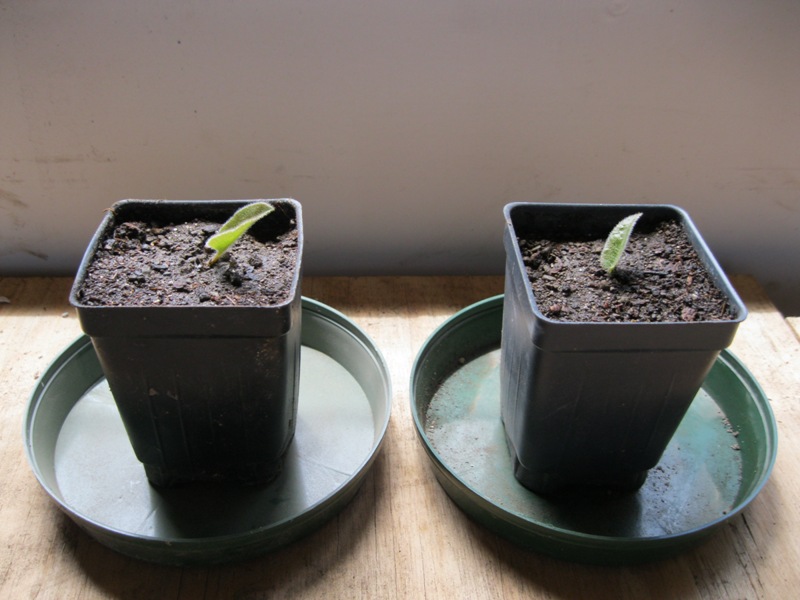
The stem cutting on the right still has its growth tip.  We have in the past seen continued growth from that point despite the fact that no plant crown or roots formed.  The heel cutting on the left will have to grow  its leaf larger.  Our potting medium consists of equal parts of white builders sand and screened soil taken from under a white pine tree.  Plastic saucers allow the water to rise up to the top keeping the rooting medium in place.

We are not using ordinary tap water here.  When the soil was removed from under the white pine tree, masses of roots crisscrossed every shovelful.  Screened out, the roots were placed in a bucket to collect rain water.  That is the source of the brew that will water these cuttings.


Old juice bottles with their bottoms removed provide a humid environment for the plant parts recently severed from their roots.  When the time seems right, the bottle caps will be removed to lower the humidity inside the bottles.  At that time everything will be moved into brighter basement light.  After another wait, the bottles will be removed.  In the past, arbutus leaves remained green at this point but rootless.  The brown color of plant death quickly followed.  So the wait begins again.


Here is the current status of our older transplanted patch.  Bright green leaves mark the extensive new growth.  The white seed berry shown above can be found in the lower right corner of the picture at the base of the first dark green leaf encountered  moving up near the edge.  The new growth heading into the stone wall at the top of the photo was the source of the cuttings.  The three pieces taken will not be missed.

Tuesday, June 24, 2014

Arbutus Seed To Soil


Eight days ago several arbutus seed clusters were nipped off the plants and placed in a tray near a basement window.  Today I could wait no longer.  These seed structures are almost as large as a pencil eraser.  Opening them while preserving their form was beyond my skill level.  Tiny seeds did fall on the paper towel as I tore the clusters apart.  These seeds are so small that I needed the photo to confirm their presence.
 

Ripe or not, the seeds were scattered on the surface of the previously prepared soil.  A handful of rotting pine needles was rubbed between my palms creating a fine natural thin covering for the seeds.  Now we wait.  When I checked back this evening, red ants were busily working the area.  Columns of these ants have been moving up and down the white pine tree trunk adjacent to the arbutus planting for days.  The purpose of this activity escapes me.  Hope that they are not interested in fresh arbutus seed although they were moving away some of the pieces of pine needles.


Eight days ago I also placed two broken arbutus stems in rooting soil.  One of these stems had been accidentally broken off several days prior to my rescue attempt.  That may be the dead one.  The second cutting looks good.  Its tiny hairy new shoot is encouraging.  These two plants were moved outside and removed from the plastic bottle covers just briefly for the photo.  Both have been returned to indirect light near a basement window.  Now we wait.


This picture shows the general condition of the arbutus plants today.  One unopened seed cluster remains attached to the plant.  It is hidden away under a flush of new growth.  A brown spot has just appeared on the surface of the cluster.  Perhaps we will be lucky enough to capture a photo of this seed structure when it opens naturally.  Now we wait.

Wednesday, June 5, 2013

Arbutus Cuttings


Our baby arbutus plant from seed is barely eight months old and its new growth is amazing.  The low cluster of three dark leaves of varying size is last year's growth.  Five light green leaves are the new growth to date.  The large bright light green leaf appeared first.  The smaller olive green leaves are rather new.  How all of this new growth can spring from such a comparatively small and young parent plant has to raise questions.  Soon finding the crown of this plant will be difficult since most of the growth will be a some distance away from it.


Nearly daily checks are taken on this cluster of female blossoms.  We are hoping to record the development of seed capsules.  There has been no apparent change since the flower petals were dropped.


We are also watching this group of male flower remains.  Since we have no botany courses between us, there is a small nagging doubt about our identification of the genders of these flowers.  If seeds appear here, then we were dead wrong with our classification.


These two stem cuttings were taken today.  Small olive green leaves are the youngest so that was our choice for cuttings.  New cells are more prone to accept a new function than older cells.  We need stem cells to convert to crown and root cells if a new plant is to appear here.  My previous attempt to root arbutus cuttings was a complete failure.  New growth was taken before but today I went with really new growth.  Clear plastic juice bottles with the bottoms removed are in place over the cuttings with the entire affair moved to dim light.  Water is in the saucers.  The race is on to see if the cuttings can send out roots to get water before the leaves dry out.  The bottles should maintain a moist environment around the severed leaves.  In a few days the caps will be removed from the bottles to allow some air circulation.  We will also allow the saucers to dry out between watering.


All of these bright green leaves are new growth this year.  A woodchuck ate this plant down to the crown last year but it appears that this one is a survivor.  With all of this new growth, there may be suitable structures available to support flower bud formation this fall.

Expect to see a post announcing the fate of the cuttings taken today.  We will report either success or failure.  We also hope to be able to report the formation of seed capsules.  Our immediate goal is to gain some understanding of the natural cycle of this plant.  If we learn enough, perhaps we can reintroduce some arbutus plants into the wild.