Showing posts with label bees. Show all posts

Wednesday, June 29, 2022

Milkweed Flowers


June drawing to a close has always been a special time of year.  Thirty-four times it marked the change from working in the classroom to ten weeks of vacation or a summer job.  For many, Milkweed is little more than a roadside weed.  Its unique connection to the Monarch butterfly makes it an incredibly important native plant.  Our retirement land was purchased more than one quarter of a century ago and its wildly rural nature placed us in close contact with both the butterfly and its food source.  Memory of its powerful scent could not go unnoticed.


The difference in the color of the open flowers remains an unanswered question.  Many are close to white colored while others show a rose pink.  One possible explanation could be the age of the open flower but we see both colors on plants with both open flowers and unopened buds.  Perhaps this issue is similar to the variation in human eye or hair color.  It just happens.


Several years ago we started squash seeds indoors well ahead of the last frost date.  When these plants were moved outside there was a long period when no blossoms were pollinated.  The newly opened flowers on the milkweed were a powerful magnet drawing in all of the bees.  Our squash simply had to wait until these flowers were finished.  Early yesterday morning when I first saw open flowers, a perfect Fritillary butterfly was finding food there.  When I returned in the afternoon with a camera the bees had taken possession of these flowers.  The only butterflies seen then were being chased away by selfish bees.


It comes as no surprise to those people that know us that we meddle in the natural order.  As Fall approaches we see huge numbers of Milkweed plants with no leaves as they die down.  This is at the exact time when the caterpillars need a food source.  These developing creatures eat only Milkweed leaves and they are scarce at that time.  Milkweed is an amazing plant.  When it has a visit from a lawn mower, it simply regrows.  We mow two large fields intending to end mowing in July so that the new growth will have young leaves for the caterpillars.  This sounds like a good plan but some of the plants that we cut down are feeding new caterpillars.  We do have large areas that never see the mower so we are not killing all of them.  This working with nature is never easy.

Sunday, July 5, 2020

Common Treasure


Not one to be driven by standard practice, we on occasion walk a less traveled path.  Some of our garden plants are nothing more than common roadside weeds.  Milkweed is just such a plant.  It was never purchased and we cannot recall intentionally planting it.  It occurs widely in our various gardens and is difficult to remove.  Its deeply placed horizontal root might require power equipment in order to completely dig it out.  It is a tough plant and we intentionally mow large patches of it so that the resulting new shoots and leaves will be available for the butterfly caterpillars that desperately need it to survive in the fall.

Some years Milkweed flowers opened at the same time as the end of the school year.  The appearance of this overpowering scent marked the beginning of yet another summer vacation.  One does not have to get close to the plants to savor the amazingly sweet fragrance but it always draws me close.  After all of these years, I still stop to enjoy the scent while placing my nose in close proximity to feeding bees.  Their mood has always been tranquil while they gather this delicious pollen.  Some find this behavior of me intentionally getting close to bees slightly disturbing.


Our fields also hold many of these plants.  The famed Monarch Butterflies feed on various different flowers but lay their eggs only on milkweed plants.  The difference in flower color is worth noting.  Why that happens remains an unanswered question but I still marvel at it.  This lighter colored blossom clearly shows the unusual complexity of each flowers structure.  The darker petals fall away from the sexual parts making the pollinator's access easy.

We have yet to see the first Monarch Butterfly this year.  That they survive at all with their unusual migratory habit is a wonder.  Still, we will be relieved when they finally make their appearance here.  Some years their numbers are small but they have so far always returned.  Milkweed leaves await their return but for that butterfly any flower will do.

Two days after this post was written, a Monarch butterfly was seen flying in close proximity to a Milkweed blossom.  Becky had twice seen Monarchs earlier but then she is more observant than me.  All is right with the natural world as life continues to provide for the next generation.

Saturday, July 7, 2018

Mating Monarchs


This is not a photograph you see everyday.  In fact it's amazing that I got this picture at all.  Ed was mowing the area  by the bluebird houses that I can see from my kitchen window.  He noticed a pair of mating Monarch butterflies on a milkweed plant.  He stopped mowing and  called me so I could see the coupled pair.  Over the years he has seen this many times back where we have acres of milkweed growing, but this was my first time!  I thought it might be rude and insensitive to get the camera to record this event, but I went back in the house to get the camera deciding if they were still there I would give it a shot.  I slowly approached being respectful and quiet but when I got almost close enough, they flew away.  I snapped a picture anyway pointing the camera in their general direction.  Ed had been watching me and was positive that I got a blurry picture of nothing. I  can't believe my luck!  This is not part of a video!  It has not been enhanced, cropped, centered or in any way altered.


Wildlife centered gardening can be a bit tricky.  We leave the milkweed so that the mating butterflies have plenty of leaves on which to lay their eggs.  However Bluebirds and Tree Swallows like to be next to an area of short vegetation so they can fly directly into their nest.  One box that can't be seen in this picture is currently empty.  Nearly grown  Tree Swallow babies  are in the box you can see.  Frequent  feeding trips need to be made by the adults.  I watched and they swoop around the milkweed plants and into the hole in the nest box with ease.


Milkweed flowers are buzzing with  bees.  The scent of the plants is intoxicating!  I guess for the Monarchs it all comes together to put them "In The Mood"!

Wednesday, July 13, 2016

Busy As A Bee


Today  is wordless Wednesday.

Tuesday, March 13, 2012

The Pure Delight of Early Spring Bulbs


These are the snow drops that came up in the leaves around my tree peony.  Their flowers are open in spite of the fact that the foliage  is still yellowed from the lack of sunlight.  I think in time the leaves and stems will be their normal green, but the flowers have no time to wait.  If the weather stays warm, their chance to bloom will be short.


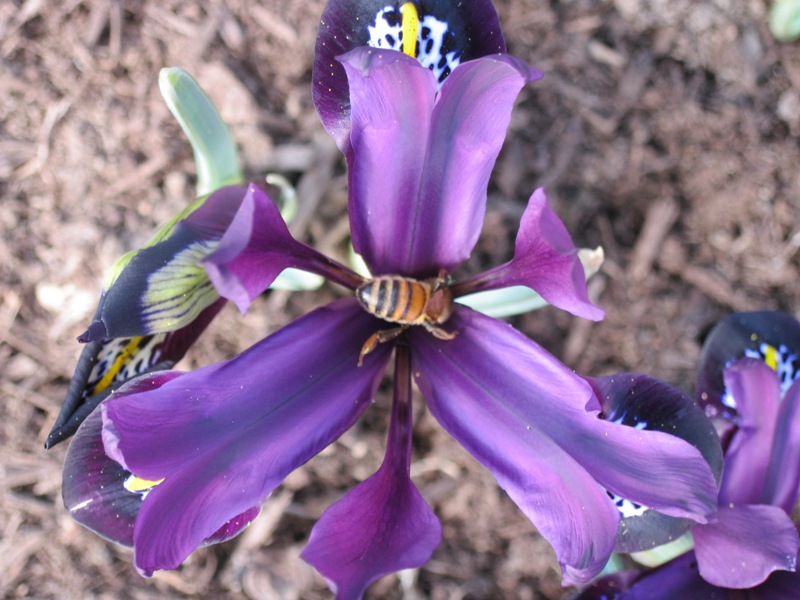
The bees are just as delighted as I am to see these beautiful little Dutch Iris flowers.  Many years they bloom in the snow.  They thrive in cool weather.  Even if these early  temperatures in the sixties  shorten their bloom time, their exquisite beauty lifts my spirits.


With  the deer frequently visiting here, wire cages give these little flowers a measure of protection against being eaten or trampled.  The system is not foolproof.  Small rabbits or squirrels can easily pass through the wire mesh. I look forward to tomorrow  in the garden confident there will be even more of these perfect little flowers making an appearance. 

Tuesday, August 24, 2010

Rainy Day Cheer


We have been getting steady , sometimes heavy rain for a couple of days. The garden loves the water, but it changes our outdoor activity. This morning we watched as a the usual parade wandered by the garden. First the doe and her fawn came by and disappeared up Ed's path to the high meadow. It's been fun to watch that fawn grow bigger and braver. He wandeers away from mom more and more.

The family of turkeys spend a lot of time working the grass around the garden. Still two hens and 3 babies, the little family group seems to have settled in right in this area. It was especially interesting to watch when the doe and fawn returned to the lawn while the turkeys were still there. They didn't seem to be intimidated by each other, but at the same time it seemed like the party had become too crowded. First the deer left our sight and soon the turkeys were gone too.

The sunflower and bee picture is a couple of days old, taken before the rains came. Bees are fair weather pollinators. These two really have those pollen bags packed. Today the weather could go either way. The cloud cover is thick. I don't see the patch of blue sky big enough to make a pair of trousers that my grandmother said was necessary for the weather to clear. Either outcome will be good for the garden and there is plenty for us to do as well.

Sunday, June 13, 2010

Thyme For Weeding On A Rainy Day


Too bad the weeds still grow when the thyme is in bloom. On a sunny day the flowers are covered with many sorts of bees. On a rainy day however, the bees stay home and weeding can be done without all that buzzing and the risk of being stung. Early morning works too, bees sleep in until things warm up a bit. Today was raining on and off, so I took my chance to weed the red creeping thyme on the patio. I did leave one woolly thyme plant hoping to move it to a place where I want it later.

Yesterday when Amy and I were in the garden we discovered a new spotted fawn. He might have been born yesterday because he was small and unsteady. Mom was nowhere in sight. We were relieved when he tottered off into the pines. Today while I was working in the garden I was snorted at repeatedly. I guess Mom is still around and a bit miffed that I was occupying her space. Ed and I still have the idea that this is our garden.