Friday, August 2, 2013

Sun Ripened Tomatoes


Tomatoes fresh from the garden on a warm sunny day are a taste experience that defies description.  That is one reason why we garden.  The quality of home grown can wildly surpass anything offered for sale at the market.  For the past two years, late blight has taken our tomatoes soon after the first tomatoes ripened.  Our choice was to give up or try something different.  Not ready to quit, we tried something different.

Starting our own plants from seed gives us total control over both variety and condition of the plants. This year we started our plants earlier than normal planning to move them into one gallon pots well in advance of the June first frost safe date.  That size container allowed the new transplants ample room to grow.  Cold nights found us carrying the pots into the warmth of the basement.  May 30th is the date of the wall picture.


This close up was taken three days later.  Good thick stems with generous leaf growth put these plants well ahead of nursery stock.  Dowels were added for support after a strong wind bent the plants.  We decided to try transplanting without cut worm collars since the thick stems seemed beyond their bite.  We lost no plants to cut worms.  A quick final weeding and these plants were ready for the garden.


Our first ripe tomato was harvested on the last day of July.  We may have had ripe tomatoes earlier if there had been more sunny days and fewer rainy ones.  If the weather cooperates, we may have weeks of sun ripened tomatoes.

At this time of year our valley fills with fog nearly every night.  All plants here start the day with wet leaves inviting fungus growth.  It is also common here for August days to be Alabama hot and humid.  That combination of heat and moisture can allow the plant leaves to remain wet all day.  Fortunately this year, our days have recently been cool and clear.  If this weather holds for some time, we may avoid the blight.

Our blight response plan has us harvesting green tomatoes at the first sign of blight.  If the tomatoes are moved inside while clean, we can continue to eat our tomatoes after the blight has ended the plants.  Tonight's meal will consist of BLTs made with lettuce and tomatoes from our garden.  We will enjoy this for us seasonal treat, as long as the harvest can continue.  We have not given up hope that the September frost will end our tomato harvest instead of that @*!# late blight!

Accurate record keeping is perhaps our weakest skill.  As luck would have it, the card showing the planting date and the varieties planted just turned up.  On April first Better Boy, Italian Goliath, Ferline and Red Siberian varieties were planted.  A more traditional seed starting date would be mid April here.  The early start followed by the transplant to one gallon pots allowed us to plant out large healthy tomato plants.

Thursday, August 1, 2013

Got Rocks


When we were searching for our retirement land, we had a list of prerequisites.  Since I was still employed, nearness to the job was at the top of that list.  My new found delight in piling field stones into walls mandated a generous supply of stones.  We found the last piece of an old farm that seemed to fill the bill.

Our gravel bank was likely opened to bury the remains of the barn that burned following a lightning strike more than half a century ago.  Before it was ours, town highway workers removed enough gravel each year to keep the face of the bank free of vegetation.  For the past two decades the only gravel removed was taken by me using hand tools.

How our gravel hill was left behind by the retreating glacier is a puzzle.  It is a rounded dome set in the middle of lower hummocky land.  Layers of fine black sand uncovered are not horizontal.  Most of what can be seen has tumbled down the slope so the actual layers remain hidden.  Fossils are common but exotic stones from far away are rare.
 

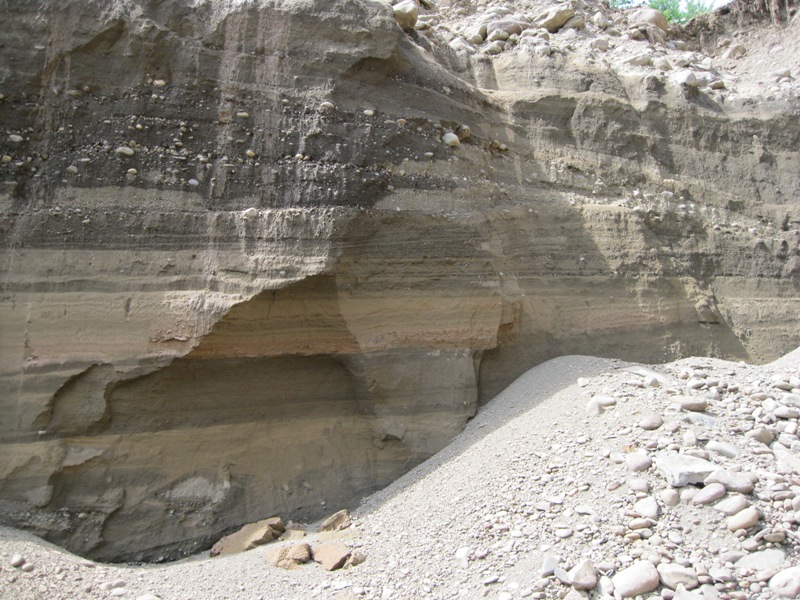
Our driveway needed more fill than could be hand shoveled from our bank.  Five miles upstream from us is home to a real gravel operation.  My interest in how these deposits were formed prompted an invitation from the owner to visit his site.  This location is near a long straight section of the Unadilla River.  This gravel was likely deposited in a depression between the remains of an ice tongue and the bedrock ridge.  Water trapped here allowed an occasionally gentle period of deposition.


This exposed face reveals horizontal layers of sand and clay.  Each must record different climate conditions that caused different volumes and speeds of meltwater.  The layer containing the rounded pebbles deserved closer examination but the exposed face is not stable.  My invitation to visit was based on the owner's belief that I was smart enough to stay out of trouble.  I love to visit this place, but I don't want to be buried here!


This area of New York State has not sparked much geologic study.  We lack the beautiful long lakes and waterfall filled glens that the glacier left behind to our north.  Our rivers are flat and muddy and our local stones are gray.  A metamorphic or igneous stone found here has been transported over great distance from its point of origin.  These exotics spark our interest.  We would like to know them by name and have some understanding of how they acquired their present form.  The pictured treasures were picked from the margins of the professionally operated gravel mine.
  

The white chunks pictured here are likely quartz while the rusty colored cement may be rich in iron.  The professional geologist that prepared the report to obtain state certification found some copper in the gravel.  Is it possible that this stone contains copper?