Showing posts with label glacial deposits. Show all posts

Wednesday, December 4, 2013

Landslide


We believe that our gravel bank was first opened about one half  century ago to bury the remains of the barn that burned following a lightening strike.  More recently, town road crews had removed gravel to repair roads.  In the two decades that we have owned this land, gravel has been taken only by me using hand tools.  A four tined stone fork is used to pull the material down hill separating out some of the larger stones.  Various sized screens are then used to sift according to the demands of the job.  A level pile is kept between me and the undercut bank.  So far any slide that has happened while I was working has been stopped by the level ground.  This small car sized slide happened while no one was working the bank face.  Much material slid closer to the spot where I sift and I was not trapped in it.  Luck continues to be with me.

We understand that the most recent glacier created this feature.  The hill is cone shaped in sharp contrast to the surrounding landscape.  Surface material is unsorted stone, gravel and mud.  Beneath this top layer are bands of water sorted deposits.  Wide brown bands of fine sand are overlain with a thin layer of clean black sand with larger grains.  These sorted layers are not level but occur on a slope.  How these slanted layers happened has puzzled me.

Many of the gravel mines in the area feature deposits that were dropped in standing water.  Sediments fall out of the stream in a some what orderly fashion if the stream empties into a lake.  Recently I read a description of streams pouring over the edge of the ice face.  Sediment laden water falling some distance into a pool of water would pile material in a cone shape.  Since all of the sediment load was dropped in a heap, no sorting by size occurred.  During periods of low water volume only fine material could be carried by the stream.  This change in the force of the stream flow would explain the sorted sloped deposits.

I stand in wonder when I work this material that has been buried for thousands of years.  When new gravel is exposed I am looking at stones that are just as the glacier melt water left them.  The occasional fossil bearing rock is seen for the first time by me.  Then I destroy all traces of historical record by sifting the gravel and adding it to my driveway.

Thursday, August 1, 2013

Got Rocks


When we were searching for our retirement land, we had a list of prerequisites.  Since I was still employed, nearness to the job was at the top of that list.  My new found delight in piling field stones into walls mandated a generous supply of stones.  We found the last piece of an old farm that seemed to fill the bill.

Our gravel bank was likely opened to bury the remains of the barn that burned following a lightning strike more than half a century ago.  Before it was ours, town highway workers removed enough gravel each year to keep the face of the bank free of vegetation.  For the past two decades the only gravel removed was taken by me using hand tools.

How our gravel hill was left behind by the retreating glacier is a puzzle.  It is a rounded dome set in the middle of lower hummocky land.  Layers of fine black sand uncovered are not horizontal.  Most of what can be seen has tumbled down the slope so the actual layers remain hidden.  Fossils are common but exotic stones from far away are rare.
 

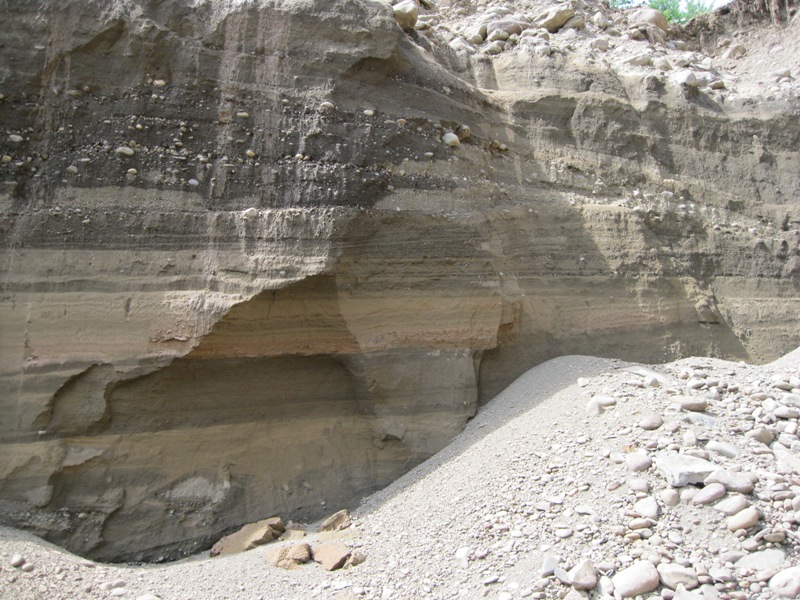
Our driveway needed more fill than could be hand shoveled from our bank.  Five miles upstream from us is home to a real gravel operation.  My interest in how these deposits were formed prompted an invitation from the owner to visit his site.  This location is near a long straight section of the Unadilla River.  This gravel was likely deposited in a depression between the remains of an ice tongue and the bedrock ridge.  Water trapped here allowed an occasionally gentle period of deposition.


This exposed face reveals horizontal layers of sand and clay.  Each must record different climate conditions that caused different volumes and speeds of meltwater.  The layer containing the rounded pebbles deserved closer examination but the exposed face is not stable.  My invitation to visit was based on the owner's belief that I was smart enough to stay out of trouble.  I love to visit this place, but I don't want to be buried here!


This area of New York State has not sparked much geologic study.  We lack the beautiful long lakes and waterfall filled glens that the glacier left behind to our north.  Our rivers are flat and muddy and our local stones are gray.  A metamorphic or igneous stone found here has been transported over great distance from its point of origin.  These exotics spark our interest.  We would like to know them by name and have some understanding of how they acquired their present form.  The pictured treasures were picked from the margins of the professionally operated gravel mine.
  

The white chunks pictured here are likely quartz while the rusty colored cement may be rich in iron.  The professional geologist that prepared the report to obtain state certification found some copper in the gravel.  Is it possible that this stone contains copper?